The McCoy laryngoscope blade sits in an interesting position in airway management: it’s not a primary blade that anesthetists grab first, but it’s the blade they’re grateful to have when a standard Macintosh attempt fails. Developed in the 1990s specifically for difficult airways, the McCoy adds a single critical feature — an articulating tip controlled from the handle — that can convert a failed intubation into a successful one.
This guide explains when McCoy blades earn their place in the airway cart, how they compare to Macintosh, and what procurement teams should know when stocking them.
What is a McCoy blade?
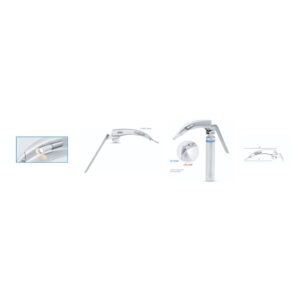
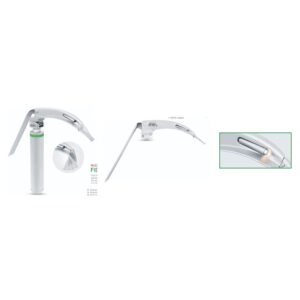
The McCoy laryngoscope blade is based on the Macintosh curved design but with one key modification: the distal 1/3 of the blade hinges via a mechanism built into the blade body. A lever on the handle (or on the blade itself, depending on the model) flexes this distal tip upward.
In use, the clinician inserts the blade as with a standard Macintosh — tip into the vallecula, lift up and anterior. If the glottic view is inadequate, the lever is depressed to articulate the tip, which physically lifts the epiglottis further anteriorly. In many cases where Macintosh gives a Cormack-Lehane grade 3 view (only epiglottis visible, no vocal cords), McCoy articulation converts the view to grade 2 or 1 (vocal cords visible).
When McCoy is the right choice
Known difficult airway
Patients with a history of difficult intubation, anatomical anomalies (large tongue, limited mouth opening, short thyromental distance), or classified Mallampati 3–4 benefit from McCoy as the first-choice blade — not a backup.
Anterior larynx
Some patients have an anteriorly placed larynx where the standard Macintosh technique produces a poor view even with optimal positioning. McCoy articulation specifically addresses this anatomy.
Limited cervical mobility
Patients with limited neck extension (rheumatoid arthritis, cervical fusion, trauma patients with c-spine immobilization) cannot be positioned in the “sniffing position” that Macintosh technique requires. McCoy articulation partially compensates.
Failed first Macintosh attempt
The most common McCoy use: the anesthetist attempts Macintosh, gets an inadequate view, and switches to McCoy as the rescue blade. This is why every difficult airway cart should include McCoy blades alongside Macintosh.
When McCoy is NOT the right choice
Routine, predicted-easy airways
For a healthy adult with a Mallampati 1 airway and good neck mobility, standard Macintosh is faster, simpler, and the technique most clinicians are trained on. McCoy’s extra mechanism is unnecessary.
Neonates and infants
McCoy is designed on the Macintosh curved platform. For neonatal intubation where Miller (straight) is clinically preferred, McCoy isn’t the answer. Miller remains the standard for <1 year patients.
Emergency intubations where speed is critical
Activating the McCoy mechanism takes conscious thought. In a cardiac arrest intubation where every second counts, clinicians default to familiar Macintosh technique. McCoy is a tool for careful, controlled difficult-airway scenarios, not pure time-pressure situations.
McCoy vs Macintosh — clinical data
Research comparing McCoy and Macintosh consistently shows:
- In routine airways: no significant advantage for McCoy over Macintosh — both deliver successful intubation at similar rates
- In predicted difficult airways: McCoy produces improved Cormack-Lehane grades in 30–50% of cases compared to Macintosh
- In cervical spine immobilized patients: McCoy significantly reduces force required at the tongue base
- Intubation time: McCoy adds 5–15 seconds on average (for the articulation step) but often reduces total time by avoiding second-attempt setup
McCoy blade sizes and specifications
McCoy blades are manufactured in the same size range as Macintosh:
| Size | Patient use | Stock recommendation |
|---|---|---|
| McCoy 2 | Children 5+, small adults | 2 units per difficult airway cart |
| McCoy 3 | Most adults — primary McCoy size | 3–5 units per difficult airway cart |
| McCoy 4 | Large adults, bariatric | 2 units per difficult airway cart |
McCoy blades are available in fiber optic and conventional configurations. For modern ISO 7376 compliant handles, use fiber optic McCoy blades — they provide superior illumination exactly where the articulated tip is working.
Handle compatibility
Standard ISO 7376 Green Spec handles work with McCoy blades — the hook-on connection is identical. The articulation lever is part of the blade itself (not the handle), so any compliant handle works. This means McCoy blades can be added to existing Green Spec handle inventories without replacing handles.
Sourcing McCoy laryngoscope blades
McCoy blades are more mechanically complex than Macintosh (they include the hinge mechanism and lever linkage). Quality matters more because a failed articulation in a critical moment defeats the purpose. Verify:
- ISO 13485 certified manufacturer
- ISO 7376 Green Spec compliance (for fiber optic)
- AISI 420 stainless steel on mechanism components for long wear life
- Tested articulation — manufacturer should cycle-test mechanisms to 10,000+ actuations
- Lifetime warranty on the blade body, with explicit coverage of articulation mechanism
Fizza Surgical manufactures McCoy blades in sizes 2, 3, and 4 in both fiber optic and conventional configurations. Our McCoy mechanisms are cycle-tested to 15,000 actuations and backed by lifetime warranty on the blade body. Browse our McCoy range or request factory pricing.
FAQ
Does McCoy replace Macintosh in our inventory?
No. McCoy complements Macintosh — it’s for difficult airway scenarios. Most anesthesia departments stock Macintosh as the routine workhorse (80% of cases) and McCoy in the difficult airway cart for when Macintosh fails or is predicted to fail.
Can non-anesthesiologists use McCoy safely?
The articulation mechanism requires training. Emergency department physicians, paramedics, and other airway practitioners who use McCoy should receive specific training on the mechanism. Misuse of the articulation can cause dental trauma or soft tissue injury.
How does McCoy compare to video laryngoscopy?
Video laryngoscopy is the current gold standard for known difficult airways in facilities that can afford it. McCoy is a direct laryngoscopy solution that costs 10–30× less than video laryngoscopes. Many facilities use both — video for elective difficult airways, McCoy in the emergency cart for unexpected difficult airways.
Where We Serve
Fizza Surgical exports to 50+ countries. Browse our country-specific pages with local regulatory guidance and pricing: