Craniotomy Instrument Set: Neurosurgery Tools Complete Guide
Complete craniotomy instruments guide: scalp, bone flap, dural and micro stages with sizes, steel grades and tray counts from an ISO 13485 maker.
 Made in Sialkot · Since 1980
The first thing a scrub nurse learns about cranial surgery: the scalp bleeds more than almost any tissue in the body. Within ninety seconds of the skin incision, the surgeon expects Raney clips loaded and ready — a dozen of them, applied edge-to-edge along the flap before the field turns red. That is where a craniotomy set earns its keep, before the skull is even open.
This guide walks through the complete instrument configuration for an elective craniotomy — scalp stage, bone stage, dural stage, and the intracranial micro-instruments — with the sizes, counts, and steel grades that a functioning neurosurgical tray actually requires.
The Four Stages of a Craniotomy — and What Each Demands
A craniotomy tray is really four sub-sets stacked in one container. Each stage of the operation uses an almost completely different group of instruments, and a missing item at stage three cannot be improvised from stage one.
Stage 1: Scalp and Soft Tissue
- Scalpel handles No. 3 and No. 7 with No. 10 blades for the skin incision and No. 15 for pericranial work
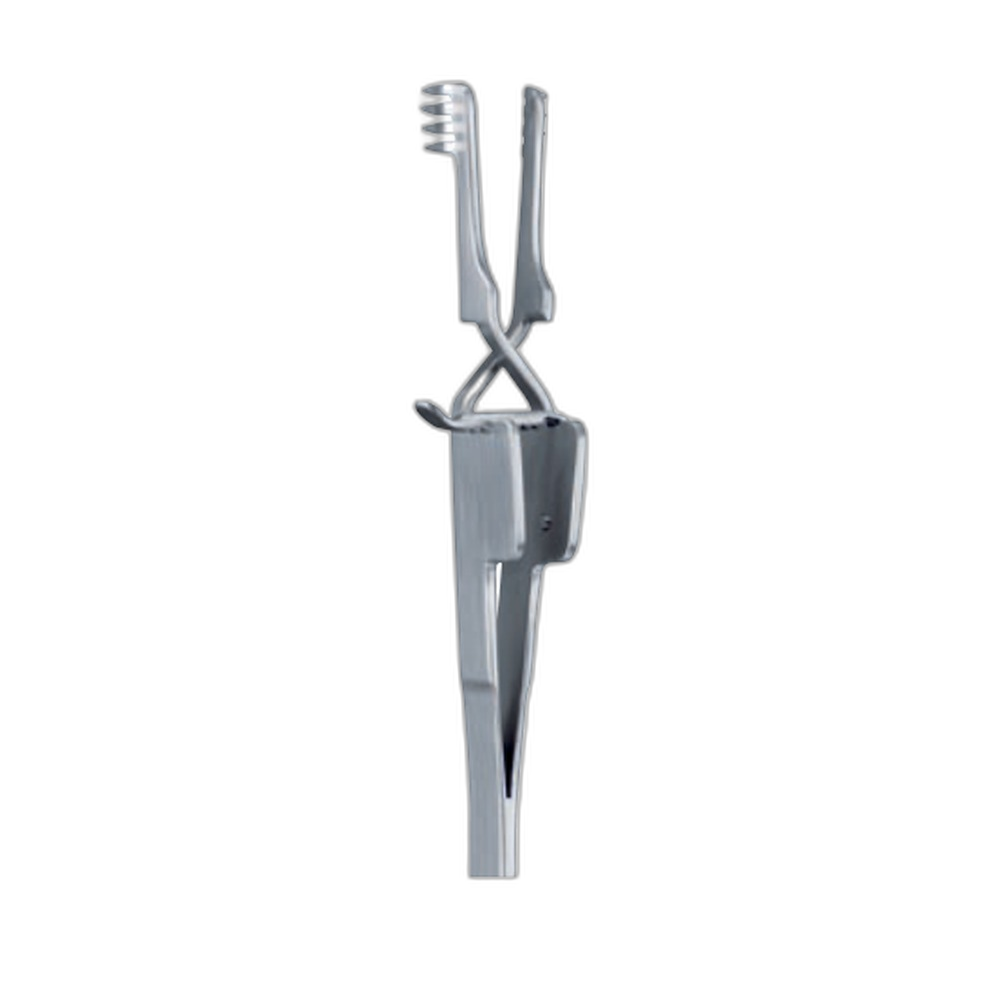
- Raney scalp clips (24–40 pcs) with two applying forceps — spring-loaded plastic or stainless clips that compress the galeal edge; introduced by the Raney brothers in 1936 and still the standard for scalp hemostasis
- Adson and Gerald tissue forceps (toothed, 12 cm and 18 cm) for skin and galea handling
- Fish hook retractors with elastic bands (6–10 pcs) — maintain scalp flap reflection without an assistant’s hand in the field
- Curved Metzenbaum scissors, 14.5 cm for subgaleal dissection
- Periosteal elevators (Langenbeck, 19 cm) to strip pericranium off the calvarium
Stage 2: Bone Flap
- Hudson brace with cranial perforators (13 mm and 16 mm) — the hand-powered burr hole option; the conical perforator design is self-arresting at the inner table, which is precisely why it has survived into the powered-drill era as a backup
- Gigli saw wire (3 pcs, 50 cm) with handles and saw guide — connects burr holes when a powered craniotome is unavailable; the guide protects the dura while the wire cuts outward through bone
- Bone curettes (Volkmann, sizes 0–3) for cleaning burr hole margins
- Kerrison rongeurs (2 mm, 3 mm, 5 mm, up-biting 40°) — nibble the bone edge and enlarge the craniotomy toward the skull base
- Leksell double-action rongeur (24 cm, 8 mm bite) for rapid bone removal where precision is less critical
- Bone wax and applicator for diploic vein bleeding along cut bone edges
For a deeper look at the wire saw technique — including why the cut must always run from inside outward — see our Gigli saw guide for bone surgery and craniotomy.
Stage 3: Dura
- Dura hooks (sharp, 16 cm) — tent the dura upward before the opening nick, keeping the cortex safe below
- Dura scissors (Taylor, angled on flat, 17 cm) — the angled blade rides on the inner dural surface without contacting brain
- Adson dural forceps, 1×2 teeth, bayonet pattern
- Dural needle holder (Ryder, 20 cm, tungsten carbide jaws) for 4-0 and 5-0 dural closure sutures
Stage 4: Intracranial Work
- Penfield dissectors, full set Nos. 1–5 — the workhorse instruments for separating dura from bone and developing arachnoid planes; our complete Penfield dissector guide covers what each of the five patterns does
- Bayonet bipolar forceps (0.5 mm, 1.0 mm, 2.0 mm tips, 19.5 cm) — the offset bayonet shaft keeps the surgeon’s hand out of the microscope’s line of sight
- Bayonet tissue forceps and cup forceps for tumor specimen retrieval
- Frazier suction tips, French gauge 6 through 12, with stylets — finger-controlled suction relief is essential when working on cortex; sizing logic is covered in our Frazier suction tube guide
- Micro scissors (straight and curved, bayonet, 18 cm)
- Brain spatulas / malleable ribbon retractors (6–26 mm widths, graduated set) with a flexible-arm self-retaining system
- Cottonoid patties and rubber dam holders (technically consumables, but the pattie plate lives in the tray)
Retraction: Scalp vs Brain Are Different Problems
Scalp retraction is high-tension, low-precision — solved with fish hooks and the Weitlaner or Adson cerebellar self-retaining retractors (3×4 prong, blunt). Brain retraction is the opposite: pressures above roughly 20 mmHg under a brain spatula measurably reduce local cortical perfusion. That is why graduated malleable spatulas come in 2 mm width increments, and why modern sets pair them with flexible arm systems rather than fixed-blade retractors. The rule taught to registrars: the widest spatula that fits distributes the lowest pressure.
Specification Table — Core Craniotomy Set
| Instrument | Size / Pattern | Qty | Steel |
|---|---|---|---|
| Raney clip applying forceps | 16 cm | 2 | AISI 420 |
| Hudson brace + perforator/burr | 13 mm, 16 mm | 1 set | AISI 420 |
| Gigli saw wire + handles + guide | 50 cm | 3 + 2 + 1 | AISI 304 wire |
| Kerrison rongeur | 2 / 3 / 5 mm, 40° up | 3 | AISI 420, TC option |
| Leksell rongeur | 24 cm, 8 mm | 1 | AISI 420 |
| Penfield dissector | Nos. 1–5 | 5 | AISI 420 |
| Taylor dura scissors | 17 cm angled | 1 | AISI 420 |
| Bayonet bipolar forceps | 0.5 / 1.0 / 2.0 mm | 3 | AISI 316L insulated |
| Frazier suction tips | Fr 6–12 | 4 | AISI 304 |
| Brain spatula set | 6–26 mm | 10 | Malleable copper-alloy / SS |
| Weitlaner retractor | 16.5 cm blunt 3×4 | 2 | AISI 420 |
| Fish hook retractor + bands | — | 8 | AISI 420 |
Positioning and Fixation: The Instruments Nobody Lists
Before the first instrument touches skin, the head must be rigidly fixed — and the fixation hardware is part of the neurosurgical inventory even though it never appears on the scrub nurse’s count sheet. A three-pin skull clamp (Mayfield or Sugita pattern) holds the head via sterile single-use or reprocessable pins torqued to 60–80 lbs for adults, 40 lbs or less for thin pediatric bone. Horseshoe headrests serve supine cases where pin fixation is unnecessary. Units running image guidance add the reference arc and its adaptor to this module.
Why mention this in an instrument set guide? Because procurement that treats the skull clamp as “equipment” and the tray as “instruments” routinely ends up with pins that do not match the clamp, or a reprocessing protocol that covers the tray but not the pin torque screwdriver. Specify the fixation module alongside the tray and the gaps disappear.
Tumor, Vascular, Trauma: How the Core Set Flexes
The four-stage core above serves an elective convexity craniotomy. Three common variants adjust it:
Tumor work adds the micro tray proper — micro dissectors (Rhoton-pattern, 6–8 pcs), tumor grasping forceps, ring curettes in 2–5 mm sizes, and micro needle holders — plus an ultrasonic aspirator handpiece where available. The bipolar range extends down to 0.3 mm tips.
Vascular cases (aneurysm, AVM) add temporary and permanent clip appliers with a full graded clip inventory, micro Doppler probe, and fine arachnoid knives. Nothing in the bone or scalp stages changes.
Trauma craniotomy strips the set in the other direction: speed matters more than finesse, so the tray emphasizes large-bite rongeurs, extra suction (two Yankauers running in parallel with the Fraziers), dural tenting suture capacity, and hemostatic agent applicators. Many trauma units keep a dedicated “crash crani” tray of 35–40 instruments that opens in ninety seconds.
Pediatric Craniotomy Sets: Not Just Smaller
Scaling an adult set down misses three genuine differences. Pediatric skull bone runs 2–4 mm thick against the adult 5–8 mm, so perforators must be the self-arresting pediatric pattern with a shallower stop. Raney clip spring tension calibrated for adult galea will tear an infant’s scalp edge — pediatric clips are a distinct item, not a smaller version. And brain spatula widths start at 4 mm rather than 10 mm. A children’s hospital tray is a separate build, not a filtered adult list.
Powered vs Manual Bone Work
Most units now open the skull with a pneumatic or electric craniotome and perforator attachment. The manual instruments — Hudson brace, Gigli wire — remain in the tray for three reasons. First, equipment failure mid-case is not survivable without a manual fallback. Second, field and low-resource settings often run entirely on manual kit. Third, certain re-do craniotomies with scarred, adherent dura are genuinely safer with the slow control of a hand perforator. A craniotomy set without manual backup is an incomplete set, whatever the catalogue says.
Material and Regulatory Notes
Cutting and biting instruments (Kerrisons, rongeurs, curettes) are forged from martensitic AISI 420 hardened to 48–54 HRC so the jaws hold their edge against cortical bone. Suction tubes and Gigli wire use austenitic AISI 304 for ductility. Bipolar forceps require AISI 316L bodies with fused insulation rated to 4 kV. All instruments should conform to ISO 7153-1 for surgical instrument materials and be manufactured under an ISO 13485 quality system with CE marking under EU MDR — the documentation package matters as much as the steel when a hospital’s sterile processing department audits its loaner and owned trays. Fizza Surgical’s certifications are listed here.
Care Points Specific to Cranial Instruments
Three failure patterns dominate craniotomy tray audits:
Kerrison jaw fouling. Bone paste dries inside the sliding channel. If the footplate does not glide freely by thumb pressure alone, the instrument goes to repair, not back on the tray. Enzymatic pre-soak within 30 minutes of use prevents most of this.
Bipolar insulation breaks. Any visible crack or bubble in the shaft coating is an instant reject — insulation failure arcs current into tissue outside the surgeon’s view.
Gigli wire fatigue. The wire is single-patient-use in most protocols. Reprocessed wire work-hardens and can snap mid-cut, which is a genuinely dangerous event with the saw under tension in bone.
Count Sheet Strategy: Organizing 80 Instruments So Nothing Goes Missing
Craniotomy trays fail count audits more than almost any other set, for a simple reason: the smallest items — Penfield tips, micro scissors, patty plates — are also the most used and most passed. Three practices from high-performing sterile processing departments:
Stage-based stringing. Ring-handled instruments racked in operation order (scalp → bone → dura → micro), not alphabetically. The scrub nurse’s hand finds the next instrument where the operation is, and a missing item is obvious by the gap in its stage.
Micro instruments in a fixed-position mat. Silicone finger mats with a printed outline per instrument. A Penfield No. 4 missing from its outline is visible across the room; the same instrument missing from a loose pile is invisible until final count.
Raney clips counted as a unit. Clips are loaded in cartridges or racks of 10 — count racks, not clips, intraoperatively, with a per-clip reconciliation only at closure. Counting 36 individual clips three times per case is how counts get pencil-whipped.
Instrument-level marking supports all of this: laser-etched identifiers survive thousands of cycles and let the SPD trace which tray a stray Kerrison actually belongs to.
Frequently Asked Questions
How many instruments are in a standard craniotomy set?
A full adult craniotomy tray runs 60 to 90 instruments across the scalp, bone, dural, and intracranial stages — plus a separate micro-instrument tray in units doing tumor and vascular work. Pediatric configurations are smaller in both count and instrument length.
What is the difference between a craniotomy and craniectomy set?
The instruments are nearly identical. In a craniotomy the bone flap is replaced and fixed — so the set adds a cranial plating system (titanium miniplates, 1.5 mm screws, screwdriver). In a craniectomy the bone stays out, and no fixation module is needed.
Why are neurosurgical forceps bayonet-shaped?
The offset shaft keeps the surgeon’s hand below the line of sight through an operating microscope or down a narrow corridor. A straight instrument would put the knuckles exactly where the surgeon needs to see.
Are Raney clips reusable?
Plastic Raney clips are single-use. Stainless steel versions exist and can be reprocessed, but most units have moved to disposable plastic because spring tension in reprocessed metal clips becomes unreliable after repeated autoclave cycles.
What steel grade should Kerrison rongeurs be?
Martensitic AISI 420 hardened to roughly 50 HRC, per ISO 7153-1. Premium versions add tungsten carbide footplate inserts, which hold a cutting edge several times longer between sharpenings.
Fizza Surgical manufactures complete craniotomy configurations — scalp through micro stage — in Sialkot under ISO 13485, with pediatric and field variants available. Browse the bone surgery instruments range or contact us for a tray configuration sheet matched to your unit’s approach preferences.
Need precision surgical instruments?
Configure complete instrument sets with our team — ISO 13485 certified, CE marked, made in Sialkot since 1980.
Related Guides
View all articles →
Where We Serve
Fizza Surgical exports to 50+ countries. Browse our country-specific pages with local regulatory guidance and pricing: