Hoof Trimming Tools: Complete Farrier Instrument Guide
Hoof trimming tools explained: nipper sizes, hoof knife types, rasp use, steel grades and care. A practical farrier instrument guide.
 Made in Sialkot · Since 1980
A 16-hand Warmblood has been standing on a hard-packed paddock through a dry August. The wall has run forward, the heels have collapsed under, and there is a full 18 mm of excess toe. Reach for a knife first and you will be there an hour, sweating, with a sore wrist and a hoof that still isn’t level. Reach for the right pair of nippers and the bulk comes off in four bites.
That sequencing — bulk first, detail second, finish last — is the whole logic behind a farrier’s kit. Every tool in it exists because the one before it was the wrong instrument for that stage. Understanding which hoof trimming tools do which job, and in what order, matters more than owning an expensive set.
The Three-Tool Core
Strip a working farrier’s box down and three items do roughly 90% of the trimming: nippers, a hoof knife, and a rasp. Everything else — pullers, creasers, clinch cutters, the hoof stand — supports shoeing rather than trimming.
Nippers remove wall. The knife addresses sole, frog, and bar. The rasp levels and finishes. Use them out of order and you fight the hoof.
Hoof Nippers: Length Is Leverage
Nipper length is not a comfort preference. It is a mechanical decision about how much force reaches the jaws.
| Length | Typical Use | Notes |
|---|---|---|
| 12″ | Foals, ponies, show and race horses | Light leverage; suits smaller hands and thin walls |
| 14″ | General riding horses — the default | Best balance of power and control |
| 15″ | Dry, hard feet; heavier breeds | Noticeably more bite, slightly less finesse |
| 16″ | Draft horses, severely overgrown walls | Heavy; fatiguing for a full day’s work |
Most professionals settle on 14″ or 15″. A 14″ nipper handles the overwhelming majority of domestic horses, and if you are buying one pair to cover a mixed yard, that is the size to buy.
Jaw geometry matters as much as length. Nipper blades meet edge-to-edge rather than passing each other like scissors, so the two faces must close in perfect register along their whole arc. Hold a new pair against light: any daylight between the closed blades means the hoof wall will crush and tear at that point instead of shearing cleanly.
Blade material is where cost separates. Nipper jaws are typically drop-forged from a high-carbon or martensitic stainless grade in the AISI 420 family, hardened into the 56–58 HRC range at the cutting edge while the handles stay softer and tougher. Too soft and the edge rolls on a gravel-embedded wall. Too hard and it chips. That heat-treatment window is the single biggest quality difference between a nipper that holds an edge for a season and one that dulls in a fortnight.
Hoof Knives: Straight, Loop, and Handedness
The knife is the most personal item in the kit, and the one most often bought wrong.
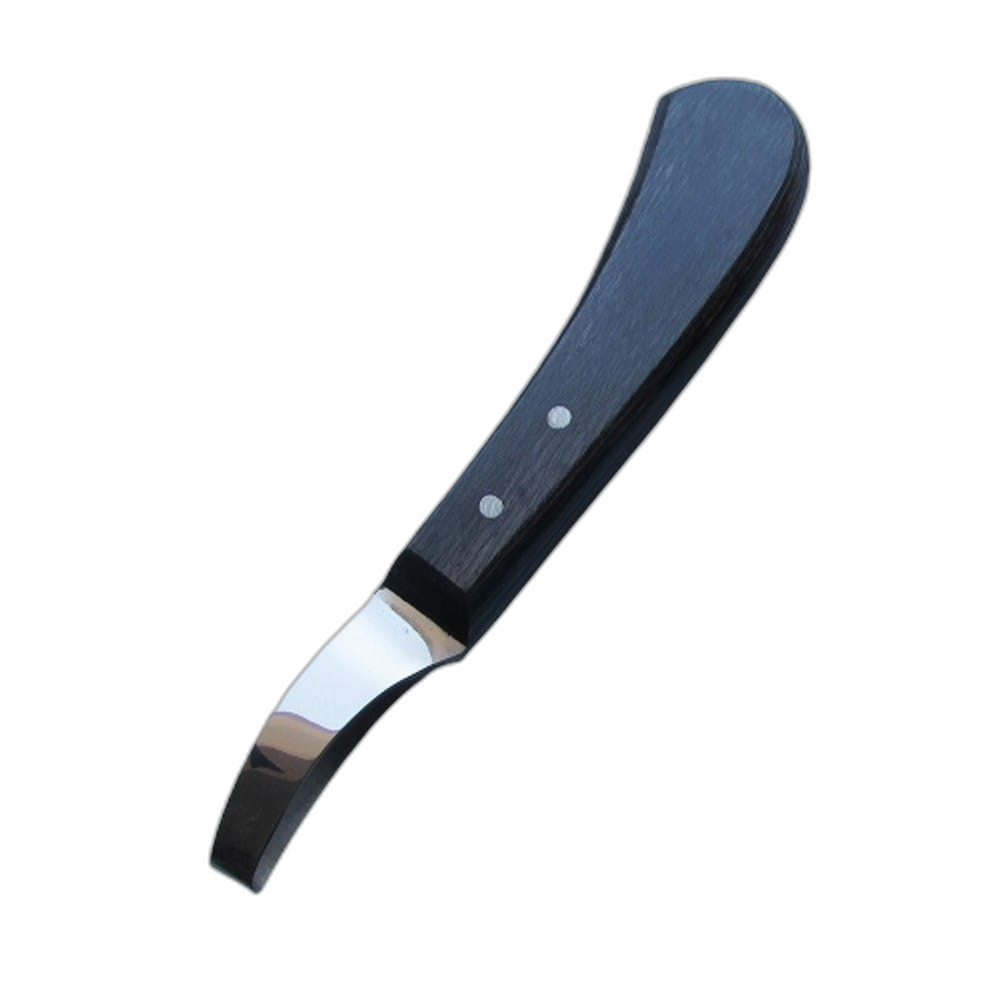
A straight knife has a blade that runs forward with a hooked tip. It gives the strongest slicing stroke and is the tool for paring broad areas of retained sole and for opening up the collateral grooves. Blade widths of 10–12 mm suit general work; narrow-blade versions get into the seat of corn without gouging.
Loop knives — sometimes called hoof gouges — carry a closed oval cutting ring. They cut on the pull stroke in confined space, which makes them the right choice for cleaning out a deep central sulcus, tracking a white line separation, or debriding an abscess without widening the hole more than necessary.
Double-edged knives cut on both push and pull. They are fast in experienced hands and unforgiving in inexperienced ones.
Handedness is not marketing. A right-handed hoof knife has its bevel ground on one specific side, and using it left-handed forces the wrist into a rolled position that both tires the hand and lifts the cutting angle off the sole. Left-handed trimmers should buy left-handed knives.
Edge geometry sits around 20–25 degrees. Steeper than that and it will not slice damp sole; shallower and it folds on contact with grit. The blade wants to be hardened to roughly 58–60 HRC — harder than nippers, because a knife edge is thin and takes no impact loading.
The Rasp: Coarse Side, Fine Side
A farrier’s rasp is a two-faced tool. One side carries chisel-cut rasp teeth for rapid stock removal; the flip side is a file cut with fine parallel rows for finishing and for smoothing the outer wall after shoeing.
Standard length is 14 inches, with 16-inch versions available for draft work. The tang takes a wooden or composite handle — work a bare tang for an afternoon and you will understand why.
Rasps are consumables. A farrier working full time will retire several a year. When the coarse side stops biting and starts polishing, it is finished; there is no practical resharpening. Store rasps so the faces never touch each other or other steel, because rasp teeth dull far faster against metal than against horn.
Supporting Tools
Hoof pick and brush. Trivial, essential. You cannot assess a foot you cannot see, and packed dirt hides both landmarks and abscess tracts.
Hoof testers. A large sprung caliper used to localise pain by applying controlled pressure across the sole and frog. Standard length is around 12–15 inches. Not a trimming tool, but the instrument that tells you whether trimming is even appropriate today.
Hoof gauge / T-square. Measures hoof-pastern axis and heel angle. Useful for documenting change over a shoeing cycle rather than for judging a single trim in isolation.
Clinch cutter and pull-offs. Shoe removal, not trimming — but any horse arriving in shoes needs these before a trim can start.
Material and Manufacturing Standards
Farrier tools live a harder life than almost any surgical instrument. They meet grit, they are dropped on concrete, and they spend their working hours wet.
Quality-made hoof trimming tools use the same metallurgical thinking as surgical steel: a martensitic stainless or high-carbon alloy, forged rather than stamped, with heat treatment matched to the job the edge does. Forging aligns the grain flow along the blade, and that grain orientation is what stops a nipper jaw from cracking when it hits an embedded stone.
| Tool | Typical Steel | Target Hardness | Rationale |
|---|---|---|---|
| Nippers (jaws) | AISI 420 / high-carbon | 56–58 HRC | Impact resistance over ultimate sharpness |
| Hoof knife | High-carbon tool steel | 58–60 HRC | Thin edge, pure slicing, no shock load |
| Rasp | Carbon steel, case-hardened teeth | 62+ HRC (teeth) | Abrasive wear is the failure mode |
| Hoof testers | Spring steel / stainless | Tempered for elasticity | Must return to shape indefinitely |
Instrument makers in Sialkot have supplied both surgical and veterinary markets for decades, and the overlap is real — the forging, milling, and heat-treatment lines that produce a hemostat produce nippers to the same process controls. If you want to understand how that pipeline works, our overview of large animal surgical instruments for equine and bovine work covers the wider veterinary range.
Trimming Sequence in Practice
- Clean and assess. Pick out, brush off, look at the foot on the ground before you lift it. Weight-bearing shape tells you things a lifted foot hides.
- Exfoliate loose sole. Knife only what flakes away. Live sole is your depth gauge and your protection — pare into it and you have made a lame horse.
- Nipper the wall. Work heel to toe, following the sole plane you just exposed. Small bites; the wall should come away in a continuous ribbon.
- Address bars and frog. Trim only ragged, undermined flaps. Healthy frog does not need shaping.
- Rasp level. Coarse side across the wall, checking flatness against the rasp face itself.
- Bevel the edge. A light roll on the outer wall reduces chipping between trims.
The commonest error in the whole sequence is trimming to a target number rather than to the foot in front of you. Sole depth varies by breed, environment, and season. The foot dictates.
Care, Sharpening, and Service Life
Hoof horn is mildly acidic and holds moisture against steel. Tools put away wet corrode, and corroded edges do not sharpen.
- After every horse: wipe blades dry. Ten seconds.
- Knives: touch up on a fine ceramic rod or 1000-grit stone before each horse, not after the edge is gone. Maintaining an edge takes seconds; rebuilding one takes twenty minutes.
- Nippers: professional regrinding once or twice a year. Never file the outer faces yourself — the blades must stay in register, and freehand filing destroys that.
- Rasps: brush the teeth clear with a file card. Horn packs between teeth and stops the cut long before the teeth are actually worn.
- Storage: a roll or box with separate slots. Steel against steel is what dulls tools between jobs.
Between yards, tools that have touched a horse with white line disease, thrush, or any infectious hoof condition should be disinfected before the next animal. The same cross-contamination logic that governs a hospital tray applies on a farm — our guide to enzymatic cleaning solutions explains why organic debris must be removed before any disinfectant can work.
Buying: What Actually Separates Grades
Price ranges enormously across hoof trimming tools, and the differences that justify cost are specific:
- Blade register on nippers. Test it against light before accepting delivery. This is the single most common defect in low-grade nippers.
- Rivet and joint quality. A nipper joint that develops lateral play cannot be corrected. Flex the handles sideways; any wobble is a reject.
- Consistent heat treatment. Hard to inspect visually, which is why documented process control and a manufacturer willing to state hardness ranges matter.
- Handle finish. Wet hands, heavy tool. Texture is a safety feature.
- Replaceable knife blades. Some systems allow blade renewal; for high-volume trimmers this changes the running cost substantially.
For yards buying at volume, the practical checklist in our article on inspecting instruments before purchase transfers directly to farrier tooling. The full veterinary range is available through our veterinary instruments catalogue.
Frequently Asked Questions
What size hoof nippers should I buy first?
Fourteen inch. It handles the great majority of riding horses with enough leverage for dry feet and enough control for accurate work. Move to 15″ or 16″ only if you regularly trim drafts or very overgrown feet.
How often do hoof knives need sharpening?
A working farrier touches up the edge between horses on a ceramic rod. Full resharpening on a stone depends on conditions — sandy, gritty ground dulls a knife within a handful of feet, while soft pasture horn may allow a day’s work between stones.
Can I use one rasp for both trimming and finishing?
Yes — that is what the two faces are for. The chisel-cut side removes material, the file-cut side finishes. When the coarse side stops biting, replace the rasp; rasps are consumables and cannot be practically resharpened.
Are stainless steel farrier tools better than carbon steel?
Not automatically. Stainless resists corrosion, which matters for tools that live wet, but many farriers prefer high-carbon knife blades because they take a keener edge and are easier to restore. The right answer depends on whether you maintain your tools daily or store them for long periods.
Do left-handed farriers need left-handed knives?
Yes. The bevel on a hoof knife is ground on one side only. Using a right-handed blade left-handed forces an incorrect cutting angle and rolls the wrist, which is both inefficient and fatiguing over a full day.
The Short Version
Buy a 14-inch nipper with jaws that close in true register. Buy a knife ground for your dominant hand and learn to maintain its edge rather than replace it. Treat the rasp as the consumable it is. Dry everything, every time.
Good hoof trimming tools do not make a good trim — the eye and the hand do that. But bad tools will actively prevent one, and no amount of skill compensates for nippers that crush instead of cut.
Need precision surgical instruments?
Configure complete instrument sets with our team — ISO 13485 certified, CE marked, made in Sialkot since 1980.
Related Guides
View all articles →
Where We Serve
Fizza Surgical exports to 50+ countries. Browse our country-specific pages with local regulatory guidance and pricing: