ACL Reconstruction Instrument Set: Knee Ligament Surgery Guide
ACL reconstruction instruments explained: tibial and femoral guides, reamer sizes, tendon strippers, graft sizing blocks and tunnel preparation.
 Made in Sialkot · Since 1980
An ACL reconstruction is a sequence of four mechanical problems: harvest a graft, put a tunnel in the tibia, put a tunnel in the femur, and fix the graft at both ends under tension. Every instrument on the tray exists to solve one of them.
Organising the set that way — by stage rather than by instrument family — makes both the scrub’s job and the procurement decision considerably clearer. ACL reconstruction instruments map onto those stages almost one to one.
| Stage | Instrument group | Critical dimension |
|---|---|---|
| Graft harvest | Tendon stripper, harvest retractors, sizing block | Stripper diameter must match tendon |
| Notch preparation | Notchers, shaver, curettes, rasps | Adequate clearance for graft |
| Tibial tunnel | Tibial aiming guide, guide pins, reamers | Guide angle setting |
| Femoral tunnel | Femoral aimer / offset guide, reamers | Offset determines posterior wall thickness |
| Passage and fixation | Passing sutures, graft tensioner, screwdrivers | Screw diameter vs tunnel diameter |
Graft Harvest Instruments
Graft choice drives this section of the tray entirely. Hamstring autograft and bone-patellar tendon-bone (BTB) autograft need almost completely different instruments.
Hamstring Harvest
The defining instrument is the tendon stripper, and it comes in two forms that are not interchangeable:
- Open (semitendinosus) stripper — a slotted, part-circumferential head that allows the tendon to be stripped while remaining accessible. Used first, before the tendon is fully released.
- Closed stripper — a complete ring that transects the tendon proximally at the end of the strip.
Stripper head diameters typically run 5, 6, 7 and 8 mm. Undersizing is the error that costs grafts: a stripper narrower than the tendon and its accessory bands catches a fascial slip and amputates the tendon short. A 6 cm graft is a failed harvest.
The set also needs a tendon-preparation station: a graft board with tensioning post, a whip-stitch clamp, and a graft sizing block with holes stepped in 0.5 mm increments from 6.0 to 11.0 mm. Sizing is measured, never estimated — the sized diameter determines every reamer used afterwards.
Bone-Patellar Tendon-Bone Harvest
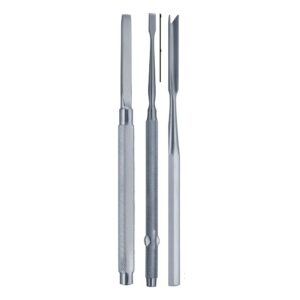
BTB replaces the stripper with cutting instruments: a double-bladed tendon knife set to graft width (usually 9 to 11 mm), an oscillating saw or dedicated bone-block cutting guide for the patellar and tibial blocks, small osteotomes to lever the blocks free, and a bone block sizing sleeve.
Because BTB harvest is genuine bone work, the tray needs a rongeur and a bone rasp to trim block edges — a block that will not pass the sizing sleeve will not pass the tunnel either. The same bone-cutting principles covered in our guide to bone drills versus bone saws apply directly to block harvest, where thermal damage to the graft bone is a real risk.
Tunnel Preparation: Guides and Aimers
This is where accuracy is decided, and where the instrument quality genuinely differentiates outcomes.
Tibial Guide
The tibial aiming guide is an adjustable-angle device with an intra-articular hook that references the tibial footprint, and an extra-articular bullet through which the guide pin is drilled. The angle setting — commonly 45 to 55 degrees — controls tunnel length and obliquity.
Guide rigidity matters more than the specification sheet suggests. A guide that flexes under drilling load shifts the pin exit from the intended footprint, and the error is not recoverable once the tunnel is reamed.
Femoral Guide
Femoral tunnel placement is the technical crux of the operation and the most common cause of graft failure when it goes wrong.
Offset femoral aimers reference the over-the-top position and offset anteriorly by a fixed distance to preserve a posterior wall. Offsets of 5, 6 and 7 mm are standard. The relationship is simple and worth stating plainly: the offset must exceed half the reamer diameter, or the reamer breaches the posterior cortex and the tunnel blows out.
For a 9 mm femoral tunnel, a 5 mm offset leaves only 0.5 mm of wall. Most surgeons will not accept that margin, and this arithmetic is why offset aimers are supplied as a graduated set rather than a single instrument.
Anteromedial portal drilling requires additional instruments: a flexible reamer system or a low-profile aimer, since the knee is hyperflexed and the working angle is severe.
Reamers and Dilators
Cannulated reamers run 6.0 to 11.0 mm in 0.5 mm increments, headed and cannulated to track over a guide pin. Sharpness is not a comfort feature: a dull reamer generates heat, and thermal necrosis at the tunnel wall impairs graft incorporation.
Retrodrilling systems reverse the cutting direction to create a socket while preserving the cortex, which maximises fixation surface. These require their own dedicated retrograde cutting instrument and matching guide.
Tunnel dilators — sequentially sized, non-cutting — compact rather than remove bone. Some surgeons prefer them for the denser tunnel wall they produce.
Notch Preparation
A graft that impinges on the intercondylar notch will fail. Notchplasty instruments earn their place:
- Arthroscopic notchers — angled bone punches for removing osteophytes at the notch margin
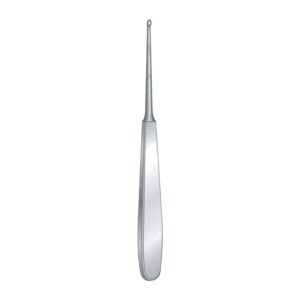
- Curved and straight curettes — clearing residual ACL stump from the femoral footprint to expose landmarks
- Rasps — smoothing the notch roof
- Microfracture awls — where concurrent chondral treatment is indicated, in angled sets covering the femoral condyles and tibial plateau
These sit alongside the general arthroscopic instrumentation described in our arthroscopy instrument set guide — probe, graspers, baskets and cannulae, all of which the ACL set assumes are present rather than duplicating.
Passage, Tensioning and Fixation
Graft passage instruments are simple and easy to under-order: a Beath pin (an eyeleted guide pin), passing sutures or a passing loop, and a graft pusher.
Fixation splits by construct:
- Interference screws — need a matched guidewire, a tap for hard bone, and a cannulated screwdriver. Screw diameter is normally matched to tunnel diameter, or 1 mm over for soft-tissue grafts in soft bone.
- Suspensory fixation — needs a depth gauge to measure total femoral tunnel length, a passing wire, and a flipping suture. The depth gauge is the instrument most often forgotten and most consequential: loop length is calculated from that measurement, and an error puts the graft short of the socket.
- Cortical staples and washers — need a staple driver and a mallet.
A graft tensioner applies reproducible tension during tibial-side fixation. Freehand tensioning varies substantially between surgeons and between cases.
Materials and Reprocessing
ACL reconstruction instruments face a specific durability problem: cannulated instruments with long narrow lumens, drilled in bone, then cleaned.
Every cannulation is a cleaning challenge. Bone debris and marrow set hard inside a reamer cannula, and if it is not removed before sterilisation it bakes on. Lumen brushes sized to each cannula are not optional, and enzymatic pre-soak before mechanical cleaning is essential — the process described in our ultrasonic cleaning guide applies directly.
Cutting instruments — reamers, tendon knives, notchers — are martensitic stainless (AISI 420 range) hardened for edge retention. Guides, aimers and handles are austenitic 304 or 316, which cannot hold a cutting edge but resists corrosion far better across repeated cycles.
Guide pins and Beath pins are consumable. Reusing a blunted guide pin causes wandering during drilling, and a wandered pin in the femur is an unplanned tunnel.
Frequently Asked Questions
What reamer sizes should an ACL set include?
Cannulated reamers from 6.0 to 11.0 mm in 0.5 mm increments cover essentially all graft diameters. Most cases use 8.0 to 10.0 mm, but the graft is sized after preparation and the tray must match whatever the sizing block reads — carrying a partial range guarantees an occasional mismatch mid-procedure.
Why do femoral aimers come in different offsets?
The offset preserves the posterior femoral wall. It must exceed half the reamer diameter or the tunnel breaches posteriorly. A 10 mm tunnel needs more than 5 mm of offset, so 6 and 7 mm aimers exist for larger grafts. Matching offset to planned tunnel diameter is a deliberate step, not a preference.
Do hamstring and BTB grafts need separate instrument sets?
The harvest instruments differ almost entirely — strippers and graft boards for hamstring, tendon knives, saws and osteotomes for BTB. Tunnel and fixation instruments are largely shared. Units performing both commonly hold a common core tray plus two smaller harvest-specific sets.
How are cannulated ACL instruments cleaned properly?
Enzymatic pre-soak immediately after use to prevent bone debris drying, then lumen brushes sized to each cannula, then ultrasonic cleaning, then thorough drying. Bone and marrow left in a reamer cannula bake on during sterilisation and are extremely difficult to remove afterwards.
What is the most commonly missed instrument on an ACL tray?
The femoral tunnel depth gauge, when suspensory fixation is used. Loop length is calculated from that measurement — without it the graft may not seat fully in the socket, and the error is not obvious until fixation is attempted.
Building the Tray
Specify by graft technique first. A unit doing hamstring autograft with suspensory femoral fixation and interference tibial fixation needs a materially different tray from one doing BTB with interference screws at both ends — and building a tray that covers both without a clear surgeon preference produces an oversized, expensive set with instruments that never leave the corner.
Fizza Surgical manufactures ACL reconstruction instruments to ISO 13485:2016 under CE marking, including tendon strippers, sizing blocks, tibial and femoral guides, and cannulated reamer sets. Trays can be configured to your surgeon’s technique and instrument card — see our bone surgery instruments range or request a specification against an existing set.
Need precision surgical instruments?
Configure complete instrument sets with our team — ISO 13485 certified, CE marked, made in Sialkot since 1980.
Related Guides
View all articles →

Where We Serve
Fizza Surgical exports to 50+ countries. Browse our country-specific pages with local regulatory guidance and pricing: