Laminectomy Instrument Set: Spinal Decompression Guide
Laminectomy instruments explained: Kerrison rongeur sizes, Cobb elevators, curettes, retractors and the full spinal decompression tray layout.
 Made in Sialkot · Since 1980
Robert Kerrison described his rongeur in 1907 for mastoid work. Frank Cobb’s elevator arrived decades later out of scoliosis surgery. Neither instrument was designed for the operation that now defines them.
That accident of history explains something practical about laminectomy trays: they are assemblies of borrowed instruments, adapted from ENT, general orthopaedics and early neurosurgery, and refined by use rather than designed as a system. Knowing which instrument came from where tells you a good deal about how it behaves at the bone.
A laminectomy removes the lamina to decompress neural structures. The instruments divide cleanly by what they touch — soft tissue, bone, or neural tissue — and the boundary between the second and third categories is where the surgery is won or lost.
Exposure Instruments
Before bone work begins, the paraspinal muscles must be stripped from the posterior elements and held there.
Periosteal Elevators
The Cobb spinal elevator is the workhorse — a broad, slightly curved blade on a substantial handle, designed for subperiosteal stripping of muscle from lamina and facet. Blade widths of 9, 13 and 19 mm cover cervical through lumbar work.
The technique detail that matters: the elevator works with the bevel against bone, using a sweeping motion along the fibre direction. Levering it like a crowbar tears muscle rather than stripping it, and bleeding from torn paraspinal muscle obscures the field for the rest of the case.
A smaller Freer or Penfield elevator handles the finer work at the facet joint and interlaminar space.
Self-Retaining Retractors
Three patterns dominate:
- Taylor retractor — a single-blade hand or weight-suspended retractor, hooked over the facet, held by a weighted cord over the table edge. Simple and very effective for unilateral exposure.
- McCulloch / Williams retractor — a two-blade self-retaining frame with a toothed muscle blade and a smooth nerve-root blade. Standard for microdiscectomy and limited laminectomy.
- Beckman-Adson or Weitlaner — cross-action self-retaining retractors with sharp or blunt rakes, used for superficial exposure at the start.
Tubular retractors and sequential dilators serve minimally invasive approaches, working through a muscle-splitting corridor rather than a subperiosteal strip. The dilator sequence — typically 6, 12, 16, 18 and 22 mm — progressively separates muscle fibres before the working tube is docked on the lamina.
Bone Removal Instruments
This is the substance of the operation.
Kerrison Rongeurs
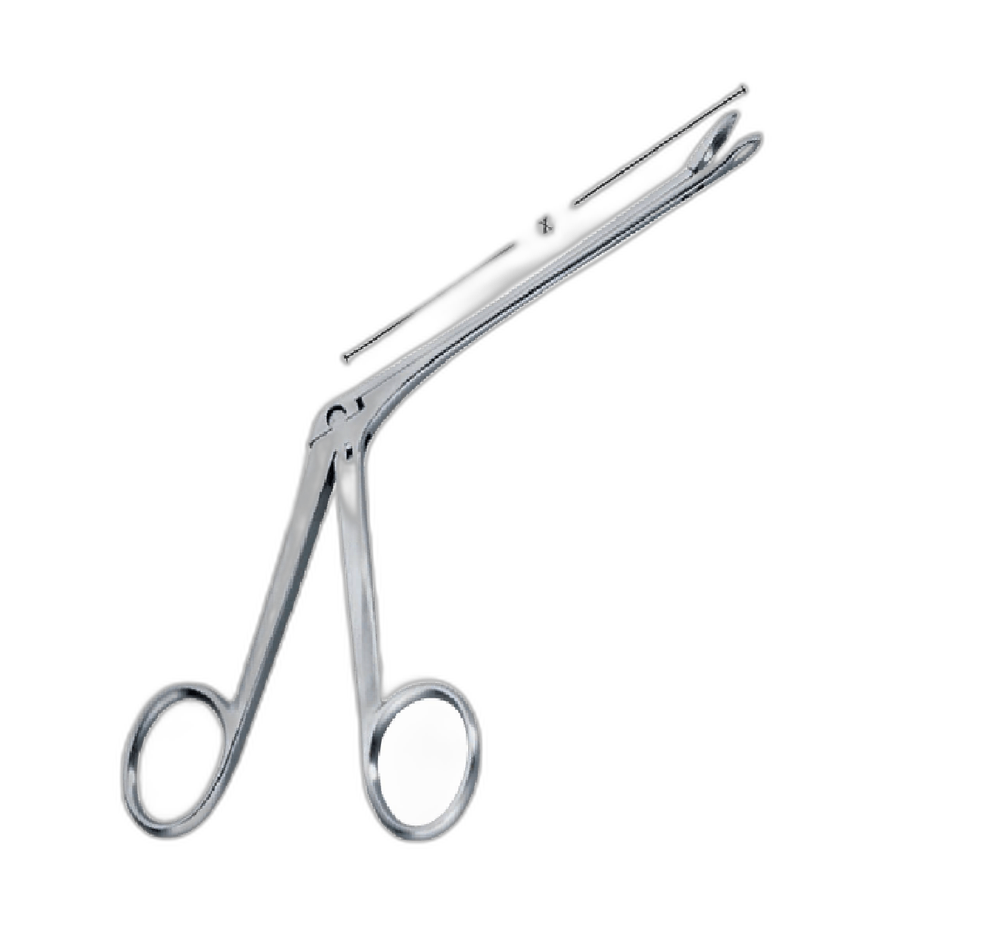
The defining instrument of spinal decompression. A Kerrison has a footplate that slides beneath the lamina and a punch that closes onto it, biting bone in a controlled, measured increment.
Two dimensions define any Kerrison and both must be specified:
| Dimension | Range | Selection driver |
|---|---|---|
| Bite width | 1, 2, 3, 4, 5, 6 mm | Space available beneath lamina |
| Footplate angle | 40°, 90°, 130° up-biting; down-biting variants | Approach angle to the bone |
| Shaft length | 18–24 cm typical | Patient habitus, approach depth |
The footplate thickness is the specification that separates a good Kerrison from a poor one. A thinner footplate slides into a tighter interlaminar space and displaces less dura, which is precisely why thin-footplate designs command a premium. Detachable-shaft Kerrisons, which open for cleaning, address the reprocessing problem discussed below.
Working practice: start with a 2 mm to establish the plane, move to 3 or 4 mm for the bulk of the laminar removal, and return to 1 or 2 mm for foraminal work where the nerve root is close. Our Kerrison rongeur sizes guide covers the 1 mm to 6 mm range and the up-bite versus down-bite decision in more detail.
Laminectomy Rongeurs
Distinct from Kerrisons. Leksell and Beyer rongeurs have opposed cupped jaws that bite bone between them rather than punching against a footplate. They are used for bulk removal of the spinous process and lamina before finer Kerrison work begins.
Leksell rongeurs come in straight and curved jaw patterns, typically 24 cm, with jaw widths from 3 to 6 mm. Double-action versions multiply the mechanical advantage — worth having for dense cortical bone and sclerotic facets.
Curettes
Spinal curettes come straight, angled and reverse-angled, in sizes 0 through 6. The angled and reverse patterns reach under the lamina to separate ligamentum flavum from bone and to clear the undersurface before the Kerrison footplate is introduced.
Bayonet-shaped handles matter here for the same reason they do throughout spinal surgery: the offset keeps the surgeon’s hand out of the sightline down a deep, narrow corridor.
High-Speed Burr
A matchstick or acorn burr thins the lamina to an eggshell before the Kerrison completes the removal. The technique reduces the force transmitted to the spinal canal, since a Kerrison forced under a thick lamina displaces dura ahead of its footplate.
Diamond burrs cut more slowly and are markedly safer near dura and nerve root; cutting burrs are faster on cortical bone away from neural structures. Irrigation is not optional — thermal necrosis of bone is real, and a dry burr near dura is a thermal injury waiting to happen.
Neural Instruments
The instruments that touch or protect neural tissue are the ones where quality of finish matters most, because a burr or a rough edge on a nerve root retractor causes injury that no technique can compensate for.
- Nerve root retractors — angled blades with smooth, rolled edges for gently displacing the root medially to expose the disc space.
- Ball-tip probe / nerve hook — for palpating the foramen and confirming decompression. The classic test of an adequate decompression is passing the probe freely around the root.
- Penfield dissectors — numbered 1 through 5, used constantly for separating ligamentum flavum from dura, developing epidural planes, and protecting dura during Kerrison work. The Penfield 4 in particular is the instrument most surgeons reach for to shield dura from an advancing footplate.
- Dural hooks and Woodson elevator — fine, blunt instruments for lifting adhesions off dura.
- Micro pituitary rongeurs — straight and up-angled, 2 to 4 mm, for disc material removal where a discectomy accompanies the decompression.
Cottonoid patties on a dedicated stand, bipolar forceps with bayonet shafts, and a fine suction tip with a thumb-controlled vent complete the neural side. The vent matters: unvented suction applied directly to dura can injure it.
Haemostasis
Epidural venous bleeding is the recurring nuisance of lumbar decompression. Instruments earning their place: bayonet bipolar forceps in 1 mm and 2 mm tip widths, a Frazier suction tube with vent control, bone wax with an applicator, and patties in graduated sizes.
Bone wax is applied to bleeding cancellous bone edges — the cut lamina surface is a reliable bleeder and waxing it early saves time later.
The Reprocessing Problem
Laminectomy sets are among the hardest instrument trays in the hospital to clean properly, for one structural reason: the Kerrison rongeur.
A traditional fixed-shaft Kerrison has a long, narrow channel between shaft and slider where bone debris and blood collect. That channel is not accessible to a brush and not reliably cleared by ultrasonic treatment alone. Residual bone debris in a Kerrison is a documented and persistent CSSD finding.
Three mitigations, in order of effectiveness:
- Specify take-apart Kerrisons where budget permits. The shaft separates, exposing every surface. This is the only complete solution.
- Immediate enzymatic pre-treatment. Bone debris that dries in the channel is dramatically harder to remove. Point-of-use spray or immersion before the tray leaves theatre.
- Dedicated flushing. Pressurised irrigation along the slider channel during manual cleaning, before ultrasonic processing.
The wider workflow — decontamination, inspection, assembly, sterilisation — is covered in our CSSD workflow guide, and laminectomy trays are a good stress test for whether a department’s process actually works as documented.
Inspection Points
Three checks before a laminectomy set is released:
- Kerrison footplate and punch alignment. A punch that does not close squarely on the footplate tears bone rather than cutting it, and transmits force to the canal. Test-close each one.
- Curette edge sharpness. A blunt curette requires more force, and force near dura is the problem.
- Nerve root retractor edges. Run a gloved finger along the blade margins. Any burr or roughness takes the instrument out of service.
Steel and Construction
Kerrison rongeurs, laminectomy rongeurs and curettes are cutting instruments and are made from hardenable martensitic stainless — AISI 420 range — heat treated for edge retention. Tungsten carbide inserts at the cutting edge extend service life substantially on high-volume Kerrisons and are worth specifying for a set that runs daily lists.
Retractors, elevators, probes and dissectors are non-cutting and are better made from austenitic 304 or 316, which resists the corrosion that repeated steam cycles and blood contact drive. The trade-off between these grades is set out in our guide to surgical steel grades 410, 420 and 440.
Where decompression is a prelude to instrumented fusion, the laminectomy tray is normally opened alongside a separate implant set — see our spinal fusion instrument set guide for that complement.
Frequently Asked Questions
What Kerrison sizes does a laminectomy set need?
A working set covers 1, 2, 3 and 4 mm at minimum, with 5 and 6 mm for bulk removal in large lumbar exposures. Both 40° and 90° up-biting footplates should be present. The 2 mm and 3 mm are used most heavily, so many departments carry duplicates of those two rather than a single instrument in every size.
Why are laminectomy instruments bayonet-shaped?
The bayonet offset keeps the surgeon’s hand and the instrument shaft out of the line of sight down a deep, narrow corridor. In a lumbar decompression under loupes or microscope, a straight handle occludes exactly the view the surgeon needs. It is an ergonomic solution to a sightline problem, not a mechanical one.
Are take-apart Kerrison rongeurs worth the extra cost?
For high-volume spinal units, generally yes. The fixed-shaft slider channel is a known cleaning failure point, and residual bone debris there is a recurring CSSD finding. Take-apart designs expose every surface. The cost premium buys a genuine reprocessing improvement rather than a marginal one.
What is the difference between a Kerrison and a Leksell rongeur?
A Kerrison punches bone against a footplate that slides beneath the lamina, giving controlled small bites in a confined space. A Leksell has opposed cupped jaws that bite bone between them, used for bulk removal of spinous process and lamina. Leksell first for volume, Kerrison for precision near neural structures.
How is a high-speed burr used safely near dura?
Thin the lamina to eggshell thickness with the burr, then complete removal with a Kerrison, so the burr never works directly against dura. Use a diamond burr rather than a cutting burr as you approach neural structures, and irrigate continuously — a dry burr causes thermal injury to both bone and dura.
Configuring a Set
Scope the tray to the approach. An open multi-level lumbar decompression, a single-level microdiscectomy, and a minimally invasive tubular decompression have genuinely different instrument requirements, and a single tray built to cover all three is heavy, slow to process, and full of instruments that are opened but never used.
Most units settle on a core decompression tray plus a smaller MIS-specific set with tubular retractors, dilators and long bayonet instruments.
Fizza Surgical manufactures laminectomy instruments under ISO 13485:2016 with CE marking — Kerrison rongeurs in fixed and detachable patterns, Leksell and Beyer rongeurs, Cobb elevators, spinal curettes and nerve root retractors. Sets can be built to your instrument card; see our bone surgery instruments range or contact us for a tray specification.
Need precision surgical instruments?
Configure complete instrument sets with our team — ISO 13485 certified, CE marked, made in Sialkot since 1980.
Related Guides
View all articles →

Where We Serve
Fizza Surgical exports to 50+ countries. Browse our country-specific pages with local regulatory guidance and pricing: