Plastic Surgery Instruments: Rhinoplasty & Facelift Guide
Plastic surgery instruments for rhinoplasty and facelift: osteotome and rasp sizes, retractors, set building and care.
 Made in Sialkot · Since 1980
Cottle osteotomes: 4 mm, 7 mm, 9 mm, 12 mm. Joseph rasps: coarse and fine, convex and flat. Aufricht retractor: 45 mm blade with a fibre-optic variant. Skin hooks: single prong, double prong, 2 mm and 5 mm spread.
Those numbers are the whole argument for a dedicated aesthetic tray. Rhinoplasty and facelift surgery are millimetre operations, and the size increments are the specification — not the eponym on the handle.
Why aesthetic sets differ from general surgical trays
Three things separate plastic surgery instruments from their general-surgery equivalents.
Tip finish. A general surgical forceps tip is finished to hold tissue securely. An aesthetic forceps tip is finished to hold tissue without leaving a crush mark that becomes a visible irregularity under thin nasal or facial skin. That is a different polishing standard, and it is the reason aesthetic instruments cost more.
Length-to-delicacy ratio. Facelift dissection reaches 150 mm under a skin flap through a preauricular incision, and the instrument has to stay delicate at that reach without flexing. Steel selection and taper geometry do this, not bulk.
Reflectivity. Many aesthetic instruments are supplied with a matte or black chrome finish. Working under a headlight against a mirror-polished retractor blade produces glare that obscures exactly the fine detail the operation depends on.
Rhinoplasty instruments
Exposure and elevation
An open rhinoplasty starts with a transcolumellar incision, so the first instruments are fine: a No. 15 or No. 11 blade, sharp double-prong skin hooks (Joseph or Cottle pattern) to evert the columellar skin, and fine curved scissors — Converse or Fomon — to develop the plane over the lower lateral cartilages.
The Joseph elevator and Cottle elevator lift the soft tissue envelope off the dorsum. A Freer elevator handles septal mucoperichondrial flaps; the sharp end scores, the blunt end elevates, and using them the wrong way round tears mucosa.
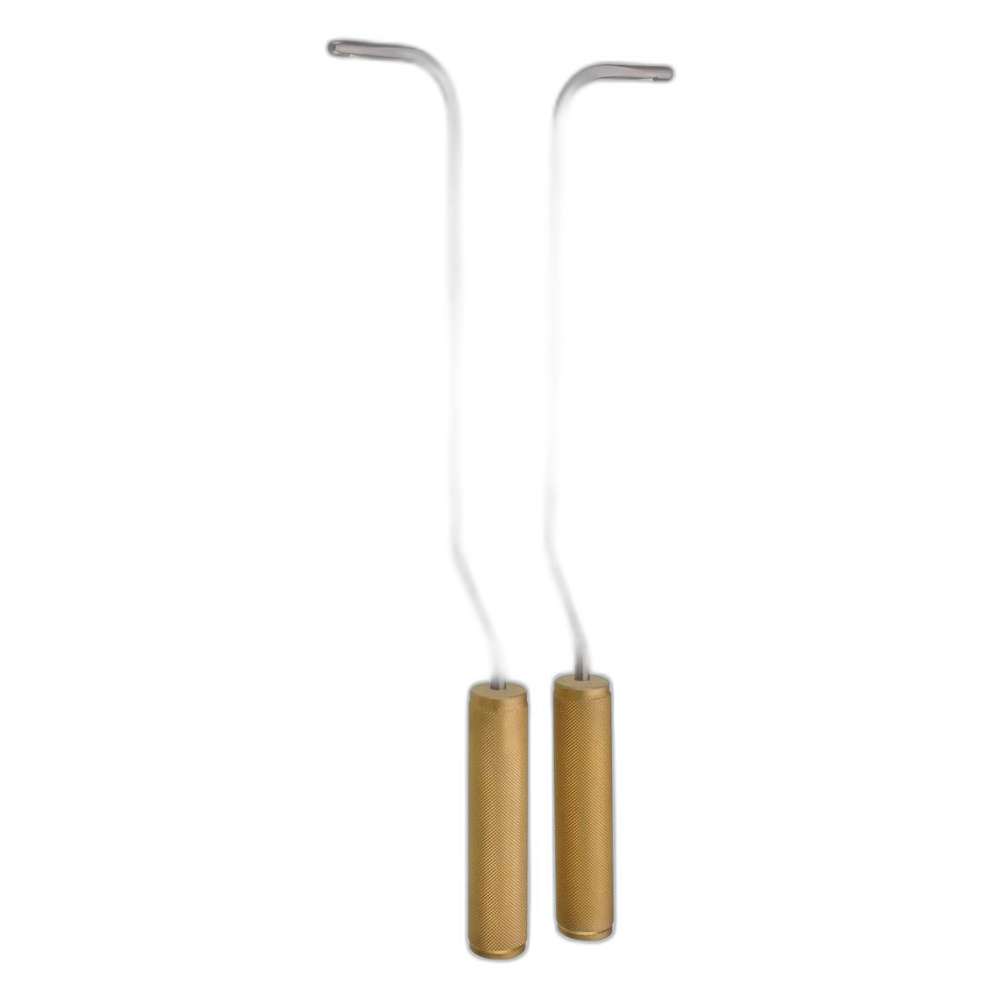
The Aufricht retractor is the defining instrument of the operation. It lifts the entire skin envelope off the dorsum so the surgeon can see what they are doing to the bony and cartilaginous roof. Fibre-optic versions carry a light channel; they cost considerably more and most surgeons who try one keep it.
Bone work
Osteotomes. Cottle pattern in 4, 7, 9, and 12 mm widths covers lateral, medial, and transverse osteotomies. Guarded osteotomes protect the periosteum on lateral cuts. A 4 mm is used for the medial oblique; 7 mm and above for lateral osteotomy in a wider nose.
Rasps. Joseph, Fomon, Maltz, and Aufricht patterns — convex, flat, and diamond-cut, coarse through fine. Dorsal hump reduction proceeds coarse-to-fine, and a fine rasp used last is what prevents a palpable step. Rasps clog with bone paste; a wire brush and immediate irrigation during the case keep them cutting.
Osteotome mallet. 200–250 g, stainless or nylon-faced. Weight matters — too light and the surgeon compensates with force, which is how greenstick fractures become comminuted.
Cartilage work
A cartilage crusher or morselizer for graft preparation, a cartilage-cutting board, fine Adson-Brown forceps with 7×7 or 9×9 teeth for atraumatic handling, and a septal scissors. A Jansen-Middleton or Takahashi forceps removes septal cartilage and bone for grafting; a swivel knife or Ballenger swivel knife cuts the septal cartilage strut.
Our septoplasty instrument set guide covers the septal half of this in detail, since most rhinoplasty trays double as septal trays.
Facelift instruments
Different operation, overlapping philosophy.
Facelift scissors — long (170–190 mm), slightly curved, with blunt tips for undermining the skin flap. Kaye, Gorney, and Rees patterns are the common eponyms. The blunt tip is deliberate: it separates the subcutaneous plane by spreading rather than cutting, which preserves the subdermal plexus and keeps the flap alive.
Facelift retractors — Converse, Ragnell, and Senn double-ended retractors for flap elevation, plus fibre-optic lighted retractors for deep dissection under the flap where a headlight cannot reach.
Skin hooks in multiples. A facelift consumes more skin hooks than any other aesthetic procedure — single-prong for delicate flap edges, double-prong for controlled traction. Six to eight is a realistic number.
Fine needle holders — Castroviejo or Webster pattern with tungsten carbide inserts, for 5-0 and 6-0 closure. A needle holder that will not hold a 6-0 needle without rotation is a wound-quality problem, not an inconvenience. For microsurgical needle holder detail, see our Castroviejo needle holder guide.
Bipolar forceps, fine-tipped, for haemostasis under the flap. Monopolar coagulation under a thin skin flap risks thermal injury and flap necrosis; bipolar confines the current between the tips.
SMAS instruments — for surgeons doing SMAS plication or SMASectomy, a fine tissue forceps and a dedicated SMAS scissors, plus long DeBakey-style forceps for deep-plane work.
Reference specifications
| Instrument | Sizes | Length | Primary use |
|---|---|---|---|
| Cottle osteotome | 4 / 7 / 9 / 12 mm | 175 mm | Medial and lateral osteotomy |
| Guarded osteotome | 3 / 5 mm | 175 mm | Lateral osteotomy, periosteal protection |
| Joseph rasp | Coarse / fine | 200 mm | Dorsal hump reduction |
| Aufricht retractor | Blade 45 mm | 150 mm | Dorsal skin envelope elevation |
| Joseph skin hook, double | 2 mm / 5 mm spread | 160 mm | Columellar and flap retraction |
| Freer elevator | Double-ended | 180 mm | Mucoperichondrial elevation |
| Converse scissors | Curved, fine | 115 mm | Cartilage and soft tissue |
| Facelift scissors (Kaye) | Curved, blunt tip | 170–190 mm | Skin flap undermining |
| Adson-Brown forceps | 7×7 / 9×9 teeth | 120 mm | Atraumatic tissue handling |
| Castroviejo needle holder | TC insert, curved | 140 mm | 5-0 to 7-0 closure |
| Osteotome mallet | 200–250 g | 200 mm | Controlled osteotomy |
| Cartilage crusher | Adjustable plates | — | Graft preparation |
Building a set that is actually used
The most common purchasing error in aesthetic surgery is buying a large catalogue set. A 71-piece rhinoplasty set looks comprehensive on paper; in practice most surgeons use 25 to 30 of those pieces and the remainder still have to be counted, cleaned, and sterilised every case. That is a permanent recurring cost for instruments nobody touches.
A better approach is a core set plus named additions:
- Core rhinoplasty (roughly 30 pieces): blades and handles, skin hooks ×4, Joseph and Cottle elevators, Freer, Aufricht retractor, osteotomes ×4, rasps ×3, mallet, Converse scissors, Adson-Brown forceps ×2, needle holders ×2, bipolar forceps, suction.
- Septal module: swivel knife, Jansen-Middleton forceps, Takahashi forceps, nasal speculum set, septal splints.
- Grafting module: cartilage crusher, cutting board, fine calipers, rib instruments if costal grafts are used.
- Facelift module: facelift scissors ×2, lighted retractor, additional skin hooks ×4, long forceps, SMAS instruments.
Surgeons who work this way generally report faster turnover and lower reprocessing cost without losing anything clinically.
Care of fine-tipped instruments
Delicate aesthetic instruments fail in ways that heavy instruments do not, and almost all of it is handling rather than manufacturing.
Tip protectors on everything fine. Skin hooks, micro scissors, and Castroviejo needle holders should never be loose in a tray. Silicone tip guards or a fitted stringer prevent the point contact that bends a hook or misaligns a jaw.
Separate tray for delicates. A Cottle osteotome and a 6-0 needle holder do not belong in the same basket. Weight on top of a fine instrument during transport bends it.
Never ultrasonic osteotomes with fine instruments. Cavitation dislodges bone debris that redeposits, and metal-on-metal contact during the cycle chips cutting edges.
Rasps get brushed immediately. Bone paste dries into the teeth and hardens; once autoclaved in, it does not come out and the rasp cuts unevenly from then on.
Inspect under magnification. A 3× loupe at reassembly catches bent hook tips, chipped osteotome edges, and misaligned scissor blades before they reach the field. Our guides to sterilising microsurgical instruments and delicate cutting instruments cover the protocols in more depth.
Material and manufacturing notes
Cutting plastic surgery instruments — scissors, osteotomes, rasps, blades — are forged from martensitic grades (AISI 420, occasionally 440) that take and hold an edge. Retractors, elevators, and specula are typically AISI 410 or 304 where corrosion resistance matters more than hardness. Needle holders carry tungsten carbide jaw inserts brazed into a steel body; the carbide is what grips a 6-0 needle, and a worn insert is replaceable in a well-made instrument.
Ask for hardness figures on the cutting group. Osteotome edges below roughly 52 HRC will roll on nasal bone within a handful of cases.
Fizza Surgical has manufactured aesthetic and reconstructive instrumentation in Sialkot since 1980, under ISO 13485 with CE marking under EU MDR, forged per ISO 7153-1 and laser-marked for traceability. Matte and black-chrome finishes are available on retractors and forceps for glare reduction. The full catalogue sits under surgical instruments, with current approvals listed on our certifications page.
Frequently Asked Questions
How many pieces should a rhinoplasty instrument set contain?
A working core set is 28 to 35 pieces. Catalogue sets of 60 to 90 pieces exist but most surgeons use only about a third of them, and the unused instruments still incur counting and reprocessing cost every case. Build a core set and add named modules for septal work and grafting.
What is the difference between a guarded and unguarded osteotome?
A guarded osteotome carries a small flange on one side of the cutting edge that rides against the periosteum and limits penetration depth. It is used for lateral osteotomies where uncontrolled depth risks injury to surrounding soft tissue. Unguarded osteotomes give a cleaner, more precise cut and are preferred for medial and transverse osteotomies where visibility is better.
Why are some plastic surgery instruments black or matte finished?
To eliminate glare. Aesthetic surgery is performed under intense focused lighting, and a mirror-polished blade reflects that light straight back at the surgeon, washing out the fine surface detail the operation depends on. Black chrome and matte satin finishes absorb rather than reflect. The finish has no effect on corrosion resistance when correctly applied over passivated steel.
Can rhinoplasty and facelift share one instrument tray?
Partially. Skin hooks, fine forceps, needle holders, bipolar forceps, and Converse scissors serve both. The osteotomes, rasps, and Aufricht retractor are rhinoplasty-specific, and the long facelift scissors and lighted retractors are facelift-specific. A shared delicate core plus two procedure modules is the practical arrangement.
How should rasps be cleaned between cases?
Brush the teeth under running water during the case itself, before the bone paste dries. At reprocessing, use a stiff nylon brush along the direction of the teeth, enzymatic soak, then thermal disinfection. Do not process rasps in the same ultrasonic load as fine instruments, and inspect the cutting teeth under magnification before wrapping.
Need precision surgical instruments?
Configure complete instrument sets with our team — ISO 13485 certified, CE marked, made in Sialkot since 1980.
Related Guides
View all articles →
Where We Serve
Fizza Surgical exports to 50+ countries. Browse our country-specific pages with local regulatory guidance and pricing: