Vessel Loop and Bulldog Clamp: Temporary Vascular Occlusion
Vessel loop bulldog clamp guide: loop sizes and colour codes, DeBakey and Dieffenbach patterns, closing force, laparoscopic variants and reprocessing.
 Made in Sialkot · Since 1980
A femoral artery is exposed, the tumour is mobilised, and the surgeon needs the vessel out of the way and bloodless for the next eleven minutes. Not ligated. Not divided. Just quiet.
That is the entire problem that vessel loops and bulldog clamps exist to solve, and the two do it in opposite ways. One is a retraction device that can be converted into an occluder. The other is an occluder that cannot retract. Confusing them costs intima.
Two instruments, two jobs
The distinction is worth stating plainly before the specifications, because catalogues list them side by side and buyers assume they are interchangeable.
A vessel loop is a flat or round silicone strand, passed around a vessel with a right-angle dissector, then held under gentle tension. Its primary job is vessel isolation and retraction: lifting the common femoral vein off the artery so you can see the junction. It becomes an occluder only when doubled back on itself and secured with a clip or a Rummel tourniquet.
A bulldog clamp is a self-retaining spring clamp with atraumatic jaws. It occludes on application and does nothing else. It will not hold a vessel out of the field; it will only stop flow through it.
Most vascular trays carry both because most vascular exposures need both, in that order: loop first for control and exposure, clamp second for occlusion at the moment of arteriotomy. A vessel loop bulldog clamp pairing is therefore the normal configuration on a tray, not an either/or purchasing decision.
Vessel loop sizes and colour convention
Silicone loops come in two profiles and are supplied sterile, usually in packs of ten or twelve.
| Profile | Typical width / diameter | Where it is used |
|---|---|---|
| Mini flat | 1.3 mm wide | Tibial and pedal vessels, paediatric, distal bypass targets |
| Standard flat | 2.5 mm wide | Femoral, carotid, brachial, iliac |
| Maxi flat | 4.8 mm wide | Aorta, vena cava, large venous structures |
| Round | 1.6 mm and 2.0 mm | Nerve and ureter retraction, tendon slings |
Flat loops distribute tension over a wider footprint and are the default around arteries. Round loops concentrate pressure into a line, which is acceptable around a nerve you intend to retract briefly and unacceptable around an artery you intend to keep.
Colour is not decoration. The near-universal theatre convention is red for arteries, blue for veins, yellow or white for nerves and ureters. In a groin dissection with four structures slung, colour is what stops the wrong loop being pulled during a tense moment. Radiopaque strands, which carry a barium-impregnated stripe, are the correct choice for any case with a plausible retained-item risk — a point worth reading alongside the surgical instrument count procedure.
The Rummel tourniquet
To convert a loop into an occluder, both ends are passed through a short length of rigid tubing — a red rubber catheter segment or a purpose-made Rummel tourniquet. Pulling the loop ends and sliding the tubing down snugs the loop against the vessel wall; a clamp on the tubing holds the tension. Release is instant and one-handed, which is its advantage over a clamp in a deep, crowded field such as the base of a cannulation site.
Bulldog clamp patterns and closing force
Bulldogs are classified by the spring geometry, and that geometry determines the closing force far more than the size does.
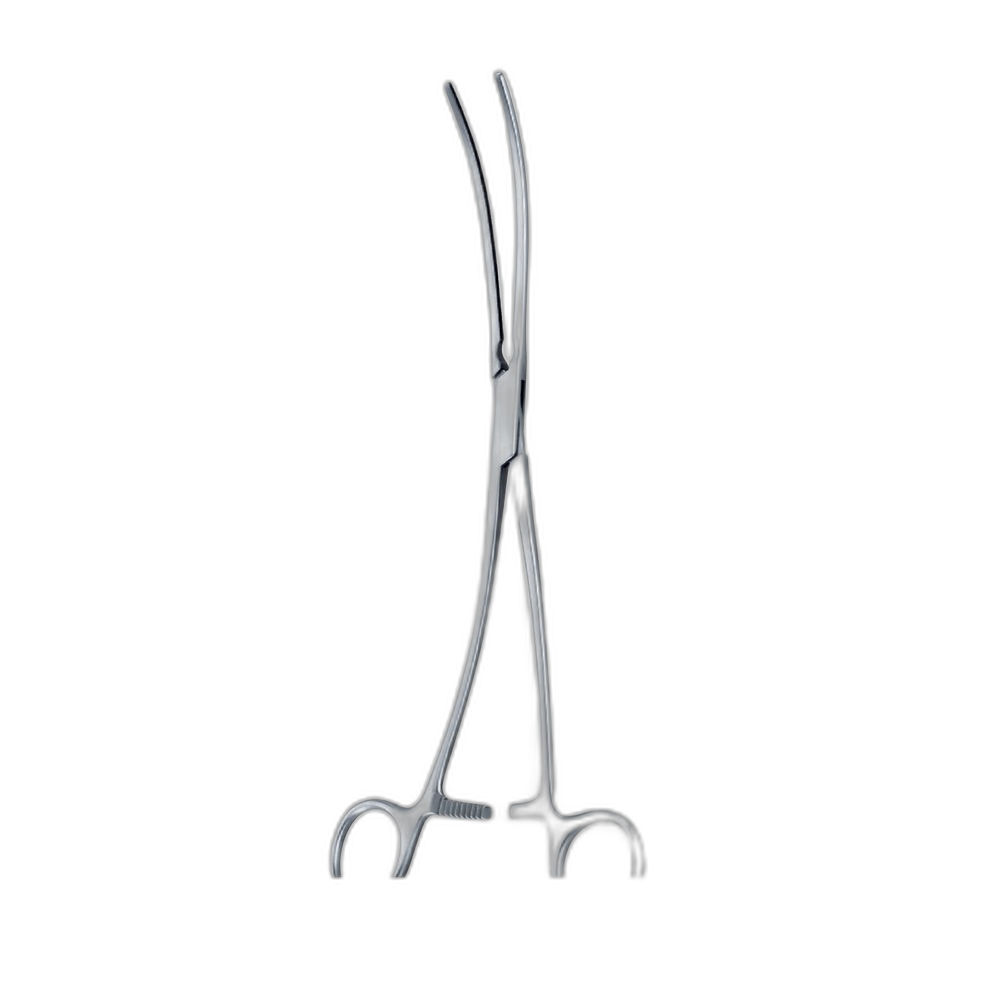
- DeBakey bulldog — straight or curved, jaws lined with the fine multi-row atraumatic serration DeBakey developed. The workhorse for arteries. Common lengths 38 mm to 75 mm.
- Dieffenbach — small, cross-action spring, jaws 5 mm to 20 mm. Used for small peripheral vessels and in microvascular and experimental work.
- Glover bulldog — heavier spring with a longer jaw, straight or angled, for larger arteries and cardiac work.
- Cooley and Satinsky patterns — technically not bulldogs, since they are ratcheted vascular clamps with ring handles, but they sit in the same tray for aortic and partial-occlusion work.
- Serrefine — the smallest of the family, flat spring, used to steady vessel ends during anastomosis rather than to occlude a pressurised trunk.
Closing force is the specification buyers ignore and surgeons feel. A clamp that is too strong crushes the intima and seeds a later stenosis at exactly the point you clamped. Too weak, and it slips off a pressurised artery mid-anastomosis. Atraumatic vascular clamps are generally specified in the 30 to 180 gram range depending on pattern and vessel calibre, and reputable manufacturers test spring tension as a release criterion, not as an afterthought.
This is also the specification that drifts. A bulldog that has been autoclaved a few hundred times and dropped twice does not hold the force it left the factory with. Spring tension should be part of the periodic instrument inspection routine described in our instrument inspection checklist — not just checked on arrival.
Materials and why the jaw insert matters
Bodies are forged from martensitic stainless — AISI 420 for the spring, which needs to hold temper, and AISI 316L where corrosion resistance outranks hardness. The jaw is the interesting part. Three approaches are in common use:
- Machined atraumatic serrations — the DeBakey solution. Fine longitudinal rows that grip without a single high-pressure line contact. All-metal, fully autoclavable, no wear part.
- Replaceable plastic or silicone inserts — softer still, but the insert is a consumable and a reprocessing liability if the seat traps protein.
- Rubber-shod — a plain clamp with silicone tubing pulled over the jaws. Improvised, cheap, and unreliable. It works until the tubing rolls.
For a reusable set intended to last, machined atraumatic jaws in AISI 420 are the defensible specification. Nothing to lose, nothing to reseat, nothing that degrades differently from the rest of the instrument.
Laparoscopic and robotic variants
The same principle miniaturised. Laparoscopic bulldogs are introduced through a 5 mm or 10 mm port with a dedicated applier and released with the same tool, and they have become the standard method of renal pedicle control in laparoscopic partial nephrectomy. The alternative technique of passing a vessel loop and securing it with polymer clips has been described as a workable substitute where a bulldog applier is not to hand, and it survives in the literature precisely because both instruments do the same job by different means.
Two practical cautions. Laparoscopic bulldogs are small, dark, and easy to lose behind the liver — count them in and out. And the applier is instrument-specific; a clamp from one manufacturer will frequently not seat in another’s applier jaw.
Reprocessing
Both instrument families are cleaned in the open position. A bulldog cleaned closed has an unwashed jaw interface, which is where blood dries first.
Spring instruments should not be stacked under load in a tray; long-term compression is what relaxes a spring. Use a rack or a silicone finger mat. Ultrasonic cleaning is appropriate and effective for the serrated jaw faces — see our guide to ultrasonic cleaning of surgical instruments for cycle parameters. Silicone vessel loops are single-use and are not reprocessed; they are supplied sterile and discarded with the drapes.
After every hundred cycles or so, check three things on each bulldog: that the jaws meet along their whole length against a light, that the serrations are unflattened, and that the spring still resists opening. Instruments failing any of the three go to repair, not back to the tray.
Frequently Asked Questions
Can a vessel loop be left in place at the end of the case?
No. Silicone loops are intraoperative devices only. Every loop placed must be accounted for at closure, which is why radiopaque strands are preferred in deep cavity work.
How long can a bulldog clamp safely stay on an artery?
That is a clinical judgement driven by the tissue distal to the clamp, not by the instrument. The instrument-side question is different: the clamp must hold the same force at minute twenty as at minute one, which is a function of spring quality.
What is the difference between a bulldog and a serrefine?
Size and intent. A serrefine is a small flat-spring clamp used to steady or approximate vessel ends during anastomosis. A bulldog is built to occlude a pressurised vessel and holds meaningfully more force.
Are flat or round vessel loops better?
Flat for arteries and veins, because the wider footprint spreads tension across the wall. Round for nerves, ureters and tendons, where a narrower sling is easier to pass and the structure is not pressurised.
Do bulldog clamps need re-tensioning?
They cannot be re-tensioned in the field. A spring that has relaxed is replaced. This is why closing force belongs in your incoming inspection and in your periodic instrument audit.
Specifying a set
A serviceable vascular occlusion tray is smaller than most catalogues suggest: six DeBakey bulldogs in two lengths, four Dieffenbach for small vessels, two angled Glover for the larger trunk, and loops in mini, standard and maxi in both red and blue. Add the Rummel tubing and you have covered nearly every open peripheral exposure.
Fizza Surgical manufactures the full vessel loop bulldog clamp range in Sialkot under ISO 13485, in AISI 420 and 316L, with spring tension verified before release. Browse the surgical instruments catalogue or review our certifications for CE and quality system documentation.
Need precision surgical instruments?
Configure complete instrument sets with our team — ISO 13485 certified, CE marked, made in Sialkot since 1980.
Related Guides
View all articles →
Where We Serve
Fizza Surgical exports to 50+ countries. Browse our country-specific pages with local regulatory guidance and pricing: