Micro-Neurosurgery Instruments: Bayonet Forceps Guide
Micro neurosurgery instruments explained: bayonet forceps tip widths, micro scissors, Rhoton dissectors, materials and safe handling under magnification.
 Made in Sialkot · Since 1980
Yaşargil’s contribution to neurosurgery is usually described in terms of technique. The instruments came first.
When the operating microscope arrived in the neurosurgical theatre in the 1960s, the existing instrument set became unusable overnight — not because the tips were wrong, but because a straight shaft and a surgeon’s own hand now sat directly between the objective lens and the target. Everything downstream of that problem, including the bayonet shaft that defines the modern set, is an optical solution rather than a mechanical one.
That history is worth keeping in mind when specifying micro neurosurgery instruments, because nearly every unusual feature on them exists to keep the working corridor visible.
Why the shaft is bayoneted
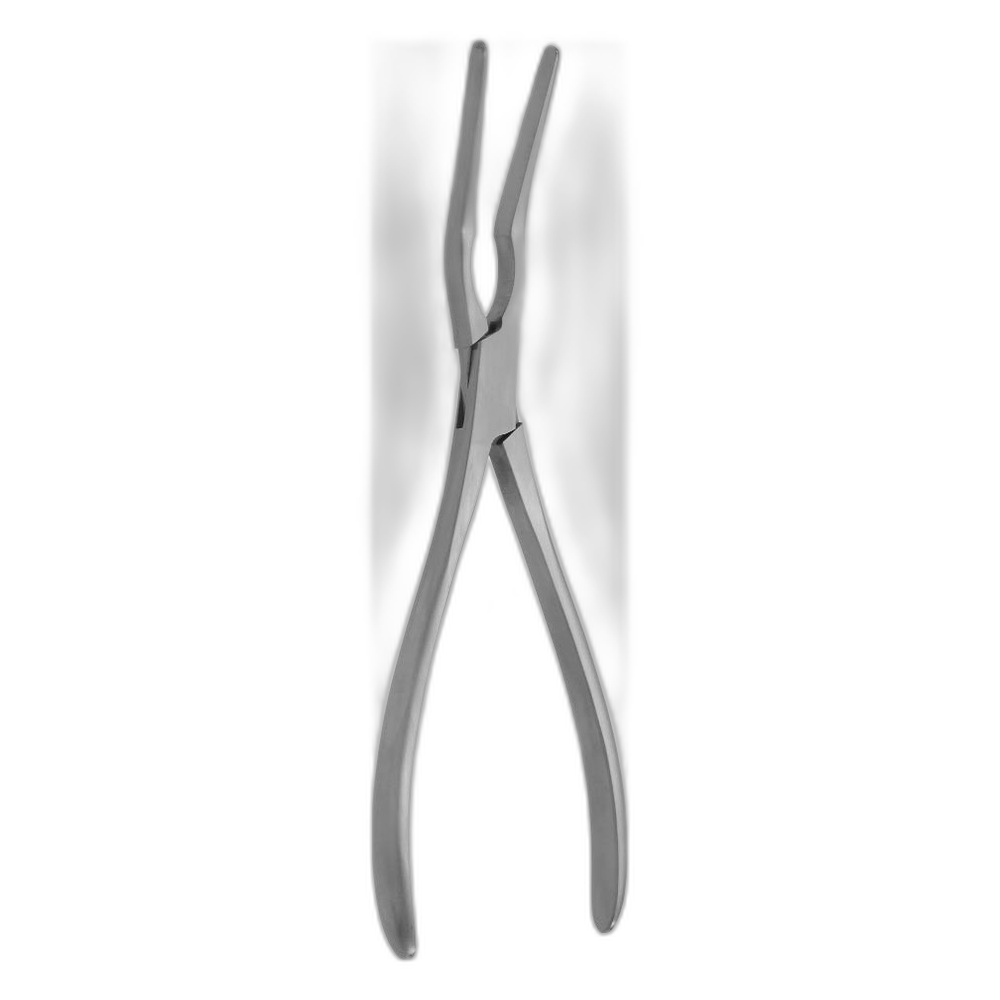
A bayonet shaft steps laterally twice, offsetting the handle from the axis of the tip. Under a microscope focused 60 mm down a corridor 12 mm wide, that offset moves the surgeon’s fingers and the instrument body out of the line of sight and out of the light path.
The step also does something less obvious. It allows two or three instruments to work in the same corridor simultaneously — suction, bipolar, and a dissector — without the handles colliding above the wound. In a pterional approach to an aneurysm, that is the difference between working and taking turns.
Two families make up the set, and the division is structural:
- Single-shaft instruments — dissectors, hooks, curettes, knives, elevators. One shaft, one functional tip, no moving parts.
- Spring instruments — the “forceps family”: forceps, scissors, needle holders. Two shafts joined at a spring handle, two functional tips that meet.
The two families fail differently and are inspected differently, which matters more than it sounds.
Bayonet forceps
Bayonet forceps are the instrument a neurosurgeon holds for most of a case, and the specification detail that matters most is the tip width.
| Tip width | Typical use | Common shaft lengths |
|---|---|---|
| 0.3 mm | Perforator dissection, microvascular anastomosis | 180 mm, 200 mm |
| 0.5 mm | Arachnoid dissection, aneurysm neck work | 180 mm, 200 mm, 230 mm |
| 0.7 mm | General microdissection, tumour capsule | 200 mm, 230 mm |
| 1.0 mm | Tissue handling, coagulation of larger vessels | 200 mm, 230 mm |
| 1.5–2.0 mm | Dural handling, packing, general purpose | 200 mm, 230 mm, 250 mm |
Length is chosen by depth of the corridor, not by preference. A 180 mm forceps in a deep skull base approach puts the surgeon’s hand where the microscope wants to be; a 250 mm forceps in a superficial cortical case is unnecessarily unsteady, because tremor amplitude scales with the distance from the point of hand support to the tip.
Bipolar coagulating forceps
The variant most sets are built around. Current passes between the two tips and coagulates only the tissue held between them, which is what makes bipolar acceptable within millimetres of a cranial nerve.
The engineering problem is tissue sticking. When coagulum adheres to the tip and is torn away on the next pass, it takes the vessel with it. Three mitigations are in production use:
- Non-stick tip alloys — typically silver or gold alloy tip inserts, which conduct heat away from the contact face faster than steel and reduce the temperature at which the coagulum bonds.
- Irrigating bipolars — a saline channel running along the shaft, dripping at the tip. Effective, and it introduces a lumen that must be flushed during reprocessing.
- Surface treatment — polished or specially finished tip faces on plain stainless tips.
Insulation is the safety-critical element. The shaft carries an insulating coating everywhere except the working tips, and a breach in that coating produces current leakage to whatever the shaft touches — which, in a transsylvian corridor, is brain. Insulation integrity should be inspected before every case and tested periodically, exactly as it is on laparoscopic instruments, where the same failure mode is better publicised.
Micro scissors
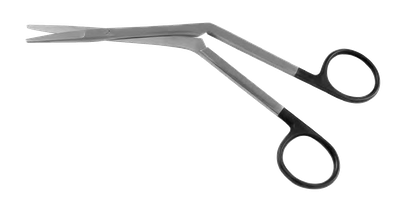
Micro scissors in neurosurgery divide arachnoid, tumour capsule, and occasionally vessel wall in bypass work. Tip geometry is chosen by what is being cut and how much room there is to open the blades.
- Straight — arachnoid bands, sutures, work directly along the corridor axis.
- Curved — cutting around a curved structure; the curve follows the aneurysm dome or nerve.
- Bayonet — the deep-corridor default, same optical logic as the forceps.
- Angled up / angled down — cutting on a plane the corridor does not allow you to approach straight on.
Blade lengths run from 5 mm down to 3 mm and below for the finest work. Two things separate a good pair from a poor one: the shear angle stays constant along the whole blade length, and the spring returns the blades to a repeatable open position under light finger pressure. A pair that cuts at the base but folds tissue at the tip has a blade contact problem and will not be fixed by sharpening.
Kamiyama and similar bayonet patterns place the blades at the end of a long fine bayonet shaft specifically for microvascular anastomosis, where the working space is a few millimetres and the instrument must not obscure the field.
Micro needle holders
For 8-0 to 10-0 monofilament in bypass and nerve work. Round-handled bayonet needle holders let the surgeon roll the instrument between thumb and index finger to drive a curved needle without moving the wrist — the reason round handles dominate here and flat handles dominate in general surgery.
Jaws are either smooth or have a very fine diamond pattern. A 10-0 needle in a coarsely serrated jaw is a bent 10-0 needle. Some patterns are supplied with and without a locking mechanism; most microvascular surgeons prefer non-locking, because releasing a lock at 25× magnification transmits a jolt to the tip.
Single-shaft instruments
The dissectors do the quiet work of the case.
Rhoton dissectors are the reference set — a numbered series of ball, round, curved and spatula tips with a standard handle, designed so a surgeon can call for a number rather than describe a shape. The ball tips (typically 1 mm, 2 mm, 3 mm) develop planes atraumatically; the spatula and elevator tips retract and separate.
Penfield dissectors, numbered 1 through 4, cover dural elevation and blunt separation and remain in every craniotomy tray alongside the micro set.
Micro curettes, straight and angled, ring diameters from 1 mm, for pituitary and tumour work.
Micro hooks, 90° and 45°, for lifting arachnoid bands off a vessel before dividing them.
Handles are usually round and knurled, sometimes counterbalanced. The counterbalance is not a luxury: a heavier proximal end damps tremor at the tip by moving the instrument’s centre of mass back toward the hand.
Aneurysm clips and appliers
Clips belong to a separate discipline but share the tray. The key point for a procurement file is that clip and applier are a matched system — an applier is designed for a specific clip family, and cross-mixing is unsafe. Modern permanent clips are usually titanium alloy for MRI compatibility and reduced imaging artefact; temporary clips are lower closing force, marked distinctly, and must never end up in the permanent tray.
Materials and manufacture
Micro instruments are made from martensitic stainless — AISI 420 where hardness and edge retention govern, 410 for general components, 316L where corrosion resistance matters more than hardness. Spring instruments need controlled temper: too hard and the spring cracks at the bend, too soft and it takes a set and stops returning.
Titanium appears where the instrument must be non-magnetic and MRI-safe, and where weight reduction genuinely helps — a titanium bipolar forceps is noticeably lighter over a six-hour case. It is softer than hardened steel, so titanium tips wear faster.
Tungsten carbide inserts, standard practice in general needle holders, are used sparingly here. Below a certain jaw size the insert braze becomes a bigger liability than the wear it prevents.
What separates instruments at this scale is finishing rather than material. A 0.3 mm tip is hand-finished under magnification; the last few microns are not a machine operation. This is why micro instruments carry the prices they do and why a set should be evaluated under a loupe before purchase, following the same discipline as our instrument inspection checklist.
Handling, reprocessing and storage
Micro instruments are destroyed by handling far more often than by use.
Never stack them. Bulk trays are how 0.3 mm tips get bent. Silicone finger mats, tip protectors, and individually slotted micro trays are the minimum.
Clean spring instruments open. A closed forceps has an unwashed tip interface.
Flush irrigating bipolar channels with a syringe on every cycle. A dried saline-and-protein channel cannot be sterilised, and the failure is invisible from outside.
Ultrasonic cleaning is appropriate for micro instruments but they must be held in a rack, not lying loose in the basket, where cavitation makes them rattle against each other. Cycle parameters are covered in our ultrasonic cleaning guide.
Inspect under magnification, not by eye. A 4× loupe at minimum. Check tip alignment on forceps by closing them against a light — any daylight between the tips means the instrument grips at one point instead of along the face. Check scissors by cutting a single strand of wet cotton at the very tip.
Segregate the micro set physically. Micro instruments that live in a general craniotomy tray get treated like general instruments, and the outcome is predictable. Separate containers, separate reprocessing handling, separate inspection interval — the reason these sets are usually managed as their own line in hospital instrument inventory systems.
Frequently Asked Questions
Why are neurosurgical instruments bayonet-shaped?
The lateral offset moves the handle and the surgeon’s hand out of the microscope’s line of sight and light path. It also lets several instruments work in one narrow corridor without the handles colliding.
What tip width should a general-purpose bipolar forceps be?
0.7 mm to 1.0 mm covers most tumour and general microdissection. Finer 0.3 mm and 0.5 mm tips are for perforator dissection and aneurysm neck work; wider 1.5 mm to 2.0 mm for dural handling.
Are titanium micro instruments better than stainless steel?
Better for MRI compatibility, non-magnetic requirements and weight. Worse for edge retention and tip durability, because titanium is softer than hardened martensitic stainless. Most sets mix both.
How do you check whether micro forceps tips are still aligned?
Close them gently against a light source under magnification. Visible light between the tip faces means the instrument is contacting at a point rather than along the face, and it should go to repair.
Can micro neurosurgery instruments be ultrasonically cleaned?
Yes, provided they are held in a rack rather than loose in a basket. Loose instruments rattle against each other during cavitation, which is a common cause of bent tips.
Specifying a set
A workable core is smaller than the catalogue suggests: bipolar forceps in three tip widths and two lengths, three or four micro scissors covering straight, curved and bayonet, one round-handled micro needle holder, a numbered dissector series, micro hooks in two angles, and micro curettes. Everything beyond that is approach-specific and should be added when a named surgeon asks for it, not bought speculatively.
Fizza Surgical manufactures micro neurosurgery instruments in Sialkot under ISO 13485, in AISI 420 and 316L with hand-finished tips inspected under magnification before release. Browse the surgical instruments catalogue, see the bone surgery range for the craniotomy side of the tray, or review our certifications.
Need precision surgical instruments?
Configure complete instrument sets with our team — ISO 13485 certified, CE marked, made in Sialkot since 1980.
Related Guides
View all articles →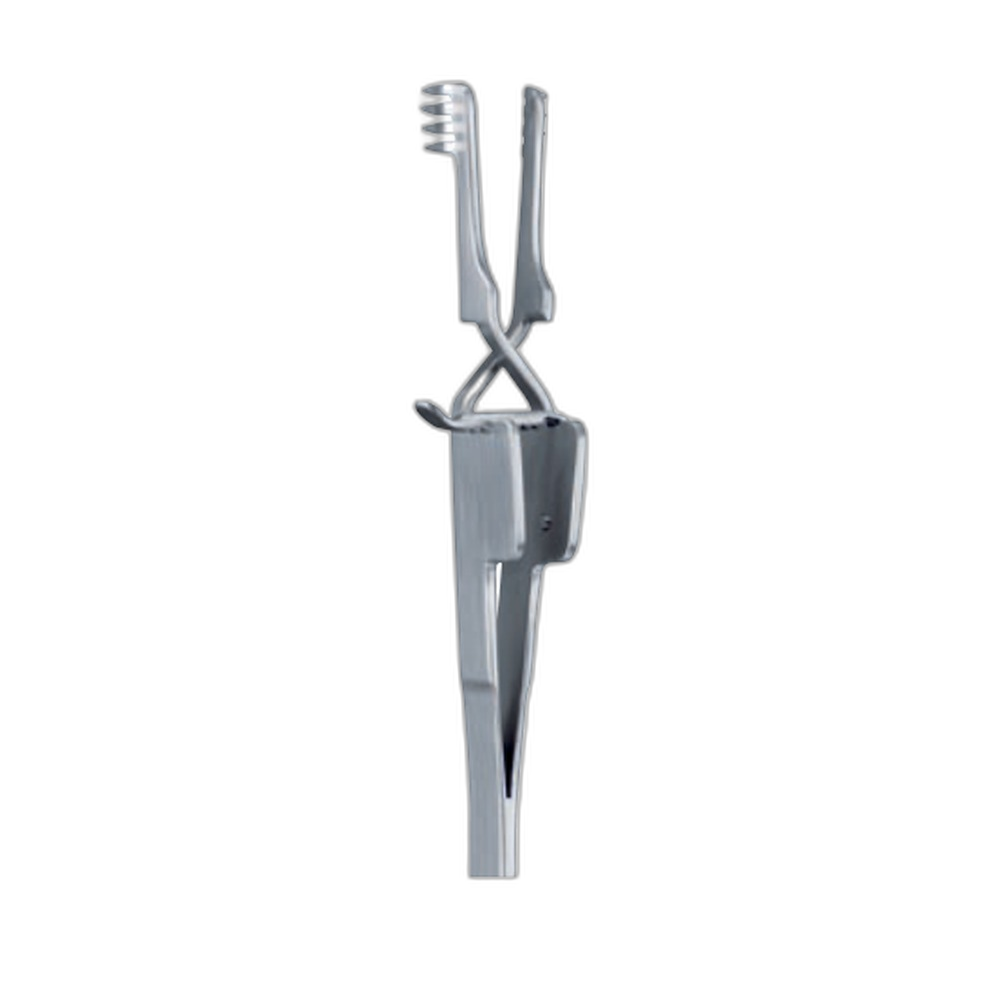

Where We Serve
Fizza Surgical exports to 50+ countries. Browse our country-specific pages with local regulatory guidance and pricing: