Biopsy Punches and Skin Punch Instruments: Sizes and Technique
Biopsy punch sizes from 2 mm to 8 mm, technique step by step, avoiding crush artefact, closure by size, and reusable punch edge life.
The instrument is a trephine — a hollow cylinder with a circular cutting edge, the same principle used to bore holes in bone since antiquity, scaled down to a few millimetres and fitted to a pencil handle. Its whole clinical value comes from one property: it removes a full-thickness core, epidermis through dermis into subcutaneous fat, in a single motion, without the operator having to judge depth by feel.
That is why a biopsy punch remains the standard diagnostic tool for inflammatory dermatoses, where the pathologist needs to see the interface between epidermis and dermis intact, and why a shave biopsy — however tempting for speed — answers a different question entirely.
Sizes and What Each Diameter Buys You
Punches are supplied from 1 mm to 8 mm. In practice four sizes cover almost all work.
| Diameter | Approx. tissue volume | Typical indication | Closure |
|---|---|---|---|
| 2 mm | Very small core | Face, eyelid margin, cosmetically critical sites; nail matrix | Second intention or 1 fine suture |
| 3 mm | Small core | General inflammatory lesions, facial sites | Second intention or 1 suture |
| 4 mm | Standard core | Most inflammatory dermatoses, the default choice | 1–2 sutures |
| 6 mm | Large core | Panniculitis, alopecia work-up, deep processes needing subcutis | 2–3 sutures |
| 8 mm | Very large core | Rare; excisional intent on small lesions | 2–3 sutures, consider ellipse instead |
The default is 4 mm and there is a reason it settled there. Below 3 mm the core is small enough that transverse sectioning in the laboratory becomes difficult and the epidermal architecture is often distorted by handling. Above 6 mm, closure under tension starts to produce a worse scar than a small elliptical excision would.
Two situations override the default. Suspected panniculitis needs 6 mm or more, because the diagnostic changes are in the subcutaneous fat and a 4 mm core frequently does not reach far enough or carry enough lobular tissue. Alopecia work-up conventionally uses 4 mm, sometimes two cores — one sectioned transversely for follicular counts, one vertically.
Disposable Versus Reusable
Disposable punches arrive sterile, individually packed, with a moulded plastic handle. The blade is ground once at the factory and is at its sharpest on first use. For a clinic doing occasional biopsies this is the correct choice — there is no reprocessing burden and no question about edge condition.
Reusable stainless punches — the Keyes pattern is the classic — have a knurled metal handle and a replaceable or resharpenable cutting cylinder. They make sense in high-volume dermatology and in veterinary practice, where per-case consumable cost matters and there is an established sterile services workflow.
The failure mode of a reusable punch is specific and worth naming: the cutting edge dulls at the rim, and a dull punch does not fail to cut — it tears. The operator applies more downward pressure, the epidermis is dragged inward at the margin, and the pathologist reports crush artefact at the edges of an otherwise adequate specimen. Test the edge on a piece of firm foam or a glove finger before use; a sharp punch enters with rotation alone.
Reusable punches are made from hardened martensitic stainless to ISO 7153-1, normally AISI 420 at 54–56 HRC. Below that the rim rolls within a handful of cases.
The Technique
- Select the site. For inflammatory disease, take an established lesion, not a scratched or excoriated one, and include the active edge. For a blistering disorder, sample perilesional skin — a biopsy through the roof of a blister gives the pathologist a detached epidermis and no interface.
- Anaesthetise. 1–2% lidocaine with adrenaline, 0.5 to 1 mL, infiltrated into the subcutaneous plane until a small wheal forms. Adrenaline is safe on digits in current practice and materially reduces bleeding from the punch base.
- Stretch the skin perpendicular to the relaxed skin tension lines. This is the step most often skipped and it costs nothing. Skin held under tension across the tension lines relaxes into an ellipse once the punch is withdrawn, and an ellipse closes with a single suture and a linear scar. A circular defect closes badly.
- Rotate in one direction with light, steady downward pressure. Rotation does the cutting; pressure only controls depth. A back-and-forth twisting motion shears the core against the cylinder wall.
- Advance until resistance drops. The change in feel as the rim passes the dermo-subcutaneous junction into fat is distinct, and it is the depth cue to work from rather than a millimetre marking on the barrel.
- Deliver the core. Lift it gently with a fine needle tip placed into the subcutaneous fat, or with fine-toothed forceps gripping fat only, and cut the base with fine curved scissors.
Crush Artefact Is the Commonest Avoidable Error
A specimen that cannot be read is a repeated procedure for the patient and a delayed diagnosis. Almost all of it comes from how the core is lifted out of the defect.
Never grip the specimen across its body with toothed forceps. Never squeeze it with a needle holder. Never lift it by the epidermal surface — that is precisely the layer the pathologist needs intact.
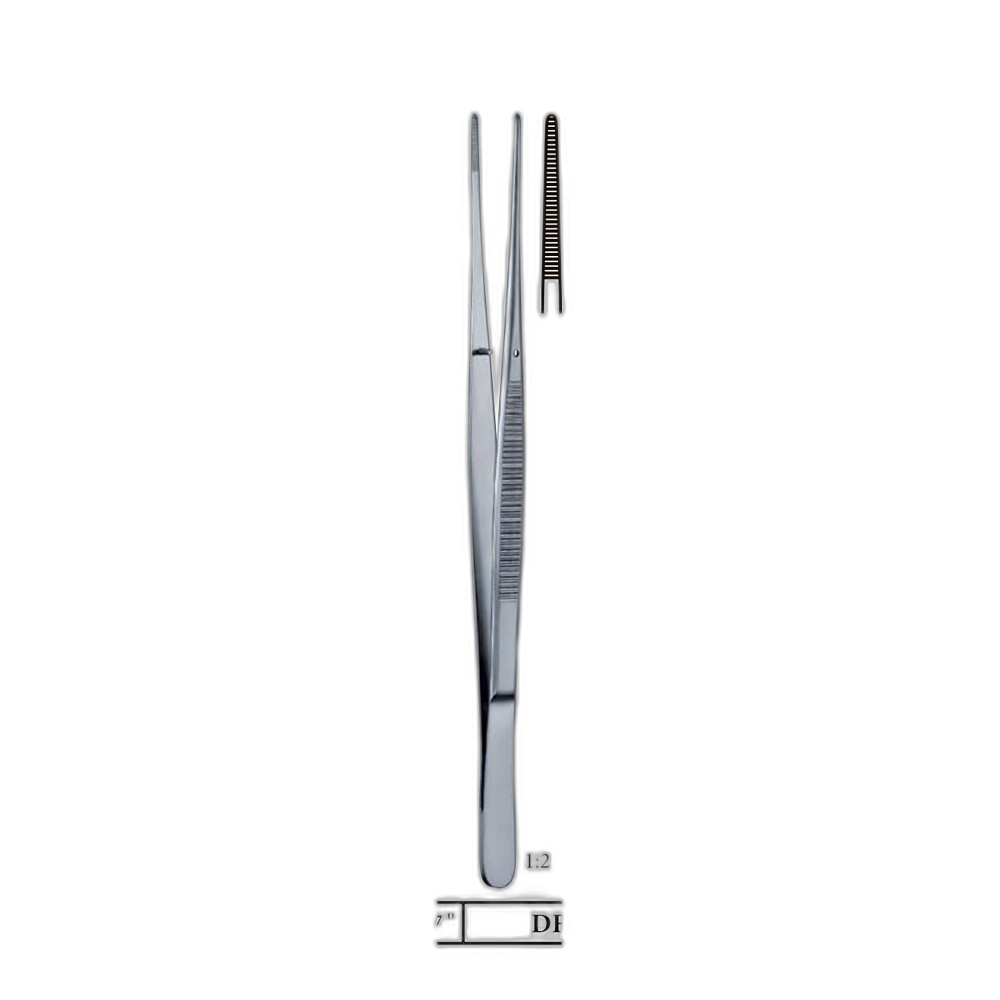
The safe manoeuvre is to engage a 21G needle tip laterally into the subcutaneous fat at the base and lever the core upward, or to grip the fat only with fine forceps such as an Adson pattern and divide the tether with fine scissors. Into formalin immediately — a core left drying on a gauze square for two minutes develops fixation artefact of its own.
Label site and clinical differential on the request form. A pathologist reading “rash” on a 4 mm core has been given half a specimen.
Closure and Haemostasis
A 2 mm or 3 mm defect on the trunk or limbs heals well by second intention with pressure and a dressing. On the face, close even small defects — the cosmetic difference is real.
4 mm defects take one or two interrupted sutures; 6 mm defects take two or three. Non-absorbable monofilament is standard, removed at 5 days on the face and 10 to 14 days on the trunk and limbs. Needle selection follows the usual dermatological logic — a small reverse-cutting needle, covered in our guide to suture needle types.
Bleeding from the punch base is usually controlled by the suture itself. Where it is not, aluminium chloride or light electrocautery works, but avoid cautery until the specimen is safely in the pot — thermal artefact travels further through a small core than most operators expect.
Sterilization and Edge Life
Reusable punches are hollow instruments with a lumen, and they are reprocessed accordingly. Enzymatic pre-soak while the tissue debris is still wet, then lumen brushing with a correctly sized channel brush — a punch cleaned only by ultrasonic immersion retains a plug of tissue in the barrel more often than staff expect.
Rinse with deionised water, dry, and autoclave at 134 °C for the standard holding time. Packaging must allow steam into the lumen; a punch sealed in a pouch tip-down with a trapped air column does not reliably sterilise inside the barrel.
Track edge life. Most units find a reusable punch needs regrinding or retirement after 15 to 25 uses depending on site and technique. That is a shorter service life than staff assume, and it is the reason a lot of clinics quietly switched to disposables for anything going to a dermatopathologist.
Fizza Surgical manufactures reusable punch instruments and the fine dissecting sets that accompany them in Sialkot under ISO 13485 with CE marking. The wider range is listed under surgical instruments.
Frequently Asked Questions
What size biopsy punch should I use by default?
4 mm. It gives enough dermis and superficial subcutis for most inflammatory diagnoses while still closing with one or two sutures. Step up to 6 mm for suspected panniculitis or any process centred in the fat, and down to 2–3 mm on the face where cosmesis dominates.
Why stretch the skin before punching?
Stretching perpendicular to the relaxed skin tension lines turns the circular defect into an ellipse once tension is released. An ellipse closes with a single suture along the natural tension line and leaves a linear scar; a true circle closes under uneven tension and scars more visibly.
How deep should the punch go?
Into subcutaneous fat. There is a distinct drop in resistance as the rim leaves the dermis, and that tactile cue is more reliable than a depth marking. A specimen that stops at mid-dermis will miss deep perivascular and panniculitic processes entirely.
Are reusable punches worth it compared with disposables?
Only at volume and only with disciplined reprocessing. Disposables are sharp on first use every time. A reusable punch needs lumen brushing, edge testing before each case, and regrinding or retirement after roughly 15 to 25 uses — beyond that it tears rather than cuts, and crush artefact starts appearing in reports.
Does a punch biopsy need sutures?
2 mm and 3 mm defects on the trunk and limbs can heal by second intention. Anything 4 mm or larger, and anything on the face, should be closed — one to two sutures at 4 mm, two to three at 6 mm.
Need precision surgical instruments?
Configure complete instrument sets with our team — ISO 13485 certified, CE marked, made in Sialkot since 1980.
Related Guides
View all articles →
Where We Serve
Fizza Surgical exports to 50+ countries. Browse our country-specific pages with local regulatory guidance and pricing: