Mayo Stand and Instrument Trolley: OR Selection Guide
Mayo stand tray sizes, height ranges, 304 steel grades and base stability, plus how an OR instrument stand differs from a dressing trolley.
Why does the scrub nurse in almost every operating theatre in the world work from a tray suspended over the patient’s legs on a single cantilevered post?
Because Charles Mayo’s design solved a problem nothing else solves: it puts the instruments in immediate reach of the sterile field without occupying floor space beside the table, and it can be rolled in and out without breaking the sterile boundary. Every alternative — a fixed side table, a back table, a shelf — either sits too far away or gets in the surgeon’s way.
The instrument stand and the dressing trolley are unglamorous items on a theatre equipment list, and they are routinely specified badly. The result is a stand that wobbles under a loaded tray, a trolley whose castors seize after six months, or a tray size that does not match the drapes the hospital already stocks. This guide covers what actually matters when specifying them.
Anatomy of a Mayo Stand
Four components, and each one is a place where a cheap unit is cheapened:
- The tray. Removable, rectangular, with a rolled or flanged edge. This is the working surface and it is the part that gets dropped, autoclaved, and replaced.
- The post and telescoping column. Carries the tray on a cantilever, adjusts for height, and locks. The lock is the failure point.
- The base. Low-profile so it slides under the operating table, weighted enough to counterbalance a loaded tray on the end of a cantilever.
- The castors. Usually 50 mm (2 inch) swivel, ball-bearing, at least two of them with brakes on better units.
Tray Sizes
Two sizes dominate, and mixing them across a theatre suite is a real nuisance because the sterile covers are sized to the tray.
| Designation | Tray size (inches) | Tray size (mm) | Typical use |
|---|---|---|---|
| Standard | 12⅝ × 19⅛ | 320 × 485 | General surgery, day-case, most procedures |
| Large | 16 × 21 | 406 × 533 | Orthopaedics, cardiac, long instrument sets |
| Jumbo / oversized | 19 × 25 | 483 × 635 | Total joints, spinal instrumentation trays |
Specify one size per theatre suite wherever possible. If orthopaedics genuinely needs the large tray, buy large for that theatre and standard for the rest — but write the sterile cover order against the tray dimensions, not against a generic “Mayo stand cover” line, or the covers will arrive undersized.
Height Range
Typical adjustment ranges are 39 to 62 inches (990–1575 mm), or 38¼ to 63⅞ inches on taller models. The bottom of that range matters more than the top. A stand that will not drop below about 1000 mm is awkward for a paediatric table or for a seated procedure, and no amount of upper travel compensates.
Two locking mechanisms are in common use:
- Thumb-screw / knob lock. Simple, cheap, reliable, and requires a hand — which means it cannot be adjusted mid-procedure by a scrubbed team member.
- Foot-operated lock. Adjustable without hands, which is the whole point in a sterile field. More mechanism, more to go wrong, meaningfully more expensive.
For a general theatre, thumb-lock units are perfectly adequate and easier to maintain. For theatres running long procedures where table height changes during the case, foot-operated pays for itself.
Steel Grade and Construction
This is where specifications quietly diverge from what gets delivered. Three constructions are sold as “stainless”:
| Construction | What it is | Service life in a wet theatre |
|---|---|---|
| Full AISI 304 stainless | Tray, column and base all austenitic stainless | Longest; tolerates repeated disinfectant exposure |
| Stainless tray, chrome-plated steel column | Mild steel tube with chrome plating | Plating lifts at the base and around the lock; rust follows |
| Stainless tray, epoxy-coated base | Painted mild steel base | Chips at castor mounts; corrodes from the chip outward |
Austenitic 304 is the right specification for OR furniture. It is not the same material as instruments — those are martensitic grades chosen for hardness, as covered in our guide to stainless steel grades in surgery. Furniture needs corrosion resistance and formability, not edge retention, and 304 delivers both. Where the environment is unusually aggressive — heavy chlorine-based disinfectant protocols, coastal humidity — 316 is worth the premium, for the same reasons set out in our discussion of 316L in hospital holloware.
A practical field test on delivery: run a magnet over the column and base. Austenitic 304 is essentially non-magnetic in the annealed condition; a strongly magnetic column under a stainless-looking finish is plated or coated mild steel, whatever the quotation said.
Base Geometry and Stability
A Mayo stand is a cantilever. The tray hangs out to one side of the column, and when it is loaded with a full instrument set — 6 to 10 kg is normal, more for orthopaedic trays — the whole assembly wants to tip in that direction.
Two design responses:
- Wide low-profile base, typically 24 inches (610 mm) across, with the castors set at the extremes. Cheap to make, stable, but the base spreads further under the table and gets kicked.
- Weighted compact base, smaller footprint with cast-in ballast. Less obstructive, more expensive, and the one to choose in crowded theatres.
Whichever you choose, the acceptance test is the same: load the tray to its rated capacity, extend the column to full height, and push the tray edge laterally. It should flex slightly and return. It should not lift a castor off the floor.
The Dressing and Instrument Trolley
A Mayo stand is not a trolley, and the two are not substitutes. The trolley — two or three shelves, four castors, guard rails — is the transport and staging item. It carries the set from CSSD, holds the back-table overflow, and moves dressings and consumables around the ward.
| Mayo stand | Instrument / dressing trolley | |
|---|---|---|
| Purpose | Immediate sterile working surface over the patient | Transport, staging, storage |
| Surfaces | One removable tray | Two or three fixed shelves |
| Height | Adjustable, cantilevered | Fixed, typically 800–900 mm |
| Base | Low-profile, slides under the table | Four-castor rectangular frame |
| Guard rails | No — rolled tray edge only | Usually on upper shelf |
Specification points that get missed on trolleys: whether the shelves are welded or bolted (welded and fully seam-finished is cleanable, bolted collects soil at every fastener), whether the castors are 75 mm or 100 mm (100 mm rolls over theatre door thresholds and cable covers, 75 mm catches), and whether at least two castors have brakes. A trolley without brakes on a sloped corridor is a genuine hazard.
Cleaning and Service Life
Neither item is autoclaved as a whole — the tray usually is, the stand is not. Both are wiped down between cases with whatever disinfectant the hospital protocol specifies, and that repeated chemical exposure is what determines service life.
Chlorine-releasing agents are the main enemy of stainless furniture. Hypochlorite left to dry on a 304 surface will pit it, and the pits then trap more solution. The mitigation is simple and routinely ignored: wipe with disinfectant, then wipe with water, then dry. Two extra passes, and it roughly doubles how long the finish lasts.
Check the castors quarterly. Suture ends, drape fibres and hair wind into the swivel bearing and are the single most common reason a stand or trolley gets condemned long before its frame has failed. Most castors are a standard stem fitting and cost very little to replace.
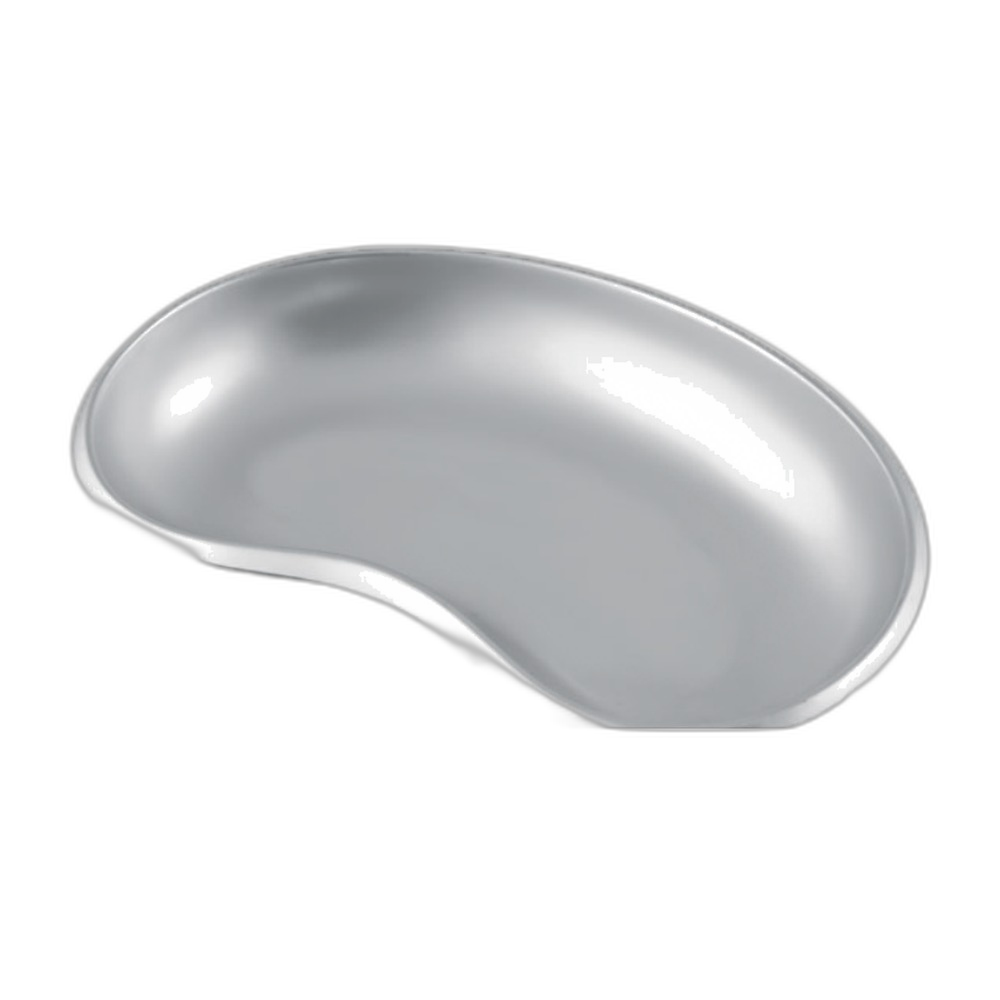
For stainless bowls, basins, kidney dishes, trays and the rest of the ward and theatre holloware range, see our hospital holloware catalogue, or contact us to discuss OR equipment requirements.
Frequently Asked Questions
What is the standard Mayo stand tray size?
The most common tray is 12⅝ × 19⅛ inches (320 × 485 mm). A large option at 16 × 21 inches (406 × 533 mm) is used for orthopaedic and cardiac sets, with jumbo trays at 19 × 25 inches for total joint instrumentation.
What steel grade should an OR instrument stand be made from?
AISI 304 austenitic stainless throughout — tray, column and base. Chrome-plated or epoxy-coated mild steel components corrode from the first chip or plating lift, usually at the castor mounts or around the height lock.
How can I tell if a stand is really stainless steel?
Run a magnet over the column and base. Annealed AISI 304 is essentially non-magnetic. A strongly magnetic column beneath a bright finish indicates plated or coated mild steel.
What is the difference between a Mayo stand and a dressing trolley?
A Mayo stand is a height-adjustable single removable tray on a cantilevered column, positioned over the patient as the scrub nurse’s immediate working surface. A trolley has two or three fixed shelves on a four-castor frame and is used for transport and staging, not as a sterile field.
Why do castors fail before the rest of the stand?
Suture ends, drape fibres and hair wind into the swivel bearing. Quarterly cleaning prevents it, and castors are a low-cost standard-stem replacement item — there is rarely any reason to condemn an otherwise sound frame.
Need precision surgical instruments?
Configure complete instrument sets with our team — ISO 13485 certified, CE marked, made in Sialkot since 1980.
Related Guides
View all articles →
Where We Serve
Fizza Surgical exports to 50+ countries. Browse our country-specific pages with local regulatory guidance and pricing: