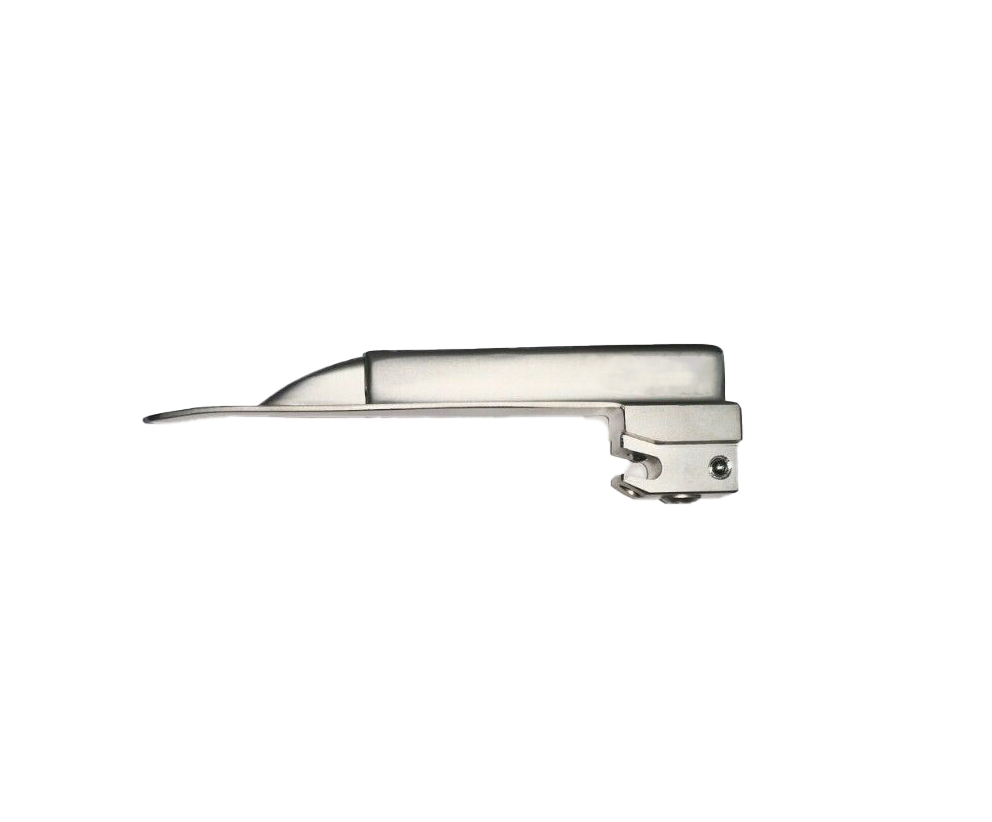
Pediatric airway management demands equipment specifically designed for pediatric anatomy. The standard adult laryngoscope blade sizes will not safely intubate a neonate — and using adult-sized equipment on a pediatric patient risks dental, soft tissue, and airway trauma. This guide covers how to select and stock pediatric laryngoscope blades for neonatal intensive care, pediatric anesthesia, and emergency departments that see pediatric patients.
Why pediatric airway anatomy requires different equipment
Infants and young children differ from adults in ways directly relevant to laryngoscopy:
- Relatively larger head and occiput — flexion of the neck in the “sniffing position” (standard for adults) actually closes the pediatric airway. Pediatric intubations are done with neutral or slightly extended neck position.
- Relatively large tongue — fills the oral cavity and obscures the airway view.
- High anterior larynx — the larynx sits at C3-C4 in infants (vs C5-C6 in adults), making it harder to visualize with the curved Macintosh technique.
- Floppy, U-shaped epiglottis — doesn’t lift indirectly from the vallecula the way the adult epiglottis does. A straight Miller blade that directly lifts the epiglottis works better.
- Narrowest airway point is the cricoid cartilage (not the vocal cords as in adults) — affects endotracheal tube sizing but not blade choice.
These anatomical realities are why pediatric intubation typically uses Miller (straight) blades rather than Macintosh (curved), and why blade sizes are much smaller.
Pediatric blade sizing by age
The standard sizing guidance for direct laryngoscopy in pediatric patients:
| Age | Primary blade | Size | Blade length |
|---|---|---|---|
| Premature neonate | Miller | Miller 00 | ~65mm |
| Term neonate (0–1 month) | Miller | Miller 0 | ~80mm |
| Infant (1–12 months) | Miller | Miller 1 | ~100mm |
| Toddler (1–3 years) | Miller or Macintosh | Miller 1 or Mac 2 | 100–108mm |
| Child (3–8 years) | Macintosh | Mac 2 | ~108mm |
| Older child (8–12 years) | Macintosh | Mac 3 | ~130mm |
| Adolescent (12+) | Macintosh (adult sizing) | Mac 3 or 4 | 130–155mm |
Practical rule of thumb: Miller blades for under 2 years old; transition to Macintosh around 2–3 years old depending on child size.
Why Miller blades dominate pediatric intubation
The Miller straight blade is preferred for neonates, infants, and toddlers for specific anatomical reasons:
Direct epiglottis lifting
The infant epiglottis is long, floppy, U-shaped, and anteriorly-angled. It does not lift indirectly when a curved Macintosh blade pulls on the hyo-epiglottic ligament from the vallecula. The Miller blade tip is placed directly under the epiglottis, mechanically lifting it out of the line of sight.
Less force on the tongue
The Miller blade’s slim profile requires less tongue displacement. In infants with relatively large tongues, this matters.
Better view in small mouths
The Macintosh’s broad flange is designed to sweep the tongue leftward in adult oral cavities. In an infant mouth, the Mac flange can block the view of the glottis. Miller’s slim straight design clears the view.
Specialty pediatric blade patterns
Beyond standard Miller and Macintosh in pediatric sizes, specialty patterns exist:
Phillips blade
A curved blade with a flatter profile than Macintosh — sometimes described as “between Mac and Miller.” Popular in pediatric anesthesia because it combines the easier technique of a curved blade with better access in small airways. Available in pediatric sizes.
Robertshaw blade
A curved pediatric blade with lateral flanges designed to maintain airway visualization. Less common today but still stocked in some pediatric centers.
Wisconsin blade
A straight blade with more pronounced curvature at the tip than Miller. Used in some specialty pediatric practices.
Oxford blade
Designed specifically for neonatal intubation with an anti-gag configuration. Niche use in specialized NICUs.
“Without screws” Macintosh
A variant Macintosh design for pediatric use that eliminates the two small screws at the base of standard Macintosh blades. Preferred in pediatric anesthesia to eliminate any risk of screw loosening during the procedure.
Building a pediatric laryngoscope inventory
Recommended stock for a mixed pediatric + adult anesthesia department:
| Blade | Typical stock | Use case |
|---|---|---|
| Miller 0 | 4-6 units | Neonatal — primary and backup |
| Miller 00 | 2-4 units | Premature neonates |
| Miller 1 | 4-6 units | Infants up to 12 months |
| Miller 2 | 3-4 units | Toddlers, difficult pediatric airways |
| Mac 0 | 2-3 units | Neonatal backup (some clinicians prefer Mac) |
| Mac 1 | 2-3 units | Infant backup |
| Mac 2 | 3-4 units | Children 3-10 years |
| Phillips 1 | 2 units | Optional pediatric alternative |
Every pediatric blade should be fiber optic. The illumination advantage matters more in small, deep airways where light shadows are amplified.
Handle considerations for pediatric use
Full-size adult handles work with pediatric blades, but some clinicians prefer shorter “stubby” handles for pediatric work. These provide better control in small patients without the leverage issue of a long handle. Any ISO 7376 Green Spec handle (short or long) will work with any Green Spec pediatric blade.
For neonatal use, LED handles are strongly preferred over halogen — the cooler light avoids any risk of thermal injury in the small airway.
Fizza Surgical’s pediatric laryngoscope range
Our complete pediatric blade range includes:
- Miller 00, 0, 1, 2 — fiber optic and conventional
- Macintosh 0, 1, 2 — including the “without screws” pediatric variant
- Phillips 1 and smaller — fiber optic configuration
- Robertshaw pediatric — by special order
- Complete neonatal laryngoscope set with handle + blades
All pediatric blades are manufactured to the same ISO 13485 and ISO 7376 standards as our adult range. Browse our pediatric laryngoscope range or request a factory quote for hospital or distributor orders.
Related reading
- Macintosh vs Miller Laryngoscope Blade: Which to Buy in 2026
- Complete Guide to Fiber Optic Laryngoscope Blades
Where We Serve
Fizza Surgical exports to 50+ countries. Browse our country-specific pages with local regulatory guidance and pricing: