American Pattern Extraction Forceps: Numbering Explained
American pattern extraction forceps numbering decoded: what 150, 151, 23, 53L and 88R mean, with full maxillary and mandibular charts.
Ask three dentists what a #23 is and you will get the same answer in a second. Ask them what a #88R does that a #53R does not, and the room goes quiet. The numbering system on American pattern extraction forceps is one of those conventions that everyone half-knows and almost nobody was formally taught — it is absorbed from whatever tray happened to be set up during training.
The numbers are not arbitrary, and they are not a size scale. They are catalogue designations that hardened into a de facto standard across the twentieth century, and once you can read them you can specify a full extraction set from a purchase order without handling a single instrument.
What Makes a Forceps “American Pattern”
Two design families dominate exodontia worldwide, and the distinction is structural rather than regional.
American pattern instruments use a horizontal hinge — the joint axis runs across the instrument, so the handles sit roughly in the same plane as the beaks and the operator’s palm applies force along the long axis of the tooth. The joint is a box joint, machined and polished so no pin or screw is visible from the outside. Handles are serrated and typically curve away from each other to seat in the palm.
English pattern instruments use a vertical hinge, placing the beaks at right angles to the handle plane and encouraging a different grip and wrist position. Neither is superior; surgeons trained on one rarely switch comfortably. Our companion guide to English pattern extraction forceps covers that family in detail.
The numbering convention discussed here belongs to the American family. English pattern forceps are catalogued by descriptive name and root count instead — “upper molar right”, “lower root” — which is why the two systems never merged.
Reading the Number
Three conventions carry almost all the information:
- The base number identifies the beak geometry and the arch it serves. It has no dimensional meaning — #150 is not bigger than #23.
- An S suffix denotes a paediatric or child-size version of the same pattern, built on a shorter, lighter frame. #150S and #151S are the two most commonly stocked.
- An L or R suffix indicates left or right, referenced to the patient’s side, not the operator’s. An #88R is used on the patient’s upper right molars.
That last point causes more mis-ordering than anything else in dental instrument procurement. When a purchasing officer asks for “the right one”, confirm they mean the patient’s right.
Maxillary Forceps: The Upper Arch Chart
Upper teeth present the geometric problem that drives most of this catalogue. Maxillary molars have three roots — two buccal and one palatal — so a molar forceps cannot be symmetrical. One beak carries a pointed projection that seats into the buccal bifurcation; the other is rounded or concave to embrace the broad palatal root. That asymmetry is precisely why upper molar forceps come as handed pairs and lower molar forceps often do not.
| Number | Common name | Indicated for | Beak characteristic |
|---|---|---|---|
| #150 | Upper universal | Maxillary incisors, canines, premolars, retained roots | Symmetrical, slightly curved beaks meeting at the tips |
| #150S | Upper universal, child | Primary maxillary anteriors and molars | Same geometry, reduced frame and beak width |
| #1 | Upper anterior | Maxillary incisors and canines | Straight handle, broad parallel beaks |
| #53L / #53R | Upper molar, handed pair | Maxillary first and second molars | Pointed buccal beak for the bifurcation, rounded palatal beak |
| #88L / #88R | Upper molar, split-root pattern | Badly broken-down maxillary molars | Long, sharply pointed beaks that engage deep into the furcation |
| #65 | Upper root tip | Retained roots and fragments | Narrow bayonet, fine tapered tips |
| #69 | Root fragment, both arches | Small root tips and fragments | Fine serrated tips, slender beaks |
| #210S | Upper third molar | Maxillary third molars, either quadrant | Universal bayonet — works in both upper quadrants |
The #53 and #88 pairs are worth separating clearly, because this is the question that stalls most conversations. Both are handed upper molar forceps. The #53 is the routine instrument: pointed buccal beak, rounded palatal beak, used on an intact crown where you intend to deliver the tooth whole. The #88 has substantially longer and sharper beaks designed to be driven deep into the trifurcation on a molar that is already broken down, effectively splitting the roots so each can be elevated separately. Reaching for an #88 on a sound tooth is over-instrumentation; reaching for a #53 on a crownless molar wastes time.
Mandibular Forceps: The Lower Arch Chart
Lower molars carry two roots — mesial and distal — set in a broadly symmetrical arrangement, so a single pattern serves both sides. This is why the lower chart is shorter than the upper.
| Number | Common name | Indicated for | Beak characteristic |
|---|---|---|---|
| #151 | Lower universal | Mandibular incisors, canines, premolars, retained roots | Beaks angled down from the handle, meeting at the tips |
| #151S | Lower universal, child | Primary mandibular teeth | Same pattern, reduced frame |
| #17 | Lower molar | Mandibular first and second molars | Straight, broad beaks with paired pointed bifurcation projections |
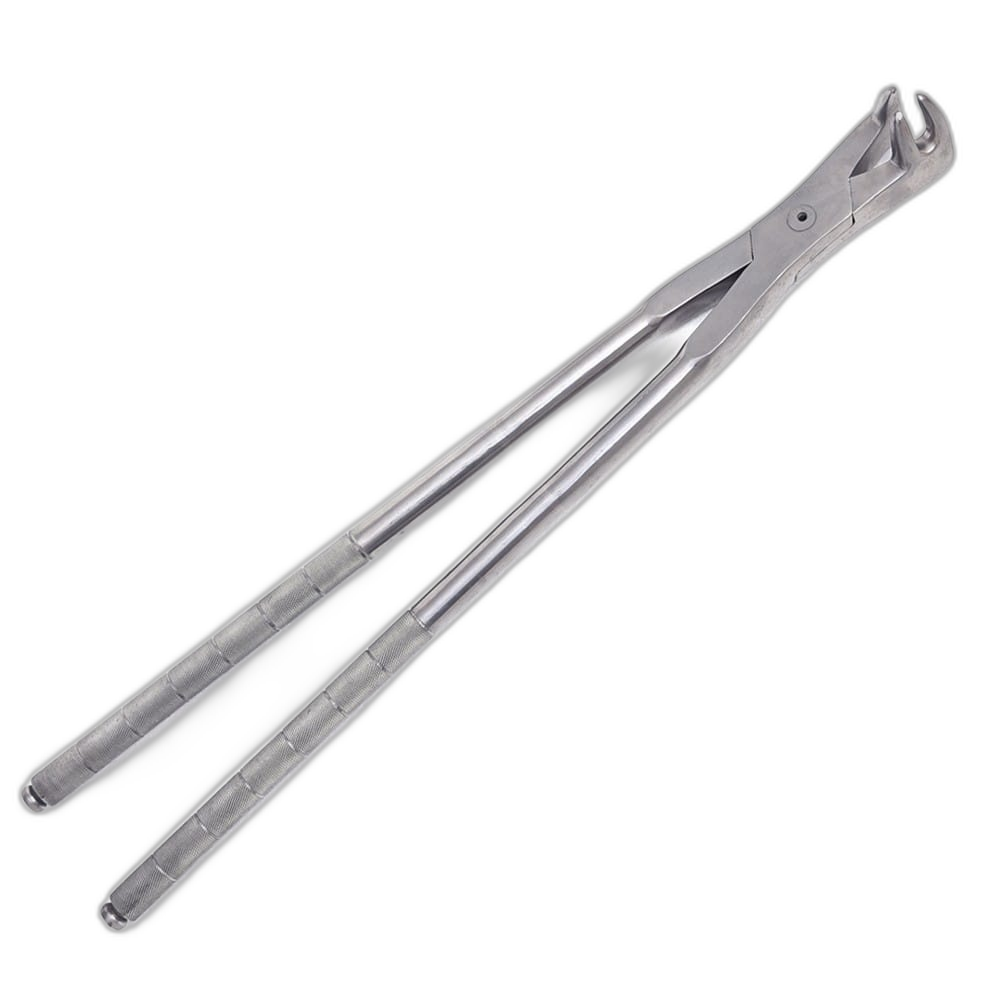
| #23 | Cowhorn | Mandibular first and second molars | Two sharply curved pointed beaks that squeeze into the bifurcation |
| #222 | Lower third molar | Mandibular third molars | Short, sharply angled beaks for restricted posterior access |
The #151 deserves an explicit warning, because it is the single most misapplied instrument in the set. It is a universal forceps for lower anteriors, canines and premolars. It is not a molar forceps. The beaks lack bifurcation projections, so on a lower molar they grip enamel rather than seating on root structure, and the predictable result is a crown fracture with roots left in situ.
The #23 cowhorn works on a genuinely different mechanical principle from everything else in the tray. Rather than gripping and luxating, the two pointed beaks are squeezed into the bifurcation of a lower molar; the beaks act against the interradicular bone and the crest, and the closing force alone begins to elevate the tooth from its socket. It is fast and effective on molars with divergent roots — and it is unforgiving on a tooth with fused or convergent roots, where the same force concentrates on the buccal plate.
Paediatric Patterns and Why the S Frame Exists
The #150S and #151S are not simply scaled-down adult instruments, and treating them as such is a procurement mistake worth avoiding.
Primary teeth sit in a mouth with a smaller inter-arch opening and are surrounded by the developing crowns of their successors. Two design consequences follow. The beaks are narrower and shallower so they engage a deciduous root without impinging on the permanent tooth germ below it, and the overall frame is shorter and lighter so the operator can work in a restricted opening without the handles levering against the opposing arch.
There is a clinical hazard specific to this group. Deciduous molar roots splay widely to accommodate the permanent premolar developing between them, so an over-aggressive grip can lift the successor with the extracted tooth. This is one reason paediatric extractions favour controlled luxation over brute delivery, and why the S-pattern beaks are deliberately less aggressive than their adult counterparts.
Practices that see occasional paediatric cases often try to manage with adult universals. It works on anterior deciduous teeth and fails predictably on primary molars, where the adult beak is too broad to seat below the cervical line on a small crown.
Beak Anatomy: Where Extraction Forceps Succeed or Fail
Whatever the number, three geometric relationships determine whether a forceps performs.
Beak-to-root adaptation
The inner surface of the beak should follow the contour of the root, not the crown. Correctly seated, the instrument sits apical to the cemento-enamel junction with the beaks in contact with root surface along their length. A beak profile that only touches at two points concentrates load and fractures the tooth.
Tip approximation
Close an unused forceps slowly under a light. On universal patterns such as the #150 and #151 the tips should meet cleanly with no lateral step. On molar patterns the pointed projections should align with each other — if one sits proud of the other, the instrument will rotate the tooth rather than deliver it along its long axis. Misalignment here is the commonest defect in economy-grade forceps and is caused by beaks being ground after, rather than before, final heat treatment.
Joint tightness
A box joint should have no perceptible lateral play. Hold the handles and try to rock the beaks side to side: any movement you can feel becomes several millimetres of wander at the tips under extraction load. Play in a new instrument means the joint was assembled loose and it will only worsen.
Material and Manufacture
Extraction forceps take higher peak loads than almost anything else in a dental tray, so material selection is not cosmetic. Beaks and joints are forged from martensitic stainless steel — AISI 420 is the workhorse grade — and hardened to the range that keeps the serrations and points from rolling over while retaining enough toughness that the beaks do not chip. ISO 7153-1 defines the acceptable metallurgy for surgical instrument steels, and ISO 13485 governs the quality system behind the manufacture.
The production route matters as much as the alloy. A properly made forceps is drop-forged to shape, machined, heat treated, then finish-ground and polished, with the box joint fitted and burnished last. Instruments that are machined from bar stock without forging lack the grain flow around the joint and are noticeably more prone to handle splay after a few hundred extractions.
Surface finish is the visible proxy for all of this. A mirror polish resists corrosion because the passive chromium oxide layer forms uniformly on a smooth surface; a satin finish reduces glare under operating lights and is preferred by some clinicians. Both are acceptable — a rough or pitted finish on a new instrument is not, because those pits become corrosion initiation sites after the first few autoclave cycles.
Building a Set: What to Buy First
A general practice doing routine exodontia can cover the great majority of cases with six American pattern extraction forceps:
- #150 — upper universal
- #151 — lower universal
- #53L and #53R — upper molars
- #23 — lower molar cowhorn
- #69 — root fragments in either arch
Add #150S and #151S if you treat children, #210S and #222 if third molars are part of your caseload, and the #88 pair only if you routinely receive broken-down molars. Forceps are complemented by elevators — our guides to luxators versus elevators and to the Howarth periosteal elevator cover the instruments that do the work before the forceps ever engage.
For hospital and distributor buyers specifying at volume, the practical checklist on a sample instrument is short: confirm beak alignment under magnification, test joint play by hand, verify the hardness certificate accompanies the batch, and check that the number is laser-marked rather than acid-etched — etched markings fade within a few hundred reprocessing cycles and an unreadable set slows every tray assembly afterwards.
Fizza Surgical has manufactured extraction forceps in Sialkot for over four decades. The full range across both numbering conventions sits under dental instruments, and batch documentation is covered on our certifications page.
Sterilisation and Service Life
The joint is the failure point. After each use, open the instrument fully, brush the box joint under running water with a soft nylon brush, and process in enzymatic solution before ultrasonic cleaning. Lubricate the joint with a water-soluble instrument milk before autoclaving — not with oil, which blocks steam penetration.
Dry the instrument completely before the sterile barrier goes on. Moisture trapped in a box joint through a steam cycle is the origin of most of the brown staining that turns up on dental forceps, and left unaddressed it progresses to genuine pitting corrosion.
Expect to retire a forceps when beak serrations flatten, when tip approximation opens visibly, or when joint play becomes perceptible. Sharpening the points of a cowhorn or an #88 is a specialist service, not a chairside task — reground beaks that lose their hardened case wear out faster than the original ever did.
Frequently Asked Questions
What does the number on American pattern extraction forceps mean?
It is a catalogue designation for a specific beak geometry and target tooth group, not a size measurement. #150 is the upper universal, #151 the lower universal, #23 the lower molar cowhorn. An S suffix means the paediatric version of the same pattern; L and R suffixes mean left and right relative to the patient.
What is the difference between #150 and #151 forceps?
The #150 is the maxillary universal and the #151 the mandibular universal. Both serve incisors, canines, premolars and retained roots in their respective arches. The #151’s beaks angle downward from the handle to approach lower teeth; the #150’s are more nearly in line. Neither is a molar forceps.
Can I use #151 forceps on lower molars?
No. The #151 has no bifurcation projections, so on a lower molar the beaks grip crown enamel rather than seating on root structure. The usual outcome is a fractured crown with retained roots. Use a #17 or a #23 cowhorn for mandibular molars.
When should a #88 be used instead of a #53?
The #53 pair is the routine upper molar forceps for teeth with an intact crown you intend to deliver whole. The #88 pair has much longer, sharper beaks intended to be driven into the trifurcation of a badly broken-down maxillary molar so the roots can be split and elevated separately.
Do L and R refer to the patient’s side or the operator’s?
The patient’s. An #88R or #53R is used on the patient’s upper right quadrant. This is the most frequent source of ordering errors, so confirm the reference point explicitly on any purchase order.
What steel are extraction forceps made from?
Martensitic stainless steel, most commonly AISI 420, forged and heat treated so the beaks and serrations resist deformation under load while retaining enough toughness to avoid chipping. ISO 7153-1 sets out the acceptable metallurgy for surgical instrument steels.
Need precision surgical instruments?
Configure complete instrument sets with our team — ISO 13485 certified, CE marked, made in Sialkot since 1980.
Related Guides
View all articles →

Where We Serve
Fizza Surgical exports to 50+ countries. Browse our country-specific pages with local regulatory guidance and pricing: