Malleable Ribbon Retractors: Widths, Depths and Selection Guide
Malleable ribbon retractor selection: widths from 6 to 100mm, why the steel is annealed, bending technique, and when work hardening means retirement.
Almost every instrument on a laparotomy tray arrives at the operating table in its final shape. The surgeon selects the pattern that best matches the anatomy and accepts the compromise.
One instrument works the other way round. The scrub nurse hands it over flat, the surgeon bends it across a gloved palm into the curve the patient’s abdomen actually has, and it holds that shape until someone changes it.
That is the entire proposition of the ribbon retractor, and it explains why a strip of soft steel with no handle mechanism, no ratchet and no moving parts remains in more general surgery sets than most of the engineered alternatives.
The one instrument you shape to the patient
A malleable ribbon retractor is a flat band of annealed stainless steel, rounded at both ends, with no hinge and usually no distinct handle. Some patterns add a flattened grip section; many are simply a uniform strip.
Its job is to hold soft tissue and viscera away from the operative field along a broad, atraumatic surface. Because pressure is force divided by area, a 50 mm blade lying across a bowel mass exerts a fraction of the local pressure that a Deaver blade of the same retraction force applies through its narrower edge.
Three properties make it genuinely different from every other retractor in the set:
- It conforms. The blade can be shaped to a costal margin, a pelvic brim, or the slope of a retroperitoneal dissection.
- It is reshapeable mid-case. As the exposure changes, the blade changes with it — no swapping instruments, no second scrub.
- It has no fixed depth. Bend the working end at 40 mm and it is a shallow retractor; bend it at 90 mm and it is a deep one.
The cost of all that is the obvious one. It is entirely hand-held, so it consumes an assistant for as long as it is in the wound.
Widths, lengths and what the numbers mean
Two dimensions define the instrument, and only one of them matters much.
| Dimension | Common range | Practical note |
|---|---|---|
| Blade width | 6 mm to 100 mm (¼” to 4″) | The primary selection variable — determines pressure distribution |
| Common widths stocked | 13, 19, 25, 32, 38, 50 mm | Roughly ½”, ¾”, 1″, 1¼”, 1½”, 2″ |
| Overall length | 150 mm to 445 mm (6″ to 17½”) | Most general sets sit in the 200–330 mm band |
| Thickness | Approximately 0.8–1.5 mm | Thinner bends more easily and fatigues sooner |
| Edge finish | Rolled or radiused, never sharp | A raised burr on a used blade is a serosal tear waiting to happen |
| Material | Annealed austenitic stainless, 300 series | Deliberately soft — see below |
| Ends | Rounded both ends, often asymmetric widths | Double-ended patterns give two widths in one instrument |
Width is what you specify. Length mostly determines how much strip is left to grip once the working end is bent, and beyond a certain point extra length is just leverage the assistant has to control.
Double-ended versions — say 25 mm at one end and 38 mm at the other — are efficient for tray count but awkward in use, because the unused end sits in the assistant’s hand exactly where a grip should be.
Why the steel is deliberately soft
This is the part that surprises people who assume all surgical steel is the same steel.
Cutting and gripping instruments are made from martensitic grades such as AISI 410 and 420 and then hardened, because an edge that deforms is useless. Those grades reach high hardness and, critically, they are chosen so they do not take a permanent bend under hand force.
A malleable retractor needs the opposite behaviour. It is made from austenitic stainless — 304 or 316 family — supplied in the annealed condition. Annealed austenitic steel has low yield strength and high ductility, which in plain terms means it deforms plastically at a force a surgeon can apply with two hands, then stays where it was put. Both material families fall under the metallic materials requirements of ISO 7153-1; they simply sit at opposite ends of it.
316 grades bring better corrosion resistance, which matters here because the working surface takes repeated plastic deformation and every bend cycle is an opportunity for a passive layer to crack.
Two consequences follow directly from the metallurgy, and both are practical.
The first is work hardening. Austenitic stainless gets harder and less ductile every time it is deformed. A new blade bends easily. The same blade after three years of daily reshaping resists, then resists more, and eventually cracks rather than bends. This is normal material behaviour, not a manufacturing defect — and it is why malleable retractors are a consumable on a longer timescale than the rest of the tray.
The second is that these instruments cannot be re-hardened or straightened by heat in the department. Annealing is a controlled furnace process. A blade that has become stiff is telling you its service life is ending.
Choosing a width by procedure
The governing rule: use the widest blade the incision will accept. Narrow blades concentrate force, and force concentrated on serosa is how retraction injuries happen.
| Procedure or structure | Suggested width | Reasoning |
|---|---|---|
| Small bowel mass, open laparotomy | 50 mm | Maximum area, minimum local pressure on serosa |
| Liver edge retraction, upper GI | 38–50 mm | Capsular tears follow narrow blades |
| Pelvic exposure, bladder | 32–38 mm | Broad but must clear the pelvic brim |
| Retroperitoneal / renal access | 25–38 mm | Shaped to the psoas contour |
| Paediatric abdominal | 13–19 mm | Scaled to incision, not to convention |
| Thoracic and cardiac assist | 25–50 mm | Often bent into a shallow S to clear ribs |
| Hand, foot, distal orthopaedic | 6–13 mm | Narrow strips shaped around small bones |
| Neurosurgical and spinal soft tissue | 6–19 mm | Fine widths, minimal bend radius |
Against the fixed-blade alternatives, the split is straightforward. A Deaver gives a rigid, predictable curve and better mechanical advantage for heavy retraction. A Richardson gives a right-angled blade that hooks the abdominal wall securely. The malleable ribbon retractor gives neither — it gives adaptability, and it wins whenever the anatomy is unusual or changing. The wider family is set out in our guide to surgical retractor types.
Technique, edges and counts
Bend it against a broad surface, not a point. Shaping a blade over the edge of a Mayo stand creates a tight local radius and a stress concentration; shaping it across a gloved forearm or palm distributes the deformation.
Aim for a smooth arc rather than a crease. A sharp fold is both a fatigue site and a hard ridge pressing into tissue.
Check the edges every time the instrument enters the field. Repeated bending raises small burrs along the long edges, and a burr that catches on a glove will catch on bowel. Any blade with a detectable edge irregularity should leave the set.
Then there is the count. Ribbon retractors are the classic retained surgical item — flat, radiopaque but easily mistaken for anatomy on a plain film, entirely inside the wound when in use, and with no handle protruding to remind anyone they are there. They belong in the formal instrument count at every stage, and the sponge-and-instrument count before closure is the control that matters. A malleable blade tucked behind the liver and forgotten is a well-documented failure mode, not a theoretical one.
When fatigue means retirement
Four signs mean the instrument has reached the end of its service life. Any one of them is enough.
It resists bending. Work hardening has accumulated. The next bend is more likely to crack than curve.
Visible creasing or a hairline. Look along the blade under good light, particularly at the point that gets bent most often. A crack propagates, and it propagates in the wound.
Edge burrs that cannot be resolved. Minor irregularities can be dressed by a competent repair service; a blade with persistent raised edges is finished.
Pitting or discolouration at a bend. Cracked passive layer plus chloride exposure equals localised corrosion, and a bend line is where it starts.
Cleaning is otherwise the simplest of any retractor on the tray. There are no joints, no box locks, no hinges — so no lubrication is required and no crevice needs a brush. Flatten the blade before processing so that both faces are exposed in the washer, and lay it flat rather than stacking, which is also how it should be stored.
Fizza Surgical manufactures malleable ribbon retractors in Sialkot under an ISO 13485 quality system, CE marked, in widths from 6 mm upward, with edge radius and annealed condition verified at final inspection. Full width and length options are listed in our surgical instrument range, and material and standards documentation is available on our certifications page.
Frequently Asked Questions
How many times can a malleable retractor be reshaped?
There is no fixed number — it depends on bend radius, blade thickness and how far each bend goes. What matters is monitoring, not counting: retire the blade when it starts resisting the bend, or when creasing appears. Progressive stiffening is the reliable warning sign.
Can a bent blade be straightened and reused?
Yes, straightening is part of normal use and it should be flattened before cleaning and storage. What cannot be done in-house is restoring ductility once the steel has work-hardened, since that requires controlled furnace annealing.
Why does mine have no handle?
Most patterns are a uniform strip, which is deliberate. Any point along the length can serve as the grip, so the surgeon decides where the working blade ends — that is what makes the depth adjustable.
Do these need lubrication after cleaning?
No. With no articulated joint there is no metal-on-metal bearing surface, so a milk bath adds residue risk with no benefit. Clean, dry, inspect the edges, store flat.
What width should a general laparotomy set carry?
Most sets carry three — around 25 mm, 38 mm and 50 mm — which covers routine abdominal work. Add narrower widths only if the unit does paediatric, hand or spinal soft-tissue cases.
Need precision surgical instruments?
Configure complete instrument sets with our team — ISO 13485 certified, CE marked, made in Sialkot since 1980.
Related Guides
View all articles →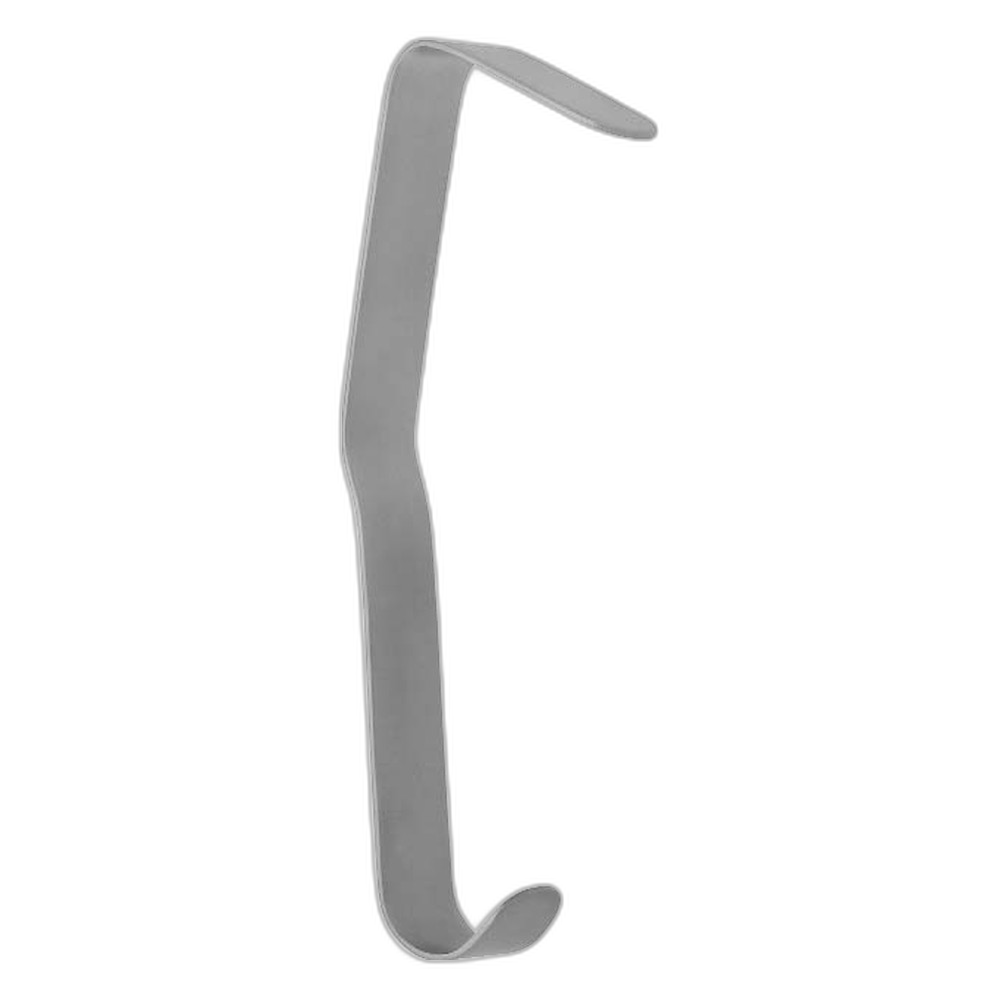
Where We Serve
Fizza Surgical exports to 50+ countries. Browse our country-specific pages with local regulatory guidance and pricing: