Minor Operations Set: Day Surgery Instrument Tray Contents
A defensible 21-instrument minor operations set contents list, what each instrument does, and how to adapt the tray to your procedure mix.
Ask five day-surgery units what belongs in a minor operations set and you will get five different lists — usually between 14 and 30 instruments, with genuine disagreement about retractors, and near-universal agreement about almost nothing else except the needle holder.
That variation is not sloppiness. A tray built for skin lesion excision under local anaesthetic has different demands from one covering abscess drainage, ingrown toenail avulsion and small biopsies on the same list. But the variation does create a procurement problem, because “minor set” on a purchase order means nothing without a contents schedule attached.
This guide sets out a defensible baseline, explains what each instrument is doing, and covers where to add or subtract depending on the procedure mix.
A Working Baseline Contents List
The following 21-instrument configuration covers the great majority of minor procedures performed under local anaesthetic in a day-surgery room, treatment room or GP minor-ops session.
| Qty | Instrument | Typical size | Function in the set |
|---|---|---|---|
| 1 | Scalpel handle No. 3 | 125 mm | Takes No. 10, 11, 15 blades — incision and excision |
| 1 | Adson tissue forceps, 1×2 teeth | 120 mm | Atraumatic skin handling during closure |
| 1 | Adson dressing forceps, serrated | 120 mm | Non-traumatic handling of dressings and specimens |
| 1 | Gillies dissecting forceps, 1×2 teeth | 150 mm | Deeper tissue handling than Adson allows |
| 1 | Iris scissors, straight, sharp/sharp | 110 mm | Fine dissection and precise skin trimming |
| 1 | Mayo scissors, straight | 140 mm | Suture cutting — kept off tissue deliberately |
| 1 | Metzenbaum scissors, curved | 145 mm | Blunt dissection through subcutaneous planes |
| 4 | Halsted mosquito haemostats, curved | 125 mm | Fine vessel control in shallow fields |
| 2 | Crile haemostatic forceps, curved | 140 mm | Larger bleeders and tissue clamping |
| 1 | Needle holder, Mayo-Hegar or Gillies | 150 mm | Suturing — tungsten carbide jaws preferred |
| 2 | Senn retractor, double-ended | 160 mm | Shallow wound retraction, sharp and blunt ends |
| 1 | Skin hook, single or double prong | 160 mm | Atraumatic edge elevation without crushing |
| 4 | Backhaus towel clamps | 110–130 mm | Securing drapes to the field |
| 1 | Sponge holding forceps | 200 mm | Skin preparation before draping |
| 1 | Gallipot / kidney dish | — | Prep solution and specimen handling |
Two things about that list are deliberate. There are two pairs of forceps with teeth and one without, because handling skin and handling a specimen are different jobs and one pair cannot do both well. And there are two separate scissors that never touch each other’s work — the Mayo pair cuts suture only, which is the single easiest way to keep a Metzenbaum sharp.
Why the Sets Differ So Much
Three forces pull minor sets apart.
Procedure mix. A dermatology-heavy list wants more fine instruments — a second pair of iris scissors, extra skin hooks, finer forceps — and barely uses the Crile haemostats. A list including abscess drainage wants sinus forceps and a curette, neither of which appear on a pure excision tray.
Cost of reprocessing per tray. Every instrument in the set costs money at every cycle, whether it was used or not. Units under CSSD cost pressure strip trays down and hold supplementary items as individually wrapped singles, opened only when needed. That is usually the right economic call, and it explains why some trays look surprisingly sparse.
Count-sheet inertia. Once a tray’s count sheet is written and validated, changing it means re-validating. Sets therefore ossify around whatever the mix was when the sheet was drawn up, sometimes a decade earlier. It is worth periodically auditing what actually gets used against what gets reprocessed — the gap is often substantial.
What Each Group of Instruments Is Doing
Cutting: three instruments, three jobs
The scalpel makes the incision. Metzenbaum scissors dissect — the long shank-to-blade ratio means the blades stay closed and spread tissue planes rather than cutting through them, which is why they are curved and why they should never cut suture. Mayo scissors are the workhorse cutter and, on a minor tray, are best designated suture-only.
Iris scissors handle the fine work: trimming a wound edge, taking a small ellipse, cutting fine suture close to the knot. They are sharp/sharp and short-bladed, and they blunt fast if used on anything they were not intended for.
Grasping: teeth versus no teeth
Toothed forceps hold skin. The 1×2 tooth configuration on an Adson concentrates grip into two points, which sounds traumatic but is actually gentler than the crushing force a serrated jaw needs to hold the same tissue. Serrated forceps handle dressings, swabs and specimens where puncture is unacceptable. Using the wrong one is the commonest cause of ragged wound edges on a closure. Our note on toothed versus non-toothed tissue forceps covers the distinction in more depth.
Haemostasis: sizing the clamp to the vessel
Mosquito haemostats are for the small subcutaneous bleeders that make up almost all bleeding in minor surgery. Four is the practical minimum — two in use, two available, since a bleeder that needs clamping rarely arrives alone. Crile forceps are there for the occasional larger vessel and for holding tissue where a mosquito would tear through.
Retraction: the most-argued item
Senn double-ended retractors give you a three-prong sharp end and a small right-angled blunt blade on one instrument, which is why they earn their tray space on a shallow-field set. Skin hooks are the atraumatic alternative for elevating a wound edge during undermining — they hold without crushing, which matters when the edge in question will be sutured. Some units carry both, some carry only hooks, and both positions are defensible. For deeper or self-retaining requirements the answer is a supplementary instrument rather than a bigger baseline tray; see our Senn retractor guide.
Suturing
Specify tungsten carbide jaws on the needle holder. TC inserts hold a fine needle without the slip that wears at surgeons’ patience, they are re-insertable when worn rather than scrapping the instrument, and on a set that sees daily use the cost difference is recovered quickly. Match the holder to the needle: a 150 mm Mayo-Hegar is right for 3-0 to 5-0 skin work, and anything finer wants a smaller jaw. Our overview of surgical suture needle types covers the pairing.
Adapting the Baseline to a Procedure List
| Procedure emphasis | Add | Consider removing |
|---|---|---|
| Skin lesion excision, dermatology | Second iris scissors, extra skin hooks, fine Adson | Crile haemostats, sponge holder |
| Abscess incision and drainage | Sinus forceps, Volkmann curette, probe | Skin hooks, Metzenbaum |
| Ingrown toenail / nail surgery | Nail elevator, nail splitter, Beaver handle | Metzenbaum, Crile haemostats |
| Vasectomy | Ring clamp, fine dissecting forceps, small artery clips | Senn retractors |
| Biopsy list | Punch biopsy set, specimen pots on tray | Crile haemostats |
The pattern across all five rows: the additions are procedure-specific and few, and the removals are instruments that were carried “just in case”. A tightly specified minor operations set with three named supplementary packs almost always beats one oversized universal tray on both cost and setup time.
Counting, Layout and Reprocessing
Lay the tray in the order of use, left to right: prep and draping, incision, dissection, haemostasis, retraction, closure. It sounds trivial and it materially reduces handling errors when the same room runs different lists on different days.
Count sheets should carry instrument name, pattern, size and quantity — not just name and quantity. “Scissors × 3” is not a count sheet; it is an invitation for a Metzenbaum to be quietly replaced by a second Mayo pair over a few years of attrition, at which point nobody can dissect properly and nobody knows why.
For reprocessing, the usual sequence applies: point-of-use moisture, enzymatic soak, ultrasonic clean, thorough rinse in deionised water, lubricate box joints, inspect, and steam sterilise with hinged instruments in the first ratchet or fully open. Minor sets cycle frequently, and it is the sheer cycle count rather than the severity of use that eventually degrades them — box joints stiffen, TC inserts polish smooth, and scissor edges roll. Build inspection into every cycle rather than periodically. Our guidance on instrument tray setup and pack organisation covers layout and containment in detail.
Reusable, Single-Use or Hybrid?
The single-use minor pack is a genuine competitor to a reprocessed tray, and the honest answer on which wins is that it depends almost entirely on volume and on what your CSSD actually costs per cycle.
Single-use packs remove reprocessing cost, decontamination risk and instrument-tracking overhead, and they guarantee a sharp scalpel and unworn scissors every time. They also cost more per procedure at volume, generate substantially more waste, and — the point most often missed — the instrument quality in a low-cost disposable pack is frequently poor. Disposable scissors that crush rather than cut, and forceps that spring out of alignment, are common enough that clinicians in high-volume lists usually push back.
Reusable sets win clearly above a few procedures per day per room, because the fixed reprocessing cost is spread and the instrument quality is far higher for the same per-procedure spend. They require functioning decontamination infrastructure, tracking and a replacement budget.
The hybrid arrangement most units settle on: a reusable core tray for the instruments where quality genuinely matters — needle holder, dissecting scissors, tissue forceps — plus single-use scalpel blades, and single-use supplementary items for the occasional procedure that would otherwise justify a whole extra tray. This gets the quality where it counts and avoids reprocessing rarely used instruments.
Whichever model you choose, price it per procedure rather than per item. A tray that costs more to buy but survives fifteen years of daily cycling is cheaper per procedure than one replaced every four.
Set Assembly Errors That Cost Money
Four failures account for most premature instrument loss on minor trays, and all four are assembly or handling issues rather than manufacturing defects.
- Silent substitution. An instrument breaks, a similar one is dropped in, the count still comes out right, and the set slowly loses its designed capability. Count sheets specifying pattern and size — not just “scissors × 3” — prevent this entirely.
- Mixed-metal storage. Storing or soaking stainless instruments in contact with dissimilar metals, or with any chrome-plated item, causes contact corrosion that shows as brown staining and then pitting. It is frequently misdiagnosed as poor steel quality.
- Sterilising hinged instruments closed. A haemostat locked on a ratchet through a steam cycle is stressed at the box joint and does not get properly exposed on the jaw surfaces. Everything hinged goes through open or on the first ratchet only.
- Detergent mismatch. Strongly alkaline or chloride-bearing detergents attack the passive layer. Persistent spotting across a whole tray at once almost always points at the washer chemistry or a rinse-water quality problem rather than the instruments.
None of these are exotic. They are the ordinary reasons a well-specified tray underperforms its expected life, and they are all cheap to fix once identified.
Materials and What to Specify
Everything on the baseline list should be martensitic stainless steel to ISO 7153-1 — AISI 420 or equivalent for cutting instruments and hinged instruments, hardened and tempered appropriately for the function. Cutting edges want higher hardness; box-joint instruments want toughness so the joint does not crack.
Beyond grade, three things determine whether a minor surgery tray lasts five years or fifteen:
- Box joint quality. A properly machined and fitted box joint stays tight through thousands of cycles. A stamped or loosely fitted one develops lateral play, and a haemostat with play does not hold. This is the single clearest quality differentiator on a hinged instrument.
- Passivation. The corrosion resistance comes from the passive chromium-oxide layer, not the polish. Instruments that pit within months were almost always inadequately passivated rather than made from the wrong steel.
- Marking. Laser-marked size, pattern and lot identifier survive autoclaving without creating a corrosion site and make set reconciliation possible. Acid-etched marking degrades and can become a corrosion initiation point.
If you are standardising across several rooms or sites, our notes on specialty instrument set procurement cover contents schedules, count sheets and acceptance criteria.
Sourcing
Order against a contents schedule that names pattern, size and quantity for every line, and require the supplier to quote line by line rather than as a single set price. Set pricing hides substitution — it is how a Metzenbaum becomes an unnamed “dissecting scissors” and a Mayo-Hegar becomes a plain needle holder without TC.
Fizza Surgical has manufactured general surgical instruments in Sialkot since 1980, ISO 13485 certified and CE marked, supplying sets built to customer contents schedules with batch-traceable material certificates. The individual instruments in this configuration are listed in our general surgical instruments catalogue, and current regulatory approvals are on our certifications page.
Frequently Asked Questions
How many instruments are in a minor operations set?
Typically between 14 and 30, depending on the procedure mix. A 21-instrument configuration covering scalpel, three scissors, three forceps, six haemostats, a needle holder, retractors, skin hook, towel clamps and a sponge holder handles most minor procedures done under local anaesthetic.
What is the difference between a minor set and a general surgery set?
Scale and depth. A minor surgery tray is built for shallow fields under local anaesthetic — short instruments, fine haemostats, handheld retractors. A general set carries longer instruments, self-retaining retractors and heavier clamps for deeper access under general anaesthesia.
Should the needle holder have tungsten carbide jaws?
On a daily-use tray, yes. TC inserts grip fine needles without slipping, resist wear far longer than plain steel jaws, and can be replaced when worn instead of scrapping the instrument. The extra cost is recovered quickly at high cycle counts.
Why keep separate scissors for suture and tissue?
Cutting suture blunts an edge much faster than cutting tissue. Designating the Mayo pair as suture-only keeps the Metzenbaum sharp for dissection, which is the pair whose performance actually depends on a fine edge. Mixing them means both pairs degrade.
Is it better to have one large tray or a small tray plus supplementary packs?
For most units, a tightly specified baseline plus two or three procedure-specific supplementary packs. Every instrument in the tray costs money at every reprocessing cycle whether used or not, so carrying rarely used items in the main set is expensive and slows setup.
Need precision surgical instruments?
Configure complete instrument sets with our team — ISO 13485 certified, CE marked, made in Sialkot since 1980.
Related Guides
View all articles →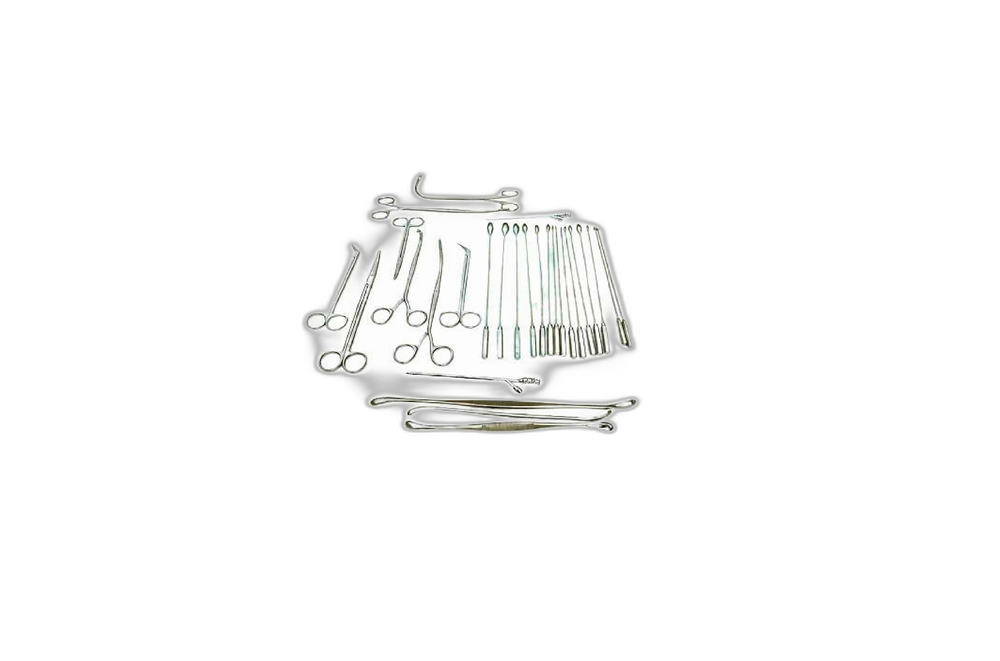
Where We Serve
Fizza Surgical exports to 50+ countries. Browse our country-specific pages with local regulatory guidance and pricing: