Potts-Smith Scissors: Vascular Surgery Guide
Potts-Smith scissors explained: why the jaws are angled, how to choose 25, 45 or 60 degrees, sizes, tungsten-carbide blades and vascular cutting technique.
 Made in Sialkot · Since 1980
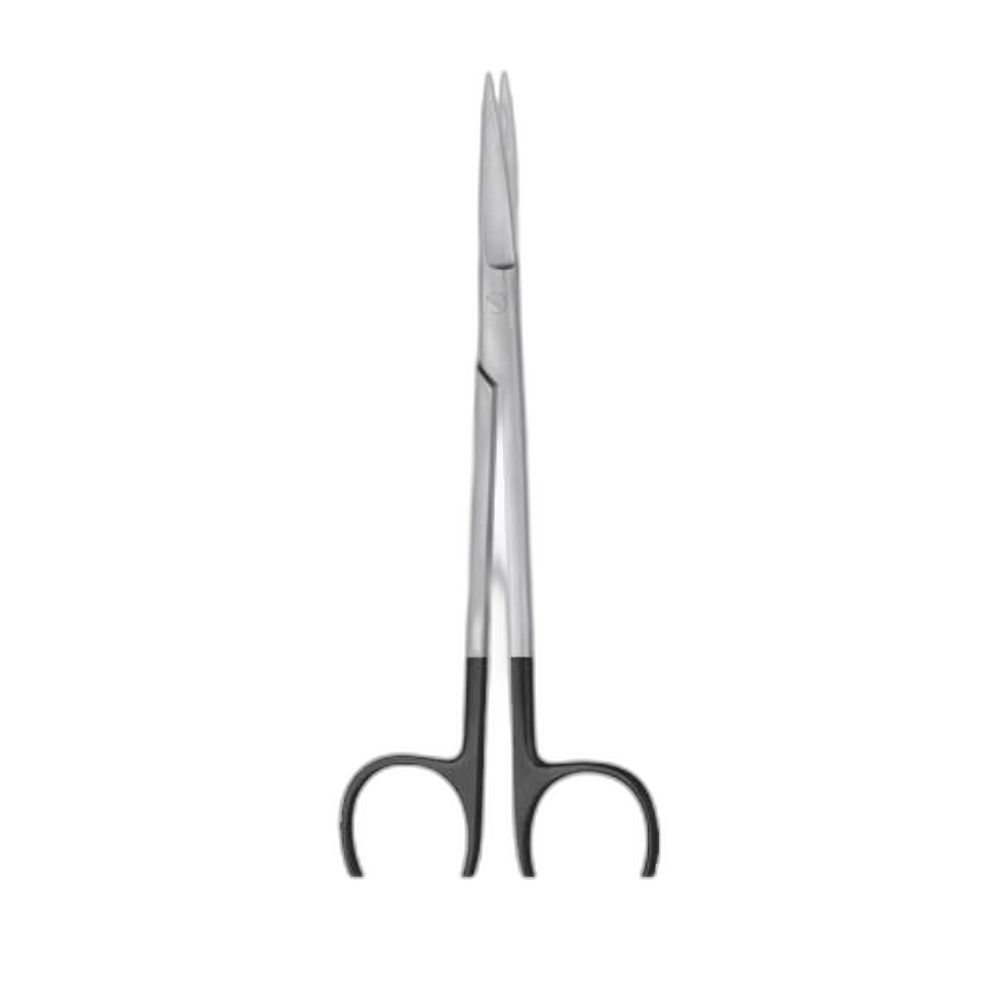
How do you extend a 3 mm arteriotomy along a vessel wall without nicking the back wall? Not with straight scissors. This is the problem the Potts-Smith scissors were designed to solve, and it explains every unusual feature of the instrument — the angled jaws, the blunt tips, the fine blades that open into a narrow lumen.
Named for cardiac surgeons Willis Potts and Sidney Smith, these are the scissors a vascular or cardiothoracic team reaches for the moment an incision has to be lengthened cleanly inside a blood vessel.
What makes the geometry unusual
The defining feature is the angle. The blades sit angled to the side of the shank rather than in line with it. That offset lets the surgeon slide the lower blade into a vessel lumen and cut along the wall while the handle — and the surgeon’s hand — stays clear of the operative field. Straight scissors would force the hand directly over the incision, blocking the view of exactly the tissue being cut.
The tips are blunt, not sharp. A blunt lower tip can be slipped inside an artery or vein as a probe without perforating the far wall, then the blades close to extend the opening. That dual role — probe and cutter — is why the instrument feels at home in delicate anastomotic work.
Choosing the angle
Potts-Smith scissors are defined by the angle between blade and shank. The angle you choose is dictated by how deep the vessel sits and how much the surgeon needs to reach around it.
| Angle | Best suited to |
|---|---|
| 25° | Superficial vessels, shallow field, minimal reach needed |
| 45° | General-purpose vascular work — the most widely stocked angle |
| 60° | Deeper vessels, reaching around curved structures in the chest |
| 90° and above | Specialized deep or acutely angled access |
If a service can hold only one, the 45° pattern covers the majority of arteriotomy and venotomy extensions. The 60° earns its place when the work moves deeper into the chest or around the aortic arch. Micro-vascular versions carry the same angles on a smaller frame with spring handles for fine control.
Sizes and blade options
Standard Potts-Smith scissors run from about 16.5 cm (6½ in) to 23 cm (9 in), with 19 cm (7½ in) the common bench length. Micro patterns are shorter, around 13–18 cm.
Two blade grades exist. The standard pattern is fully hardened stainless with a keen honed edge. A supercut or tungsten-carbide-insert version carries a harder, longer-lasting cutting edge — often marked with gold-ringed handles — that shears fine vascular tissue with less crush. TC-insert blades cost more but hold their edge far longer under repeated sterilization, which matters on an instrument whose entire value is a clean cut.
Handle style is the other variable. Standard ring-handled patterns suit open vascular and cardiac work where the instrument is passed in and out repeatedly. Spring-handled micro versions, closer in feel to a needle holder, give a surgeon continuous fingertip control for coronary or paediatric vessels where the cut is measured in millimetres. Matching handle to procedure is as important as matching the angle to depth.
How they are used at the table
The sequence is quick and precise. A scalpel or an 11 blade makes the initial stab into the vessel. The blunt lower blade of the Potts-Smith is introduced into that opening, advanced a few millimetres along the intended line, and the blades closed to lengthen the incision. Repeating in small controlled cuts produces a smooth arteriotomy ready to receive a graft or patch — no ragged edges to compromise the suture line.
Because the tips double as a probe, the same instrument helps assess the lumen before committing to a longer cut. That is a real workflow advantage in a field where every instrument exchange costs time on a clamped vessel.
Where they sit against other vascular scissors
It helps to place the instrument among its neighbours on the tray. Metzenbaum scissors dissect delicate planes but are straight or gently curved and would drag against a vessel wall. Curved Mayo scissors are too heavy and blunt for intimal work. The Potts-Smith occupies the narrow niche between them: fine enough to cut vessel wall without crushing, angled enough to stay out of the surgeon’s line of sight. That is why nothing quite substitutes for it during an arteriotomy extension.
One point of confusion worth clearing up is the name. Some catalogues and purchasing systems list the instrument as Potts Smith scissors, without the hyphen, or simply as Potts scissors — the design and the angled, blunt-tipped geometry are identical regardless of how the name is punctuated. When comparing quotes across suppliers, match on angle, length, and blade grade rather than on the spelling of the name.
Common handling mistakes
Two errors show up repeatedly. The first is choosing too shallow an angle for a deep vessel, which forces the hand over the field and defeats the entire purpose of the offset jaws. The second is using the fine tips as a dissector against fascia or suture — that is a job for Mayo scissors, and it rolls the delicate Potts-Smith edge in a single case. Kept for vessel work only, a good pair holds its edge through years of service.
Care and inspection
These are precision cutting instruments, and a Potts-Smith that no longer cuts fine tissue cleanly is worse than useless — a crushing blade damages the vessel wall. Test the edge on a strip of latex or gauze; it should slice, not tear. Clean the box joint thoroughly, because dried blood there stiffens the action and hides corrosion.
Standard blades can be re-sharpened by a qualified service; tungsten-carbide inserts are re-honed rather than ground. Store with tips protected so the fine points are not bent against a tray, and passivate after any repair to restore the corrosion-resistant surface. For the wider family of operating-room scissors and how patterns are matched to tissue, see our complete guide to surgical scissors.
Fizza Surgical manufactures Potts-Smith and vascular scissors in hardened and tungsten-carbide-insert patterns, across the full range of angles, under ISO 13485 and CE marking. Browse our surgical instruments range, and for the clamps that pair with this work, the DeBakey vs Satinsky clamp comparison covers vascular occlusion.
Frequently Asked Questions
What are Potts-Smith scissors used for?
They are angled vascular scissors used mainly to extend an arteriotomy or venotomy — lengthening an incision cleanly along the wall of a blood vessel during cardiac and vascular surgery. The blunt tips also let them act as a probe inside the lumen.
Why are the blades angled?
The side angle keeps the surgeon’s hand and the instrument handle clear of the operative field while the blade cuts along the vessel wall. This preserves the view of the tissue being cut, which straight scissors would block.
Which Potts-Smith angle should I choose?
The 45° angle is the general-purpose choice and the most widely stocked. Choose 25° for superficial vessels and 60° or more when reaching deeper into the chest or around curved structures. Many services keep both 45° and 60°.
Why do Potts-Smith scissors have blunt tips?
Blunt tips can be slipped inside an artery or vein without perforating the opposite wall, so the instrument can safely enter the lumen to extend an incision and can be used as an exploratory probe.
What is a supercut or tungsten-carbide Potts-Smith scissor?
It is a version with a harder, sharper cutting edge — often a tungsten-carbide insert with gold-ringed handles — that shears fine vascular tissue with less crush and holds its edge much longer through repeated sterilization than a standard stainless blade.
Need precision surgical instruments?
Configure complete instrument sets with our team — ISO 13485 certified, CE marked, made in Sialkot since 1980.
Related Guides
View all articles →
Where We Serve
Fizza Surgical exports to 50+ countries. Browse our country-specific pages with local regulatory guidance and pricing: