Russian Tissue Forceps: Serrated Cup Jaw Uses and Sizes
Russian tissue forceps grip dense tissue with a cup-shaped serrated jaw instead of piercing it. Sizes, uses, inspection and care explained.
A registrar is closing a thick, oedematous abdominal wall. The rectus sheath keeps sliding out of a pair of standard 1×2 toothed forceps, and every regrip leaves another puncture in fascia that is already friable. Somebody hands over a pair of Russian pattern forceps. The sheath stops slipping, and the punctures stop.
That is the whole argument for this instrument in one paragraph. It grips dense tissue by surface area rather than by penetration.
What the Cup Jaw Actually Does
Most dissecting forceps commit to one of two strategies. Toothed patterns bite — a single tooth interdigitates between two, and the tissue is held on a point. Non-toothed patterns pinch, relying on cross serrations and clamping force, which is why they slip on anything wet and heavy.
The Russian pattern does neither. The tip flares into a round, cup-shaped head, typically 8–14 mm across depending on instrument length, and the working face carries teeth arranged radially around the rim with a serrated floor inside the cup. When the jaws close, tissue is drawn into the cup and held around its entire circumference.
Two consequences follow from that geometry:
- Grip scales with contact area, not point pressure. A rat-tooth forceps concentrates the whole closing force onto one tooth tip. A cup jaw spreads it over a ring several millimetres in diameter, so the surgeon can apply real traction without shearing through.
- The tissue is not perforated. The rim teeth are short and blunt compared with a Kocher-style tooth. They index the tissue against rotation rather than piercing it.
This is why the pattern turns up wherever tough, fibrous, slippery structures need firm handling: rectus sheath, linea alba, cartilage, fibrotic omentum, uterine tissue at hysterectomy, and pedicles during large-animal work.
It is also why the pattern is a poor choice on bowel serosa, vessel adventitia, or skin edges being prepared for a fine closure. A DeBakey or a fine Adson does that job better — the comparison in our guide to DeBakey versus Adson tissue forceps covers where atraumatic patterns belong.
Lengths, Tip Widths and What Each Size Is For
Russian tissue forceps are made across a wider length range than most dissecting forceps, because the pattern is used both superficially and in deep cavities. Tip diameter generally scales with length.
| Length | Metric | Typical tip width | Where it is used |
|---|---|---|---|
| 6″ | 15 cm | ~8 mm | General minor sets, superficial closure, skin graft handling |
| 8″ | 20 cm | ~10 mm | Standard laparotomy tray, fascia and sheath handling |
| 10″ | 25 cm | ~12 mm | Deep pelvis, obese abdominal wall, thoracic approaches |
| 12″ | 30 cm | ~14 mm | Bariatric cases, deep cavity retraction assistance, equine surgery |
| 18″ | 45 cm | ~14 mm | Very deep fields and specialised prep-room use |
Buyers regularly over-order the 6″ and under-order the 8″. In practice the 20 cm instrument does most of the work on a general set. If a hospital is standardising a single length, that is the one.
A second variable worth specifying is handle serration. Older stock came with plain, polished shanks that become genuinely slippery once wet. Current manufacture almost always carries cross-serrated or knurled shanks, which reduce the pinch force the surgeon has to hold for the same grip.
Where the Pattern Sits on a Tray
On a standard laparotomy set the cup jaw forceps is not the primary dissector. It is the closing instrument. The sequence most theatres settle into looks like this:
Fine toothed forceps for skin and subcutaneous work. Non-toothed or DeBakey pattern for anything that will be anastomosed. Cup jaw pattern for the moment the sheath has to be held under tension against a needle driving through it.
In gynaecology the same instrument earns its place at hysterectomy, where the uterus is held while pedicles are secured. In thoracic work it is used on rib cartilage and intercostal muscle. Veterinary theatres use the longer patterns heavily in equine and bovine procedures for exactly the reason human theatres use the 25 cm — reach plus a grip that survives on tough tissue.
If you are building or re-costing a general set, our note on instrument tray setup and surgical pack organisation covers how many dissecting forceps a tray actually needs, which is usually fewer than the count on legacy pick lists.
Holding It Correctly
The cup jaw rewards a different grip from a fine toothed forceps. Because the holding force is distributed around a rim rather than concentrated on one tooth, squeezing harder does not meaningfully improve purchase past a certain point — it just fatigues the hand and starts to crush.
The technique that works: seat the cup squarely on the tissue so the full rim contacts, close to firm rather than maximum, and pull along the axis of the shanks rather than levering sideways. Angled traction rolls the tissue out of the cup at one edge, which is the usual reason a surgeon reports that “these are slipping” on a pair that is mechanically sound.
Steel, Joints and What Fails First
These are made from martensitic stainless — typically AISI 410 or 420 — hardened and tempered so the spring in the shanks returns the jaws reliably over thousands of cycles. That spring is the part that ages. A pair that no longer opens fully has usually been over-flexed rather than worn out at the tip.
Three failure modes are worth watching for during CSSD inspection:
- Tip misalignment. Hold the forceps closed against a light. The two cups must meet rim-to-rim with no visible step. A lateral offset of even half a millimetre destroys the grip, because tissue escapes at the mismatch.
- Flattened rim teeth. Repeated use on bone edges or clamping onto other metal rounds the teeth off. The instrument will still look serviceable and will still slip.
- Pitting inside the cup. The cup floor traps blood and detergent residue. It is the single hardest part of this instrument to clean, and the first place corrosion appears.
The cleaning point deserves emphasis. Cup jaws must be brushed open, not just dunked — an ultrasonic cycle alone will not reliably clear proteinaceous debris from the serrated floor. Anything left there bakes on in the autoclave and becomes a nucleation site for pitting. Our guide to instrument passivation and corrosion resistance explains why the chromium oxide layer matters more on recessed geometry than on a flat blade.
Fizza Surgical manufactures Russian tissue forceps in Sialkot to ISO 13485 under CE marking, in the full length range and in both standard and heavy patterns. Related dissecting and grasping instruments sit in our general surgical instruments range.
Frequently Asked Questions
Are Russian forceps atraumatic?
Partly. They do not pierce tissue the way a rat-tooth pattern does, so they are less traumatic on fascia and cartilage. But the closing force needed to hold heavy tissue still crushes delicate structures. They are not a substitute for a DeBakey on bowel or vessel.
What is the difference between Russian and Mayo-Russian forceps?
Catalogue naming varies by maker. “Mayo-Russian” usually denotes a heavier build with a wider cup and stiffer shanks, intended for the toughest tissue. Functionally it is the same pattern in a heavier grade — check the tip width in millimetres rather than trusting the eponym.
Which length should a general theatre stock?
20 cm (8″) as the default, with 25 cm available for deep or bariatric cases. The 15 cm pattern is worth having on minor sets but is too short for abdominal closure in most adults.
Can these forceps hold a suture needle?
They will grip one, but they are not designed for it and doing so flattens the rim teeth. Use a needle holder. Instruments with a tungsten carbide platform behind the teeth exist for that purpose in other patterns.
How do you check a used pair before returning it to a set?
Close the jaws against a light source to confirm rim-to-rim contact with no step, run a fingertip over the rim teeth to check they are still defined, and inspect the cup floor under magnification for retained debris or pitting.
Need precision surgical instruments?
Configure complete instrument sets with our team — ISO 13485 certified, CE marked, made in Sialkot since 1980.
Related Guides
View all articles →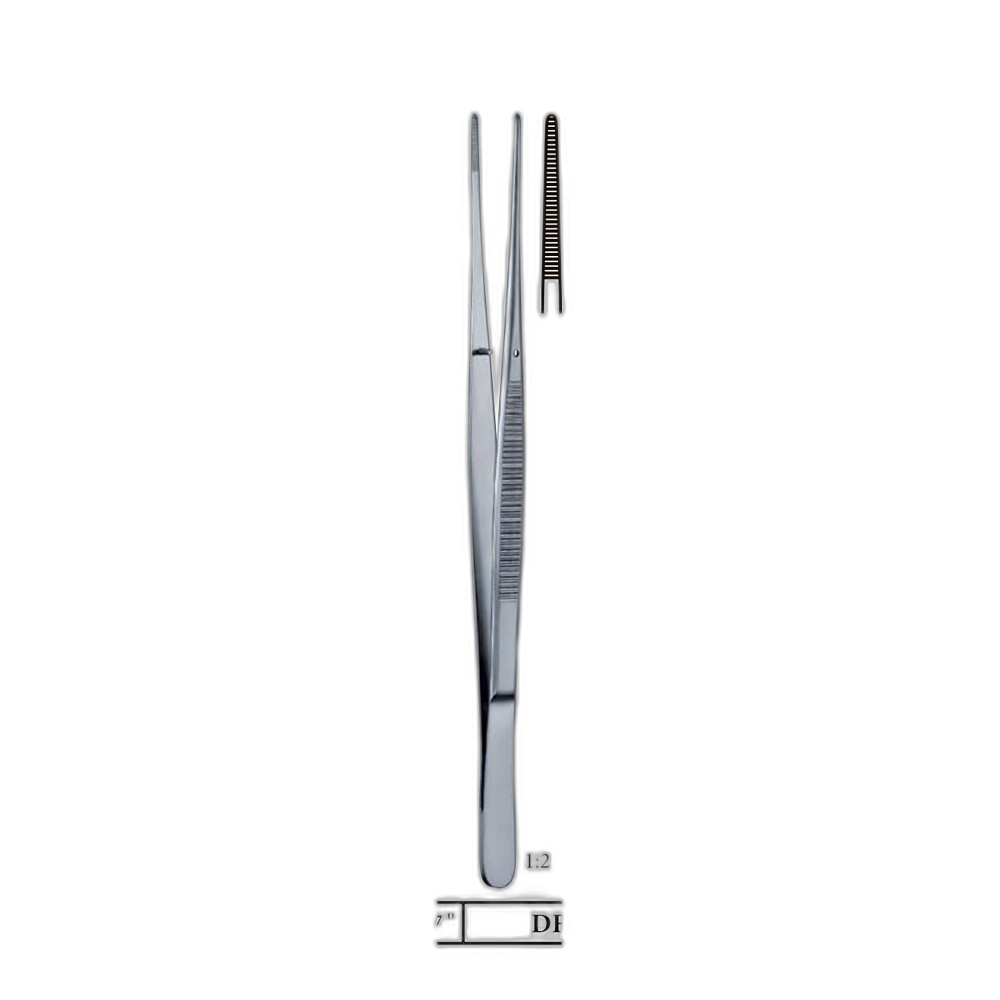
Where We Serve
Fizza Surgical exports to 50+ countries. Browse our country-specific pages with local regulatory guidance and pricing: