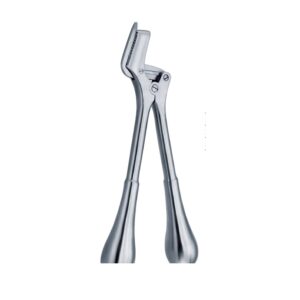
Hip Replacement Instrument Set: Total Hip Arthroplasty Tools
A surgeon's guide to the total hip arthroplasty instrument set: acetabular reamers, femoral broaches, trials, impactors and the steel behind them.
 Made in Sialkot · Since 1980
The scrub nurse lays out the tray in the order the surgeon will reach for it: acetabular side first, then the femur. A total hip replacement is really two operations happening back to back — resurfacing the socket, then rebuilding the top of the thigh bone — and the instrument set has to mirror that rhythm exactly. Miss one broach size or a single reamer increment and the case stalls while someone runs to the sterile store.
This guide walks through what actually belongs on a hip arthroplasty tray, why each family of tools exists, and the specifications that separate a set that lasts a decade from one that pits and loosens after two years of steam cycles.
How the THA workflow shapes the tray
Every hip replacement tray is organised around four surgical phases: exposure, acetabular preparation, femoral preparation, and trial reduction. A well-built set groups instruments by phase rather than by type, so the circulating team can anticipate the next handoff.
Two instruments dominate the count sheet — reamers and broaches — because both come in graduated sizes. The surgeon works up through the sizes until the bone gives the right feel and the trial components sit flush. That means a complete set is not one of each tool; it is a full ladder of increments.
Acetabular preparation instruments
The socket side sets the geometry for the entire construct. If the cup is malpositioned, no amount of femoral finesse will save the range of motion.
Acetabular reamers are hemispherical cutting baskets that carve the socket into a smooth, congruent hemisphere. They step up in 1 mm or 2 mm increments, typically spanning 40 mm to 66 mm. The surgeon under-reams or line-reams depending on whether a press-fit or cemented cup is planned.
A reamer handle — usually a modular T-handle or offset driver — couples to each basket through a quick-connect hub. The cup impactor and cup positioner then seat the real acetabular shell at the target inclination and anteversion. Most systems mark the impactor with a 45-degree alignment rod so the surgeon can reference the sagittal plane.
Supporting tools on this side include an acetabular screw drill and depth gauge for supplementary fixation, a liner inserter for the polyethylene or ceramic bearing, and a trial cup and trial liner in matching sizes.
Femoral preparation instruments
Once the socket is prepared, attention moves to the proximal femur. The neck cut has usually been made already with an oscillating saw, so the tray now focuses on opening and shaping the canal.
A box osteotome or canal finder establishes the entry point. A T-handle canal reamer or starter awl opens the medullary canal along its axis. Then the workhorse: femoral broaches, tapered rasps that match the stem geometry and compact cancellous bone into a dense envelope around the implant.
Broaches attach to a broach handle — straight or offset — and are driven with a slap hammer or mallet. The final broach that achieves rotational stability determines the stem size. A calcar planer then trims the neck cut flat so the stem collar seats evenly.
| Instrument family | Typical size range | Increment | Function |
|---|---|---|---|
| Acetabular reamers | 40–66 mm | 1–2 mm | Shape the socket hemisphere |
| Femoral broaches | Sizes 0–12 (system-specific) | 1 size | Compact canal to stem profile |
| Trial heads | 28/32/36 mm dia. | +/- neck length | Set leg length and offset |
| Canal reamers | 8–16 mm | 0.5–1 mm | Open medullary canal |
Trial reduction, impaction and extraction
Before any real implant goes in, the surgeon assembles a trial construct — trial stem, trial neck, and a range of trial heads — and reduces the hip to check stability, leg length and offset. This is where the modular head trials in 28, 32 and 36 mm earn their place; swapping a +4 for a +8 neck can be the difference between a stable hip and a dislocation on the ward.
Impaction tools drive the definitive components home. A femoral head impactor seats the ceramic or metal head onto the trunnion with a single clean strike — repeated tapping risks micro-fracturing a ceramic head. For revision or a mis-seated component, a stem extractor and slotted hammer back the implant out.
Retractors that keep the hip open
Exposure in the hip is unforgiving because the joint sits deep beneath heavy muscle. A hip tray therefore carries dedicated retractors: Hohmann retractors (narrow and wide blades) to lever around the acetabular rim and femoral neck, a Charnley self-retaining retractor for the superficial layers, and cobra or Steinmann-pin retractors for posterior exposure.
These heavy levers take enormous load. Bent blades and sprung ratchets are the first components to fail on a budget tray, which is why forging quality matters as much here as on the cutting instruments. Our own bone surgery instruments are drop-forged from AISI 420 martensitic stainless and hardened to hold an edge and a set under repeated impaction.
Materials and sterilization
Cutting components — reamers, broaches, saw blades — are made from hardened martensitic grades such as AISI 420 or 440 that take a durable cutting edge. Retractors and handles use the same family for strength. Alignment rods and some modular connectors may use 316L austenitic steel for its superior corrosion resistance where cutting hardness is not required.
Hip instruments live hard lives in the autoclave. Reamer baskets trap bone slurry between the cutting teeth, so they must be cleaned ultrasonically and inspected under magnification before every cycle. Broaches should be checked for tooth wear — a dull broach tears bone instead of compacting it. All Fizza orthopedic instruments are manufactured under ISO 13485 and CE marking; you can review our certifications for the full regulatory scope.
Building or buying the set
Hospitals face a choice: buy the implant company’s proprietary instrumentation, or source a general THA set from an independent manufacturer. Proprietary sets guarantee that reamers and broaches match the implant tolerances exactly — critical for press-fit fixation. General sets cost far less and suit teaching hospitals, cemented techniques, and facilities running multiple implant brands.
Whichever route you take, insist on a complete size ladder, matched trial components, and forged (not cast) retractors. A gap in the reamer sequence is a case-day emergency.
Frequently Asked Questions
How many instruments are in a standard total hip arthroplasty set?
A complete tray typically holds 60 to 90 pieces once every reamer and broach increment is counted, plus retractors, impactors, trials and handles. The exact number depends on the implant system and whether cemented or press-fit technique is used.
What is the difference between a reamer and a broach in hip surgery?
A reamer cuts and removes bone to shape the acetabular socket, while a broach compacts cancellous bone in the femoral canal to match the stem profile without removing much material. Reamers cut; broaches compact.
Why do femoral broaches come in so many sizes?
The surgeon works up through progressively larger broaches until one achieves rotational stability in the canal. The final broach size determines the implant stem size, so the full ladder must be present.
What steel is best for hip replacement instruments?
Cutting tools use hardened martensitic grades such as AISI 420 for edge retention, while alignment and connector components sometimes use 316L austenitic steel for corrosion resistance. Both should be forged rather than cast.
Need precision surgical instruments?
Configure complete instrument sets with our team — ISO 13485 certified, CE marked, made in Sialkot since 1980.
Related Guides
View all articles →
Where We Serve
Fizza Surgical exports to 50+ countries. Browse our country-specific pages with local regulatory guidance and pricing: