Wertheim Hysterectomy Clamp: Parametrial Tissue Clamping Guide
How the Wertheim clamp secures parametrial tissue in radical hysterectomy - jaw patterns, 240-255 mm sizes, atraumatic variants and care.
 Made in Sialkot · Since 1980
The pelvic sidewall is open. The ureter has been rolled laterally off the medial leaf of the broad ligament, the uterine artery is divided at its origin, and what stands between the surgeon and the specimen is the parametrium — a dense, vascular wedge of connective tissue that has to come away in controlled bites, low against the pelvic floor, without slipping and without compromising a ureter sitting a few millimetres away.
That single moment is what Ernst Wertheim’s clamp was designed around, and it explains almost every feature of the instrument.
What This Clamp Is Actually For
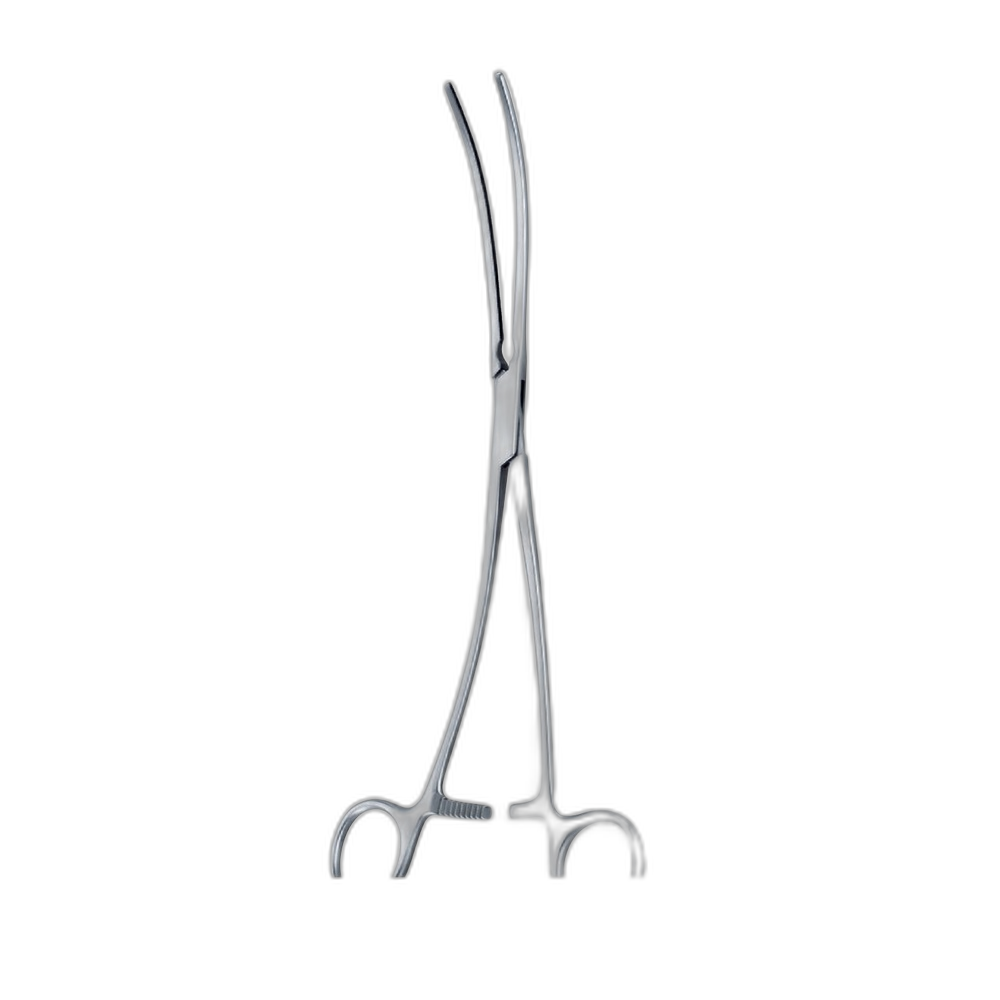
A Wertheim parametrium clamp is a long, heavy, curved hemostatic forceps with a box joint and a ratcheted finger-ring handle. Its job is to seize the parametrial and paracervical tissue — and in some techniques the upper vaginal angle — so that the pedicle can be divided and ligated with no back-bleeding.
It is not a general-purpose hemostat scaled up. Three design decisions separate it from a long Kelly or a Heaney:
- Working length of 240–255 mm. The clamp has to reach the pelvic floor with the surgeon’s hand well clear of the operative field. Anything shorter forces the hand into the line of sight during the deepest bites.
- Strong distal curve. The curve lets the jaw tips be placed at right angles across a pedicle that runs away from the operator, rather than parallel to it.
- Jaws that hold wet, fibrous tissue without needing crushing force. Parametrium is not a discrete vessel. It is a slab. A serration pattern that works on a bleeder will slide off a slab.
Wertheim described his radical operation in 1898 and the instrument set evolved with it — remove the uterus and cervix together with the parametrium, the paracolpium, the upper vagina and the pelvic nodes. More than 125 years later the clamp geometry has barely moved, because the anatomical problem has not moved either.
Specifications
| Attribute | Common configurations |
|---|---|
| Overall length | 240 mm (9½”), 248 mm (9¾”), 255 mm (10″) |
| Curvature | Curved (standard); straight pattern available for vaginal-angle work |
| Jaw serration | Longitudinal transverse serration, or atraumatic DeBakey-type 2×3 / 1×2 rows |
| Joint | Box joint (screw joint on lighter economy patterns) |
| Ratchet | Three-notch finger-ring ratchet |
| Material | Martensitic stainless, typically AISI 410 or 420 for the jaw and shank |
| Finish | Satin (preferred — reduces glare under the operating light) or mirror polish |
| Standard | Manufactured to ISO 7153-1 material requirements; ISO 13485 quality system |
The 240 mm pattern is the volume size in most gynaecologic-oncology trays. Departments that also run open radical procedures on larger patients tend to add the 255 mm as a second pair rather than replacing the shorter one.
Atraumatic Versus Standard Serration
This is the specification buyers most often get wrong, and it is worth being precise about.
Classic Wertheim jaws carry deep transverse serrations running the length of the jaw. They grip enormously well. They also leave a crush line, which is irrelevant on tissue you are about to excise and ligate, and entirely relevant if the clamp is being used on tissue that stays in the patient.
Atraumatic patterns — the DeBakey-style fine longitudinal rows, marketed under names such as Atraumata — trade a little grip for a much gentler footprint. Fine rows interdigitate and distribute pressure instead of concentrating it in ridges.
Practical rule from the trays we build: order standard serration for the parametrial and paracolpial pedicles, and atraumatic for anything where the clamped tissue will be sutured rather than discarded. A department buying a single pair for a mixed caseload is usually better served by the atraumatic version, because the failure mode of “slightly less grip” is recoverable and the failure mode of “crushed tissue you needed to sew” is not.
Where Application Goes Wrong
Three recurring problems, none of them exotic:
Clamping to the second or third ratchet notch on thick parametrium. Over-ratcheting on a slab of dense tissue springs the jaws apart at the tips. The pedicle then bleeds from the untouched distal fibres while the surgeon believes it is secured. On heavy pedicles the first notch, applied squarely, holds better than the third notch applied to a jaw that has been forced open.
Taking a bite deeper than the jaw. If tissue extends past the jaw tips, the tip is not clamping anything — it is tenting tissue. The bite has to fit inside the jaw length.
Using a sprung clamp. A Wertheim that has been over-loaded, dropped, or repeatedly autoclaved while ratcheted closed will develop tip separation. Hold the clamp closed on the first notch and look at the tips against the light: any visible gap and the instrument goes for repair, not back into the tray. The same test belongs in every incoming inspection.
Related reading on the surrounding instruments: our comparison of Jorgenson versus curved Mayo scissors covers the cutting side of the same dissection, and the Rochester-Carmalt pedicle clamp guide covers the other heavy clamp that shares tray space with it.
Material and Manufacture
A clamp that must resist springing needs hardness in the jaw and elasticity in the shank — two requirements that pull in opposite directions and are resolved through heat treatment rather than alloy choice.
At our Sialkot plant the pattern is drop-forged, milled, and then hardened and tempered so the jaw and joint area reach the working hardness while the shanks retain enough spring to close without permanent set. Serrations are cut after hardening. The box joint is fitted and the ratchet is set by hand, because ratchet engagement is the part of the instrument that dictates whether it holds at the first notch, and no automated process gets that right across a batch.
Every unit is then passivated. That step matters more on gynaecologic instruments than most buyers realise: these clamps see blood, saline and repeated steam cycles, and an incomplete chromium oxide layer is where pitting starts. We covered the chemistry in detail in the passivation guide.
Reprocessing and Ratchet Care
Two habits extend the service life of a Wertheim clamp more than anything else:
- Autoclave in the open position. Sterilising a ratcheted instrument closed loads the joint and shanks through the whole thermal cycle. This is the single most common cause of premature springing.
- Clean the box joint, not just the jaw. The joint traps protein. Ultrasonic cleaning with the instrument articulated open, followed by lubrication of the joint with an instrument milk, keeps the ratchet crisp. A stiff joint is usually a dirty joint, not a worn one.
Standard steam parameters apply — 134 °C for 3 minutes in a pre-vacuum cycle, or 121 °C for 15 minutes in a gravity displacement cycle. Nothing about the alloy requires special handling, but the ratchet does.
Frequently Asked Questions
What is the difference between a Wertheim clamp and a Heaney clamp?
Length and intent. A Heaney is shorter, with a pronounced angle designed for the vaginal-vault and uterosacral pedicles in vaginal or standard abdominal hysterectomy. The Wertheim is 240–255 mm with a long distal curve, built to reach the parametrium in a radical resection where the dissection extends laterally to the pelvic sidewall.
Is the Wertheim clamp still used now that radical hysterectomy is often done laparoscopically?
Yes, in two settings. Open radical hysterectomy remains the standard approach in many centres, particularly after the trial data questioning minimally invasive radical surgery in early cervical cancer. And every laparoscopic programme keeps an open tray available for conversion.
Which size should a department order first?
The 240 mm curved pattern. It covers the majority of parametrial work. Add the 255 mm as a second pair if your caseload includes deep pelves or high-BMI patients, rather than substituting it.
Can the jaws be resharpened or regripped?
Serrations can be recut and jaw alignment can be reset by a competent repair service, and a sprung clamp is often salvageable. What cannot be repaired economically is a worn ratchet on a screw-joint instrument — which is one reason to specify a box joint at purchase.
Are atraumatic Wertheim clamps worth the price difference?
For a mixed gynaecologic caseload, generally yes. For a tray used exclusively for radical resections where every clamped pedicle is excised, the standard serration grips better and costs less.
Supply
Fizza Surgical has manufactured gynaecologic instruments in Sialkot since 1980, under ISO 13485 with CE marking. Wertheim parametrium clamps are supplied in 240 mm, 248 mm and 255 mm patterns, curved or straight, with standard or atraumatic jaws, individually or configured into hysterectomy trays. Browse the full surgical instrument range or review our certifications for regulatory documentation.
Need precision surgical instruments?
Configure complete instrument sets with our team — ISO 13485 certified, CE marked, made in Sialkot since 1980.
Related Guides
View all articles →
Where We Serve
Fizza Surgical exports to 50+ countries. Browse our country-specific pages with local regulatory guidance and pricing: