Maxillofacial Plating Instruments: Facial Fracture Guide
Maxillofacial plating instruments by profile: 1.5/2.0mm benders, cutters, depth-stop drills, screwdrivers and tray care.
 Made in Sialkot · Since 1980
In 1978 Michelet and Champy published something that changed facial fracture surgery more than any implant since: the observation that the mandible does not need to be rigidly locked to heal. It needs to be stabilised along specific lines where functional tension concentrates. Fix along those lines with a small monocortical plate, and the bone shares the load rather than being shielded from it.
That principle is why maxillofacial plating instruments look nothing like an orthopaedic tray. The plates are thinner, the screws are shorter, the drills are finer — and the bending instruments are far more important.
Plate systems and what each one demands from the tray
Facial fixation is organised by profile, and each profile carries its own instrument requirements.
- 1.0 mm and 1.3 mm systems — orbital rim, nasal, and frontal bone. Plate thickness around 0.4–0.6 mm. Screws 3–5 mm long. These bend under thumb pressure and tear easily if you over-work them.
- 1.5 mm systems — midface, zygomaticomaxillary buttress, some paediatric applications. Screws typically 4–7 mm.
- 2.0 mm systems — the workhorse for mandible. Monocortical screws 5–8 mm along Champy’s lines; bicortical 10–14 mm when load-bearing reconstruction is required.
- 2.4 mm and 2.7 mm reconstruction systems — comminuted, atrophic, or continuity-defect mandibles where the plate must carry the entire functional load.
A hospital running the full facial trauma spectrum needs at least the 1.5 and 2.0 modules. Running one system for everything is a false economy: a 2.0 mm plate on an orbital rim is palpable through thin skin within weeks.
Core maxillofacial plating instruments
Contouring — the instruments that matter most
Facial bone is curved in two planes almost everywhere. A plate that does not follow the contour will, on tightening, pull the fracture out of reduction. This is the single most common cause of post-operative malocclusion after otherwise competent fixation.
The contouring group includes:
- Plate bending pliers, flat-nosed — in-plane bending for gentle curves.
- Three-point bending press — for controlled out-of-plane bends without twisting the hole geometry.
- Bending irons / bending levers (pair) — for reconstruction plates too stiff for pliers.
- Plate cutter — a shearing cutter, not a nipper. Nippers crush the plate end and leave a burr that has to be filed.
- Plate holding forceps — self-retaining, to hold contour against bone during the first screw.
Bend between holes, never through them. A bend across a hole ovalises it and the screw head will not seat flush — which in the mandible means a screw head sitting proud under a mucoperiosteal flap, and a dehiscence three weeks later.
Drilling and measuring
The drill sizes follow the same AO logic as the rest of orthopaedics, scaled down: 1.1 mm drill for 1.5 mm screws, 1.5 mm drill for 2.0 mm screws, 1.8 mm for 2.4 mm. A calibrated drill with a depth stop is standard for mandible work because the inferior alveolar canal sits directly beneath the working surface at the body and angle.
Depth stops are adjustable in most sets, usually in 2 mm increments from 4 mm to 16 mm. On monocortical fixation along Champy’s lines, the stop is what keeps you off the nerve and off the tooth roots. It is not optional equipment.
A short depth gauge (0–20 mm) completes the group. The scale on an orthopaedic gauge starts too high to be useful on facial bone.
Screw insertion
Self-retaining screwdrivers are essentially mandatory here. A 5 mm screw dropped into the floor of the mouth or, worse, aspirated, is a genuine adverse event. The retention mechanism is usually a sprung collet or a magnetised tip; collets are more reliable but need cleaning after every case or the retention degrades.
A ratcheting handle with a quick-coupling stem lets you swap between cruciform, hex, and Stardrive tips without changing handles. Most modern facial systems have standardised on a cruciform or hexagonal recess.
Reduction and exposure
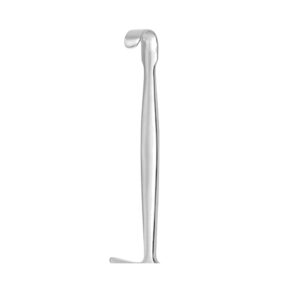
Before any of the above: fracture reduction. A reduction forceps with atraumatic serrations holds the segments; bone-holding forceps with a locking ratchet hold them while you drill. For intraoral approaches, a Langenbeck or channel retractor plus a Freer periosteal elevator opens the field. Obwegeser retractors are the standard for mandibular ramus exposure.
Arch bars, IMF screws, and wire twisters belong in the same tray if the unit does intermaxillary fixation, because establishing occlusion before plating is what determines whether the patient bites correctly afterwards. Plate the fracture first and check occlusion later, and you will be removing plates.
Instrument specifications
| Instrument | Typical size | Material | Application |
|---|---|---|---|
| Plate bending pliers | 140–160 mm | AISI 420 | 1.5 / 2.0 mm plate contouring |
| Three-point bending press | Bench or handheld | AISI 420 | Out-of-plane contour |
| Plate cutter, shearing | 150 mm | AISI 420 hardened | Trimming plate length |
| Calibrated drill with stop | 1.1 / 1.5 / 1.8 mm | AISI 420 hardened | Pilot holes, depth-limited |
| Depth gauge, short | 0–20 mm | AISI 304 / 420 | Screw length on facial bone |
| Self-retaining screwdriver | Cruciform / hex | AISI 420 + collet | Screw insertion |
| Freer periosteal elevator | 180 mm double-ended | AISI 420 | Subperiosteal exposure |
| Obwegeser retractor | Channel, 12–18 mm | AISI 410 | Ramus and angle exposure |
| Bone reduction forceps | 150–180 mm, ratcheted | AISI 420 | Segment holding |
| Wire twister | 160 mm | AISI 420 | Arch bar and IMF wiring |
Approach-specific tray variations
The instrument list shifts with the incision.
Intraoral (transoral) mandible. Angled screwdrivers and transbuccal trocars become necessary — the angle at the mandibular angle is simply unreachable in a straight line from inside the mouth. A transbuccal set with a trocar, cannula, and matching angled drill is a small addition that saves an external scar.
Coronal approach. Long-handled instruments, Raney clip appliers, and a dedicated periosteal elevator for the temporal fascia. The instrument shafts need an extra 40–60 mm of reach compared to an intraoral tray.
Transconjunctival or subciliary orbital. Fine 1.0–1.3 mm hardware, malleable retractors for globe protection, and delicate periosteal elevators. This is the sub-tray where instrument quality is most visible — a rough elevator edge on orbital periosteum causes bleeding that obscures the field for the rest of the dissection.
Reprocessing facial fixation trays
Two problems are specific to this instrument group.
Screwdriver collets. Blood and bone debris pack into the retention mechanism. Once the collet loses grip, screws drop. Disassemble modular drivers for every reprocessing cycle if the design permits it, and brush the collet under running water before enzymatic soak.
Bending instrument jaws. Repeated contouring of titanium plates transfers titanium onto steel jaws. That transferred metal becomes a galvanic corrosion site during autoclaving and shows as dark staining. Wipe the jaws down between cases and inspect them at reassembly.
Everything else follows the standard route: enzymatic soak, mechanical cleaning with attention to hinges and box joints, ultrasonic, thermal disinfection, dry, lubricate the ratchets, and inspect under magnification before wrapping. Our guides to ultrasonic cleaning of surgical instruments and instrument rust and staining cover the failure modes in more detail.
Sourcing considerations
Two specification points are worth insisting on when buying maxillofacial plating instruments.
First, hardness on the cutting and bending group. Plate cutters and bending pliers work against titanium; jaws that are too soft deform within a year and stop cutting cleanly. Working surfaces should be hardened to roughly 50–55 HRC.
Second, laser marking rather than acid etching for identification. Facial trays hold a lot of small, similar-looking pieces, and acid-etched marks fade over the reprocessing cycles until a 1.5 mm driver is indistinguishable from a 2.0 mm one. Laser marks survive.
Fizza Surgical manufactures facial fixation instrumentation in Sialkot under ISO 13485, forged from AISI 410 and 420 stainless per ISO 7153-1, passivated and CE marked under EU MDR. Related ranges sit under bone surgery instruments, and the general plating principles are covered in our bone plate and screw instruments guide.
Frequently Asked Questions
What is the difference between a miniplate and a reconstruction plate set?
Miniplate systems (1.5 and 2.0 mm) are load-sharing — the plate stabilises while the bone carries most of the functional load, so the plates are thin and the screws monocortical. Reconstruction systems (2.4 and 2.7 mm) are load-bearing, used where bone continuity is lost, and require bicortical screws, heavier bending instruments, and often a bending template.
Why does a maxillofacial set need a depth stop on the drill?
The inferior alveolar nerve runs through the mandibular canal directly beneath the fixation surface at the body and angle, and tooth roots extend further apically than most people estimate. A calibrated stop set to the intended monocortical depth removes the risk of plunging into either.
Can orthopaedic bending instruments be used on facial miniplates?
Not usefully. Orthopaedic benders are sized for 3.5 mm and larger plates; their jaw gap is too wide to grip a 0.6 mm miniplate accurately, and the leverage is high enough to crease rather than curve it. Profile-matched benders are needed.
How many instruments are in a complete maxillofacial plating set?
A single-profile module runs 20 to 30 pieces. A department covering the full facial trauma range — 1.5 and 2.0 modules, reconstruction plates, transbuccal set, IMF instruments, and approach-specific retractors — will hold 90 to 130 pieces across several trays.
Are titanium plates and steel instruments compatible in the same tray?
They can be stored together, but implants should be kept in a separate caddy from working instruments. Direct contact between titanium implants and steel instruments during autoclaving is a recognised source of surface contamination and discolouration on the implant.
Need precision surgical instruments?
Configure complete instrument sets with our team — ISO 13485 certified, CE marked, made in Sialkot since 1980.
Related Guides
View all articles →
Where We Serve
Fizza Surgical exports to 50+ countries. Browse our country-specific pages with local regulatory guidance and pricing: