Bonney and Waugh Dissecting Forceps Compared
Bonney forceps versus Waugh dissecting forceps: tooth size, needle platform, lengths and which tissue each pattern is actually built to hold.
Two dissecting forceps, both British patterns, both 1×2 toothed, both sitting on the same general set in most UK-influenced theatres. Yet swapping one for the other mid-case is immediately obvious to the surgeon holding them.
The difference is not subtle once you know what to look at: mass, tooth size, and whether there is a serrated platform behind the teeth built to take a needle. This guide covers both patterns in detail — construction, sizing, tissue selection, failure modes, and what to specify when ordering.
Where Each Pattern Came From
The Bonney name traces to Victor Bonney, the London gynaecological surgeon whose instrument designs entered general use through the 1920s and 1930s. Several instruments carry his name, including a distinct round ligament forceps that is a completely different tool — a ring-handled, ratcheted clamp — and is routinely confused with the dissecting pattern in online listings. If you order “Bonney forceps” without specifying dissecting, expect the wrong instrument to arrive at least some of the time.
Waugh’s dissecting forceps came out of the same British instrument tradition and settled into a different niche: a longer, narrower blade with finer teeth, favoured in ENT, plastic and colorectal work where the surgeon wants reach and precision rather than raw holding power.
Both are non-ratcheted thumb forceps, held like a pen or in a tripod grip, sprung open by the shanks.
Bonney Pattern: Built to Hold Fascia
The defining features of the Bonney dissecting forceps are its weight and its teeth.
Blades are broad and thick relative to most dissecting patterns. Teeth are proportionally large — 1×2 as standard, with 2×3 available in the heaviest builds — and they are cut deep enough to hold through several millimetres of dense fascia without the tissue riding up the blade face.
Behind the teeth sits a cross-serrated platform. On the better grades this platform is a tungsten carbide insert, brazed in and identifiable by gold-plated handles under the usual colour convention. That platform is the functional detail most buyers overlook: it lets the surgeon grip a suture needle mid-closure without reaching for a second instrument. During a mass closure of the linea alba, where the needle is repeatedly caught, repositioned and driven again, that saves genuine time.
Standard lengths run 13 cm, 15 cm and 18 cm, with 18 cm (7″) the workhorse. Weight at 18 cm is noticeably higher than a comparable Waugh — you can feel it before you use it.
Where it belongs: abdominal wall closure, rectus sheath, linea alba, tough scar tissue, orthopaedic soft-tissue work, and anywhere a needle is going to be handled by the same hand that is holding tissue.
Where it does not: anything you would be upset to see a tooth mark in. The teeth are large enough to leave visible defects in skin edges, and heavy enough to crush bowel serosa.
Waugh Pattern: Fine Teeth, Long Reach
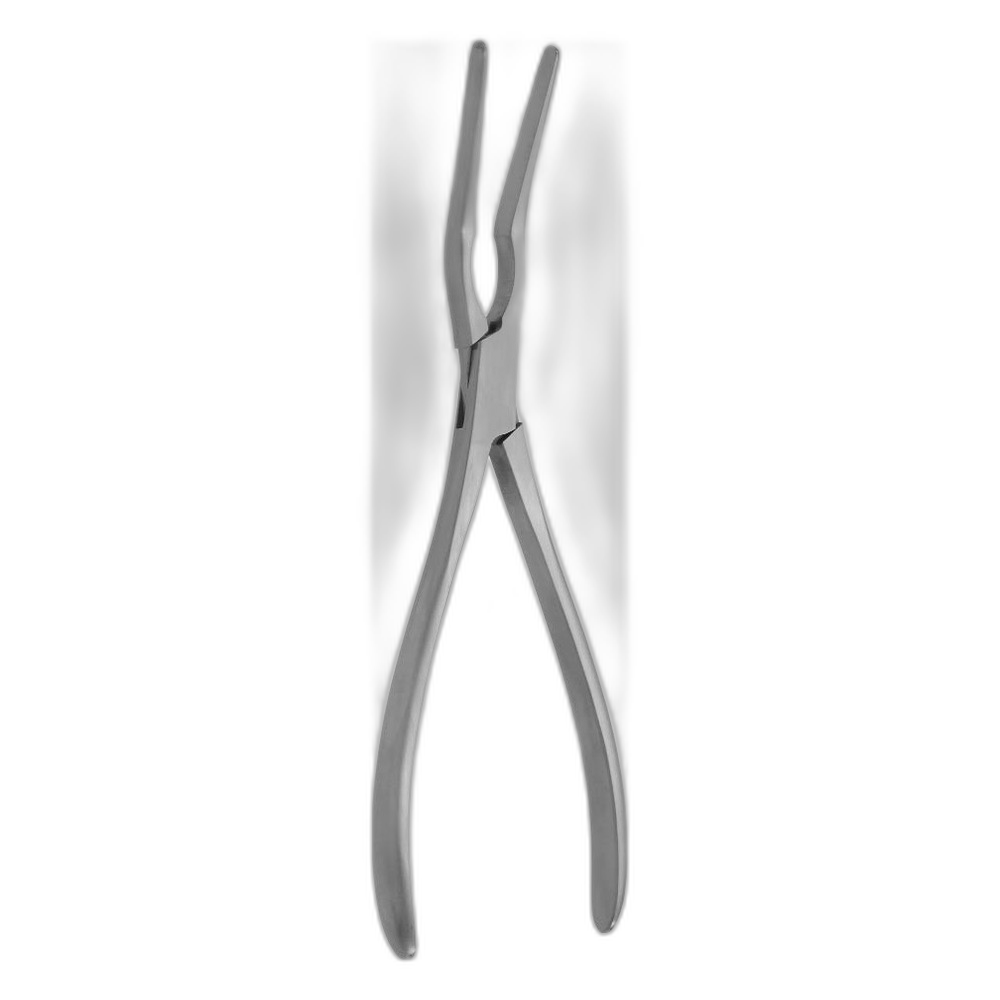
Waugh dissecting forceps are built around a narrow blade that tapers to fine 1×2 teeth over cross-serrated jaws. A non-toothed serrated variant is also produced and is common in ENT sets.
The blade is longer and thinner in section than the Bonney, which does two things. It reaches further into a narrow field without the surgeon’s hand obscuring the view. And it flexes slightly more, which gives better tactile feedback on delicate tissue — you can feel when you are gripping rather than judging it purely by hand pressure.
The trade-off is holding power. Fine teeth on a flexible blade will not hold oedematous rectus sheath under real traction. They will slip, and repeated regrips do more cumulative damage than one confident grab with a heavier instrument.
Lengths are unusually wide-ranging for a dissecting forceps: 15 cm, 18 cm, 20 cm, 23 cm, 25 cm and 28 cm are all standard catalogue items. The 20 cm is the common general-surgical size in UK practice; the longer patterns are ordered for deep pelvic and thoracic access.
Where it belongs: ENT and nasal work, plastic and reconstructive surgery, colorectal dissection, skin edge handling during fine closure, vascular exposure.
Where it does not: mass closure, fascia under tension, or as a needle-handling instrument.
Side by Side: Specification Comparison
| Feature | Bonney dissecting forceps | Waugh dissecting forceps |
|---|---|---|
| Blade profile | Broad, thick, short taper | Narrow, thin, long taper |
| Tooth configuration | 1×2 standard; 2×3 in heavy builds | 1×2 fine; serrated-only variant available |
| Tooth size | Large, deep-cut | Fine, shallow |
| Needle-grip platform | Yes — cross-serrated, TC insert on premium grades | Cross serrations only, not intended for needles |
| Common lengths | 13, 15, 18 cm | 15, 18, 20, 23, 25, 28 cm |
| Relative mass | Heavy | Light to medium |
| Blade flex | Stiff | Moderate — better tactile feedback |
| Primary tissue | Fascia, linea alba, scar, dense connective tissue | Skin edge, mucosa, fine fascia, vessel adventitia |
| Typical specialty | General, gynaecology, orthopaedics | ENT, plastics, colorectal, vascular |
Choosing by Tissue Rather Than by Habit
Most theatres pick between these two by convention — whatever was on the tray during training. A more useful rule is to choose by what the tissue will tolerate.
Ask two questions. First: will this tissue be visible in the final result? Skin edges, nasal mucosa, and anything cosmetic rules out large teeth immediately. Second: will I need to pull against resistance? Fascia under tension, a retracted sheath, thick scar — those rule out fine teeth, because the instrument that slips five times does more harm than the instrument that holds once.
The failure most often seen in practice is a fine pattern being used on heavy tissue. The surgeon compensates for slipping by squeezing harder, which crushes at the tooth tips while still not holding. The tissue ends up with both crush injury and multiple puncture sites.
The reverse error — heavy teeth on delicate tissue — is more obvious and therefore rarer, though it still shows up in skin closure when the correct fine forceps is not on the tray.
For the broader principle behind tooth selection, our comparison of toothed versus non-toothed tissue forceps sets out where each grip mechanism belongs. For the finer end of the range, the Adson forceps guide covers the patterns that sit below Waugh in weight.
A Worked Example: Midline Laparotomy
It is easier to see the division of labour in a single case than in a specification table.
Skin incision and subcutaneous dissection: a fine toothed forceps handles the skin edge. Neither pattern discussed here is ideal — Waugh is closer, but for cosmetic skin edges an Adson is better still.
Opening the linea alba: the assistant lifts the sheath while the surgeon divides it. Bonney pattern. The tissue is tough, the traction is real, and tooth marks in fascia are of no consequence.
Intra-abdominal work: neither. Bowel and vessels need an atraumatic pattern — DeBakey or equivalent. A toothed forceps on serosa is a defect waiting to be found.
Mass closure: Bonney again, and this is where the needle platform earns its keep. The sheath is held under tension with the same instrument that catches and repositions the needle between bites. Swapping to a fine pattern here means either the tissue slips or the second hand is occupied with a needle holder that could have stayed idle.
Skin closure: fine toothed pattern, not Bonney. The teeth that were an advantage forty seconds earlier will now leave visible marks.
Five stages, three different instruments. The point is that “which forceps is better” is not a well-formed question — each pattern is correct for roughly one stage of a single operation.
Regional Naming and Functional Equivalents
Both eponyms are strongest in UK, Commonwealth and South Asian practice. Theatres trained in US catalogues often do not stock either name, which causes confusion when standardising sets across regions or writing tender specifications.
The closest functional equivalent to a Bonney in US-pattern catalogues is a heavy toothed dissecting forceps of the Ferris Smith type — broad blade, prominent 1×2 teeth, serrated platform. It is not the same instrument, but a set built around one will behave like a set built around the other.
There is no clean single equivalent for Waugh. Depending on the specialty, the slot is filled by a long fine toothed dissecting forceps under various names, and the sensible approach for tender documents is to specify geometry rather than eponym: blade length, tooth configuration, tip width, and whether serrations are cross-cut.
This matters commercially. Tender specifications written around eponyms alone are routinely challenged, because the same eponym covers meaningfully different builds between manufacturers. Specifying dimensions and tooth configuration removes the argument.
Steel, Joints and Tungsten Carbide
Both patterns are made from martensitic stainless steel, typically AISI 410 or 420, hardened and tempered so the shanks return the blades reliably. The heat treatment matters more than the alloy designation on a spec sheet: an under-tempered forceps holds its tooth profile but the shanks eventually take a set and stop springing open; an over-tempered one springs correctly but the teeth round off within a couple of years of routine use.
The alloy choice is the same family used across most jointed instruments — the trade-offs are set out in our guide to surgical steel grades 410, 420 and 440.
On the Bonney pattern, the tungsten carbide question is worth resolving before ordering rather than after. A TC insert on the needle platform roughly doubles the useful life of the gripping surface in a unit that handles needles frequently, and the price premium is recovered if the instrument survives one replacement cycle. In a unit that never uses the platform for needles, plain steel is the correct purchase and the gold handles are decorative.
Neither pattern has a box joint or a screw joint — they are one-piece sprung forceps — so the failure modes discussed in our note on box joint versus screw joint construction do not apply here. What does apply is shank fatigue, which is the dominant end-of-life mechanism for thumb forceps.
Inspection and Care
Both instruments should be checked the same way, and it takes about fifteen seconds per pair.
- Tooth mesh. Close the jaws gently and hold them to a light. The single tooth must seat cleanly between the pair with no light visible at the base and no lateral offset. Misalignment here is the most common reason a forceps is returned as “slipping”.
- Tip contact. Behind the teeth, the serrated platforms should meet flat. A gap means the shanks have been sprung.
- Spring recovery. Compress fully and release. The blades should return to their rest position immediately. Sluggish or incomplete return means the shanks have taken a permanent set — the instrument is finished, and no amount of adjustment restores it.
- Tooth wear. Under magnification, the tooth tips should be defined, not domed. Domed teeth still look serviceable to the naked eye and will not hold.
- TC platform integrity. On carbide-inserted instruments, check the braze line for lifting or corrosion at the joint between insert and blade.
For cleaning, both patterns need the tooth interface brushed while held open. The gap between a seated tooth and its neighbours traps tissue and is not reliably cleared by an ultrasonic cycle alone. Store sprung open, not compressed, so the shanks are not held under load between cases.
Ordering Notes
Four specifications should appear on any purchase order for these patterns, because leaving them off is how the wrong instrument arrives:
- Pattern and instrument class. “Bonney dissecting forceps”, not “Bonney forceps” — the round ligament clamp shares the name.
- Length in centimetres. Do not rely on “standard”; the Waugh range spans 15–28 cm.
- Tooth configuration. 1×2 or 2×3 for Bonney; 1×2 toothed or serrated-only for Waugh.
- TC or plain. State it explicitly for Bonney, and confirm the gold handle convention with the supplier since it is a convention rather than a standard.
Fizza Surgical manufactures both patterns in Sialkot under ISO 13485 with CE marking, in the full length ranges described above and in both plain steel and tungsten carbide grades. The complete range sits in our surgical instruments catalogue, and certification details are on our certifications page.
Frequently Asked Questions
Are Bonney forceps and Bonney’s round ligament forceps the same instrument?
No. The dissecting pattern is a sprung thumb forceps with 1×2 teeth. Bonney’s round ligament forceps is a ring-handled, ratcheted clamp used in gynaecological surgery. They share only the surgeon’s name, and confusing them is a common ordering error.
Can Waugh forceps replace Bonney forceps for abdominal closure?
Not reliably. Waugh teeth are too fine to hold oedematous rectus sheath under traction, and the pattern has no needle-gripping platform. On a thin patient with good tissue it will work; on the cases where it matters, it slips.
What do the gold handles on some dissecting forceps mean?
Gold-plated handles conventionally indicate a tungsten carbide insert at the working surface. It is an industry convention rather than a regulated standard, so confirm the insert with the manufacturer rather than assuming from the colour alone.
Which lengths should a general set carry?
For most general theatres, 18 cm Bonney and 20 cm Waugh cover the majority of cases. Add a 25 cm Waugh where deep pelvic access is routine.
How long should a pair of thumb forceps last?
With correct cleaning, open storage and no use as a needle holder, both patterns commonly last several years of routine theatre use. The limiting factor is almost always shank fatigue from being stored compressed or over-flexed, not tooth wear.
Need precision surgical instruments?
Configure complete instrument sets with our team — ISO 13485 certified, CE marked, made in Sialkot since 1980.
Related Guides
View all articles →

Where We Serve
Fizza Surgical exports to 50+ countries. Browse our country-specific pages with local regulatory guidance and pricing: